
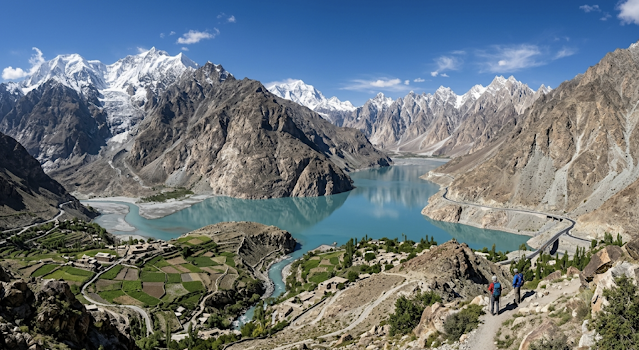
Glacial Lake in Pakistan's Gilgit-Baltistan Region - Source AIGEO360
Nepal Tragedy Raises Fears of Massive Glacier Melt in Pakistani Mountains
By Riaz Haq
CA

Northern Pakistan is home to over 13,000 glaciers which pose a risk of catastrophic flash floods similar to the recent flash floods in Nepal. Pakistani officials have warned that shifts in glacier behavior are increasing the risk of glacial lake outburst floods (GLOF), particularly in Gilgit-Baltistan and Khyber Pakhtunkhwa, where communities face growing exposure to sudden flooding and landslides.
Pakistan is actively monitoring its glaciers using real-time weather tracking and roughly 350 sensor devices installed by the National Disaster Management Authority (NDMA) and the Pakistan Meteorological Department (PMD) to mitigate glacial flash flood risks.
This year, the PMD reported record-breaking summer heat across northern valleys (such as Chilas reaching 48.5°C and Bunji hitting 46.1°C), accelerating ice melt in Gilgit-Baltistan region and Khyber Pakhtunkhwa province. The heat triggered two major GLOF events that were officially recorded during the 2026 monsoon season in Gilgit-Baltistan, causing localized road and infrastructure damage but no casualties due to early siren activation and community alerts.
Pakistani lawmakers and committees argue that the current count of 350 sensors remains critically low for tracking the vast Hindu Kush–Karakoram–Himalayan (HKH) glacier network. They are calling for expanded international support to significantly increase the number of sensors to enhance monitoring network.

Hasanabad Bridge collapse in Pakistan
Earlier in 2022, record-high temperatures in Pakistan's northern region caused Shisper glacier to melt rapidly, triggering the collapse of the Hassanabad Bridge along the Karakoram Highway.
Pakistan is in the midst of a major solar energy revolution led by consumers. Driven by soaring electricity costs, unreliable grid infrastructure, and cheap imported solar panels, millions of households and businesses have installed rooftop solar. This rapid transition to solar has transformed the country's energy landscape. According to the report, Pakistan’s total electricity demand increased by 33 terawatt-hours (TWh) between fiscal years 2023 and 2025. Distributed solar generation alone grew by 36 TWh during the same period, making it the primary driver of electricity demand growth and offsetting declines elsewhere in the power system.
Pakistan, which contributes less than 1% of global carbon emissions, is among the countries considered most vulnerable to climate change. About a third of the country was devastated by massive floods in 2022. The nation committed continued pursuit of nature-based solutions to the problem at COP26 in Glasgow in 2021. As part of this commitment, the country is planting one of the world's largest mangrove forests in the Indus River Delta, a key component of its Ten Billion Tree Tsunami campaign launched by former Prime Minister Imran Khan.
The United States, Europe, India, China and Japan, the world's biggest polluters, must accept responsibility for the catastrophic floods in Pakistan and climate disasters elsewhere. A direct link of the disaster in Pakistan to climate change has been confirmed by a team of 26 scientists affiliated with World Weather Attribution, a research initiative that specializes in rapid studies of extreme events, according to The New York Times .
(Riaz Haq is a Silicon Valley-based Pakistani American analyst and writer. He blogs at www.riazhaq.com)
