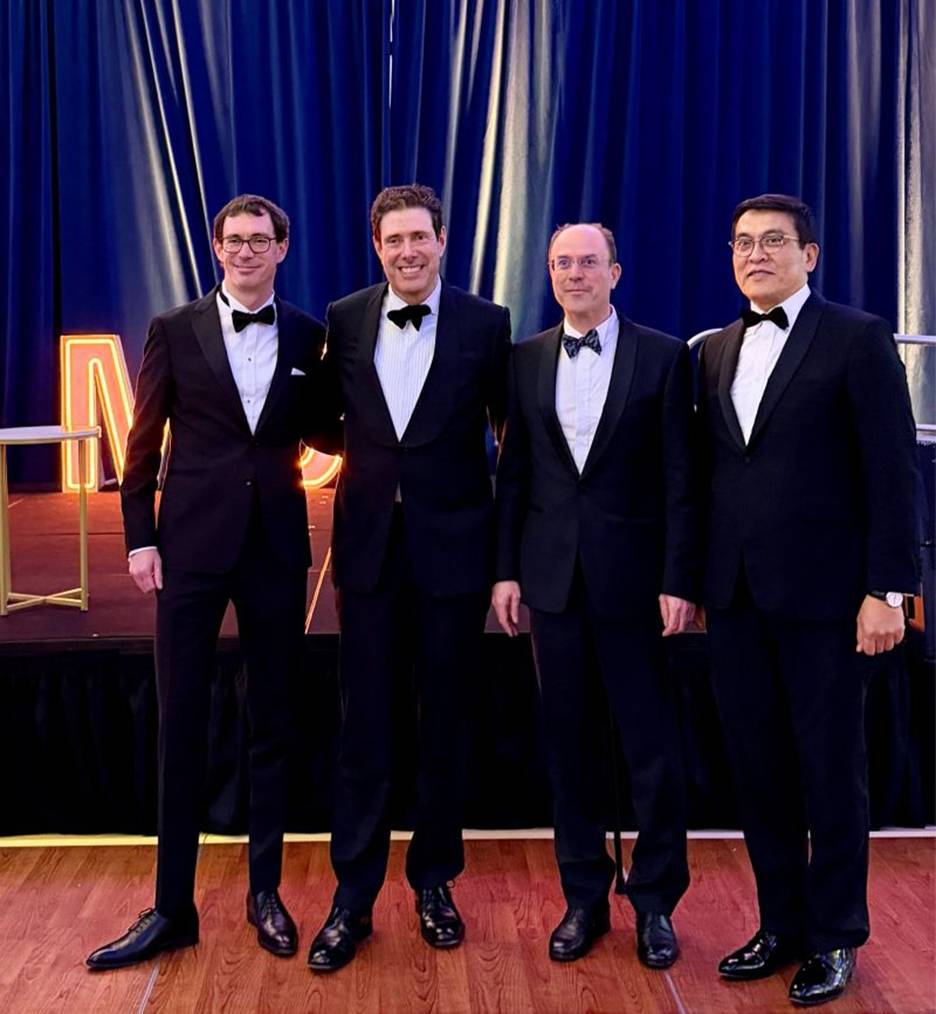
Left to right: Ambassador Georg Sparber of Liechtenstein, Dr Bruce Wollman, Ambassador Patrick Hemmer of Luxembourg, and Ambassador Edil Baisalov of Kyrgyzstan - Photo Tony Powell
A Tapestry of Hope: Confronting Multiple Sclerosis from Washington to Karachi
By C. Naseer Ahmad
Washington, DC
It is remarkable how closely we are tied together as human beings. We share the same biology, the same fragile bodies, and the same red blood flowing through our veins. Yet, throughout our lives, different illnesses strike different organs, testing our spirit, our resolve, and our resilience.
As a child growing up in Pakistan, I suffered terribly from asthma. An attack would strike without warning, leaving me gasping for air for days on end. In those days, modern inhalers and effective treatments simply were not available in my homeland. I still vividly recall the physical exhaustion of struggling for a single breath, and the helplessness reflected in my parents’ eyes as they sat beside my bed. That early experience taught me an indelible truth: physical vulnerability is a universal human trial, but having access to effective medical care and genuine human compassion changes everything.
Decades later and thousands of miles away, I met a wonderful friend and colleague, Dr Bruce Wollman. It was only recently that I learned he has been quietly confronting a debilitating illness of his own. What truly unites Dr Wollman and me, however, is not simply that we have experienced the trials of chronic illness. Rather, it is our shared conviction that human beings must look out for one another. It was my distinct honor when Dr Wollman succeeded me as Chair of the International Affairs Committee of an organization we both hold dear, carrying forward our shared commitment to bridge cultures, connect people, and champion the public good.
Through my friendship with Dr Wollman, I came to appreciate the profound, often hidden reality of Multiple Sclerosis (MS). Behind closed doors across the globe, millions of families face this unpredictable condition. A college student wakes up one morning unable to see clearly out of one eye. A mother feels a creeping numbness in her fingertips that steals her balance. A hardworking parent is overcome by an exhaustion so crushing that lifting a hand feels like bearing an impossible weight.
In Washington, where envoys gather to hammer out trade accords and security pacts, a gentler yet urgent diplomacy has taken root—one founded on human health and dignity.
On the evening of September 25, 2026, the ballroom of the Waldorf Astoria in downtown Washington, DC, was filled with an extraordinary convergence of purpose. Diplomats, physicians, community leaders, and advocates gathered not merely for a formal dinner, but to take a stand against this quiet, relentless adversary. The gala was an inspiring demonstration of what happens when compassionate medicine joins hands with international diplomacy. It proved that while chronic illness knows no national borders, neither does the human will to heal.
Multiple Sclerosis is a chronic disease of the central nervous system. In simple terms, the body’s own immune system gets confused. Instead of defending the body, it attacks myelin—the protective coating that wraps around nerve fibers, much like insulation around an electrical wire. When that insulation is damaged, messages between the brain and the body slow down, scramble, or stop altogether. The results can be devastating: blurred vision, loss of balance, chronic pain, and sometimes paralysis. Because MS strikes most often in the prime of life—between the ages of twenty and forty—it upends careers, strains marriages, and tests the resilience of families.
Yet, where there was once only resignation, there is now genuine hope. Over the last two decades, modern science has transformed our understanding of the brain. Today, innovative disease-modifying therapies, physical rehabilitation, and early diagnosis allow thousands of patients to live vibrant, productive lives. We are closer than ever to halting this disease in its tracks, but crossing the final threshold requires sustained financial commitment and collective willpower.
At the heart of the Washington gathering stood Dr Bruce Wollman. A distinguished, board-certified radiologist with decades of clinical and executive leadership in the Mid-Atlantic region, Dr Wollman has spent his professional life peering inside the human body to uncover the earliest signs of disease. Through his work with high-resolution magnetic resonance imaging (MRI), he knows firsthand that an early, accurate picture of the brain can save a patient from years of silent nerve damage. Driven by that clinical insight and his personal journey, Dr Wollman has devoted himself to philanthropic advocacy, mobilizing resources and rallying civic leaders so that medical researchers can find permanent cures.
The fight against MS gained profound strength that evening from the diplomatic corps, whose presence demonstrated how global cooperation can lift the burden of chronic disease.
Among the honored guests was Ambassador Georg Sparber of Liechtenstein. A seasoned diplomat who has represented his country at the United Nations and across international capitals, Ambassador Sparber has long advocated for human dignity, international law, and multilateral cooperation. In Central Europe, the Alpine region has historically faced high rates of MS, a pattern long observed in northern latitudes. Liechtenstein’s close healthcare integration with Switzerland provides world-class care and specialized therapies, demonstrating how a small nation can protect its citizens’ well-being through visionary regional partnerships.
The cause was further elevated by Ambassador Patrick Hemmer of Luxembourg. Having served as his nation’s ambassador to major world capitals, including Prague, Moscow, and Bangkok, Ambassador Hemmer brings a deep understanding of international collaboration. In Western Europe, Luxembourg faces significant MS rates. Yet it has met the challenge with forward-looking ambition: Luxembourg has invested heavily in biomedical innovation, turning institutions like the Luxembourg Center for Systems Biomedicine into world-renowned hubs that study neurodegenerative diseases through cutting-edge technology. His presence underscored that public health and scientific discovery belong at the center of statecraft.
Representing Central Asia, Ambassador Edil Baisalov brought an essential developing-world perspective to the room. As a renowned reformer, human rights advocate, and senior statesman who has served as Deputy Prime Minister of the Kyrgyz Republic overseeing healthcare and social welfare, Baisalov has dedicated his life to expanding social safety nets. In Kyrgyzstan and neighboring countries, MS remains a steep challenge due to under-diagnosis, limited access to high-end MRI scanners, and the heavy cost of imported therapies. His participation delivered a vital message: breakthroughs achieved in Western laboratories must never remain the privilege of wealthy societies alone. They must reach every family in need.
This principle brings our gaze directly home to Pakistan. For decades, it was assumed that Multiple Sclerosis was rare in South Asia. But now, according to Afroz Syed, President Society for Multiple Sclerosis Patients in Pakistan (SMSPP.org.pk) MS or Multiple Sclerosis is not uncommon in Pakistan. SMSPP is aimed at educating MS patients in Pakistan and their family and friends about the disease and helping them to cope with it better. Today, Pakistani neurologists recognize that this supposed rarity was merely a reflection of under-reporting and misdiagnosis. As medical awareness expands and diagnostic imaging becomes more accessible, clinics across Pakistan are seeing a growing number of young people confronting progressive neurological decline. For most Pakistani families, the cost of long-term care and specialized drugs is staggering.
Rising to meet this challenge is the Aga Khan University (AKU) in Karachi. Through its Department of Medicine and Section of Neurology, AKU has become Pakistan’s premier institution in confronting neurodegenerative disease. AKU’s clinical researchers have conducted vital studies on demyelinating disorders, distinguishing classical MS from conditions like Neuromyelitis Optica, which frequently occur in South Asian populations. Through its Patient Welfare Program, AKU ensures that families facing financial hardship receive world-class diagnostic care, subsidized therapies, and compassionate rehabilitation. AKU proves that world-class science and social conscience can thrive together when guided by vision.
To the readers of Pakistan Link, the lesson of that evening at the Waldorf Astoria is both clear and deeply personal. In every community, we know what it means when chronic illness strikes a family member—a mother, a brother, a child, or a lifelong friend. We see the quiet courage of caregivers who carry the emotional and financial weight day after day.
No medical breakthrough happens by chance. It happens when compassionate people decide to adopt a cause, pool their resources, and stand shoulder to shoulder with clinicians and researchers. When American physicians, European diplomats, Central Asian leaders, and Pakistani researchers unite for a single purpose, despair gives way to momentum. Let us look across our own communities, identify the challenges that demand our strength, and give generously of our time and wealth. In lifting the burden of one afflicted family, we fulfill our highest human calling—and help build a world where no disease is left without a cure.