
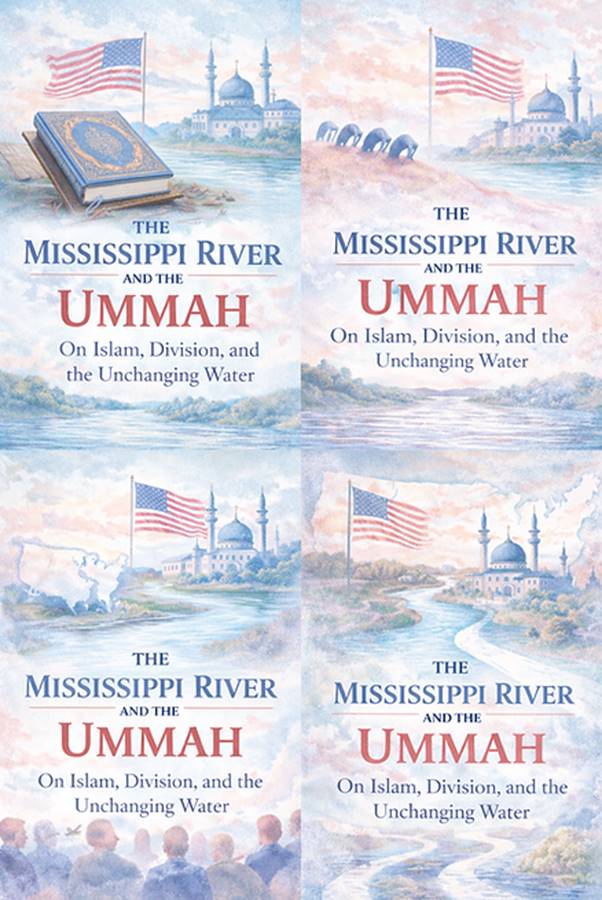
The Mississippi River and the Ummah: On Islam, Division, and the Unchanging Water
By Dr Aslam Abdullah
CA

The Mississippi River originates at Lake Itasca. Lake Itasca is located in northern Minnesota, inside Itasca State Park. From this modest lake — small, quiet, almost humble — the river begins its long journey southward. Its total length from Lake Itasca to the Gulf is approximately 2,340 miles (3,770 km).
From north to south, the river flows through or forms borders of the following states: Minnesota, Wisconsin Iowa, Illinois, Missouri, Kentucky, Tennessee, Arkansas, Mississippi, and Louisiana. It finally empties into the Gulf of Mexico.
The main channel is called the Mississippi River from Lake Itasca all the way to the Gulf. However, its headwaters are sometimes referred to as the “Upper Mississippi.” After joining the Missouri River near St Louis, its volume increases dramatically. After joining the Ohio River at Cairo, Illinois, it becomes much wider and more powerful. But the name remains “Mississippi River” throughout. The word Chemically Water remains H₂O. Its molecular structure does not change. Two hydrogen atoms, one oxygen atom — the chemistry remains the same.
Physically yes, significantly.
As the river flows it gathers sediments (mud, sand, minerals). It absorbs nutrients. It receives runoff from farms and cities. It changes temperature. It changes speed and depth. At its source in Minnesota, it is clearer, colder, narrow. By the time it reaches Louisiana, it is brown with sediment. Warm, and Vast and slow-moving
Ecologically the ecosystems differ in Northern forests and freshwater fish, in Midwestern agricultural regions, in Southern wetlands and delta marshes. By the time the river reaches the delta in Louisiana, it carries millions of tons of sediment annually, mgricultural nutrients (including nitrogen runoff), and industrial and urban pollutants The river begins as a quiet trickle in Minnesota. It becomes a continental artery. Yet its chemical identity remains constant. Its form, force, color, and social meaning transform — but its essence remains water. One might say the river changes in expression, not in essence. Its character deepens. Its burdens increase. Its influence expands. But H₂O remains H₂O.
At the northern edge of a continent, in the quiet stillness of Lake Itasca, a thin ribbon of water begins its journey. It is hardly majestic. It does not thunder. One could step across it without difficulty. No delta announces it. No empire depends upon it. It is only a beginning. Yet this modest current will become the Mississippi. It will gather tributaries. It will carve valleys. It will absorb mud, memory, and commerce. It will darken, widen, deepen. It will carry cities and civilizations upon its banks. By the time it reaches the Gulf of Mexico, it will no longer resemble its narrow northern self. And yet — chemically, essentially — it remains water. So too with Islam.
The beginning of Islam is as clear as northern water. Revelation descends in a cave outside Mecca. A single Prophet. A single recitation. A single community bound not by tribe but by faith. The Qur’an flows pure, unadorned. The early believers are few. There is no sect, no school, no theological debate — only tawḥīd, prayer, fasting, struggle, mercy. Like Lake Itasca, the source is modest yet decisive. The river at its origin is not yet burdened with silt. The community at its origin is not yet burdened with faction.
Every river gathers tributaries. Every community gathers history. After the Prophet’s death, the community meets its first great convergence: the question of leadership. Who guides the flow? Who holds authority? What is succession? From this confluence emerge Sunni and Shīʿī currents — not as separate rivers, but as powerful streams interpreting the same source differently. The water does not change its molecular structure. But the river’s path begins to branch. Political contest becomes a theological reflection. Loyalty becomes doctrine. Memory becomes identity. Sediment enters the current. The water is still H₂O. The Qur’an is still the Qur’an. The shahāda remains unchanged. But the river is no longer alone in its channel.
As the Mississippi flows southward, it gathers the Missouri, the Ohio, and countless smaller tributaries. Each adds volume, color, and force. So too Islam gathers jurisprudential schools — Ḥanafī, Mālikī, Shāfiʿī, Ḥanbalī. It gathers Ashʿarī and Māturīdī theology. It gathers Sufi mysticism and philosophical kalām. It gathers local customs, languages, and empires. The current grows wider. One may look at the water in Minnesota and compare it to the muddy breadth in Louisiana and wonder: Is this the same river? The answer is yes — and no. Yes, in essence. No, in appearance. The river now carries sediment from farms, minerals from mountains, and debris from cities. It reflects the skies of ten states. It bends to the terrain. It adapts to obstacles. It deepens where pressure demands.
Islam too carries civilizations — Persian poetry, Andalusian philosophy, Ottoman law, Indian spirituality, African resilience. The Qur’an remains. The prayer remains. The fasting month remains. But expression diversifies. Some currents emphasize law. Some emphasize love. Some emphasize rationality. Some emphasize literal fidelity. The water remains water. The river becomes civilization.
No river escapes contamination. Industrial runoff darkens the Mississippi near cities. Agricultural nutrients flow into it. Sediment thickens its color. Yet even as it carries impurities, the molecular identity of water remains H₂O. Islam’s history, too, contains conflict — civil wars, sectarian polemics, political exploitation, and colonial disruption. The names of sects multiply. Accusations harden. Identity becomes defensive. At times, observers look upon the surface — turbulent, brown, divided — and declare that the river itself has changed. But the essential recitation remains unchanged in its Arabic cadence. The daily prayers continue to align foreheads to earth. The call to prayer still echoes across continents. The divisions are banks, not essence. The disputes are sediment, not substance.
At its southern end, the Mississippi disperses into a delta, with many channels spreading into the Gulf. From above, it appears fragmented, fractured into fingers of water and marsh. Yet these distributaries are not separate rivers. They are extensions of one flow, shaped by geography and gravity. In the modern world, Islam appears similarly dispersed — Sunni, Shīʿī, Ibāḍī; reformist, traditionalist, modernist; juridical, mystical, philosophical. Movements rise and fall. Nations claim guardianship. Scholars debate authenticity. From above, it looks like fragmentation. From within, the shahāda remains singular. The Qur’an recited in Jakarta is the same as that recited in Cairo. The water drawn from Lake Itasca is chemically indistinguishable from that poured into the Gulf. The river has widened. It has carried burdens. It has absorbed history. It has bent around rocks of power and empire. But its molecular identity has not altered.
There is a temptation — especially among critics — to judge a river by its sediment. To declare that because the water appears brown, its nature has changed. But sediment does not alter the chemical structure of water. It alters clarity, not Essence. Similarly, sectarian division alters political expression, not theological foundation.
Islam’s core remains Tawḥīd — the unity of God. Prophethood — the finality of Muhammad. Revelation — the Qur’an preserved. Worship — the five pillars. The Day of Judgement. What changes is interpretation, emphasis, governance, culture — the banks along which the water flows. The river deepens with tributaries. The Ummah deepens with history.
The Mississippi does not deny its tributaries. It does not reject the Missouri for being muddy or the Ohio for altering its volume. It absorbs them and continues. Islam’s vitality has often rested in similar absorption — accommodating diversity while guarding core creed. Division becomes dangerous only when tributaries forget the source. When the sect becomes greater than scripture.When identity becomes louder than revelation. When sediment claims to be water. Yet the remedy is not to drain the river. It is to remember its origin.
Stand at Lake Itasca. Cup your hands in its clarity. Stand at the delta in Louisiana. Watch the immense, brown expanse enter the sea. Though unrecognizable in form, it is the same water.
Islam began in the desert with a single recitation. It now flows across continents, languages, and centuries. It carries jurisprudence, philosophy, mysticism, empire, reform, protest, and renewal. It has known conflict and convergence. But the Qur’an remains recited in the same consonants. The prayer still turns toward the same qiblah. The call “Allāhu akbar” still proclaims the same transcendence. The river changes in expression. The water remains water. And so too, beneath sect and school, beneath polemic and power, beneath history’s sediment, the essential current remains — tawḥīd flowing, uninterrupted, from source to sea.
(Dr Aslam Abdullah is the resident scholar at Islamicity.org, the largest internet portal on Islam. He has served as Director of the Islamic Society of Nevada and Masjid Ibrahim, Las Vegas. Dr Abdullah has also been the Editor-in-Chief of the Minaret Magazine since 1989. He was an associate editor of The Arabia in the 1980s. He also served as vice chairman of the Muslim Public Affairs Council. Not only that, but he is involved in interfaith dialogue and has represented Muslims in several interfaith conferences. He has published several books and more than 1,000 articles and papers in magazines worldwide. Originally from India, he is based in Southern California and has appeared on several TV and Radio shows.)
