
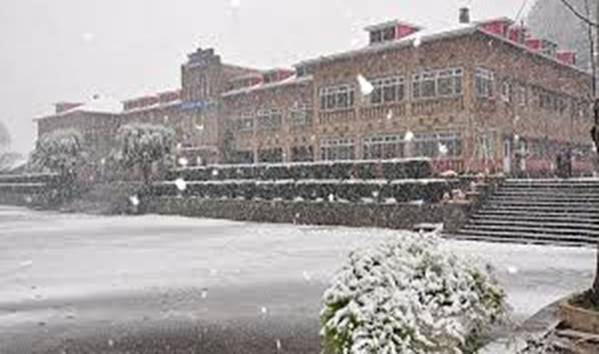
Our teachers just wanted us to play by the rules. Later in life, several senior Burn Hall boys who had joined the Civil Service of Pakistan would joke privately that the priests had “ruined our careers” because we were so much out of step with those around us. We played by the rules, while others ignored them
Crusades and Colonization on the Courts
By Dr Akbar Ahmed
American University
Washington, DC

“Look what you black bastards are doing to us.”
Father Terpstra, the tall Dutch priest, shattered the quiet of the study hour as he barged into our classroom. He stood quivering with anger. He looked threatening, as if he was about to commit violence. He carried a tennis racket which he swung ominously. The students looked puzzled and mystified by his racial slur. Those with a sense of irony looked around to note the boys with blue eyes and blond hair as they came from the northern areas of Pakistan.
“You beasts raped our women,” he murmured venomously. He wheeled about abruptly and walked out of the class.
Terpi, as we called him, was a large man with short-cropped hair, bad teeth and a perpetual scowl on his face. He usually wore a black leather jacket when he was not in the black robes of a Catholic priest and owned a noisy and battered motor bicycle. His appearance and demeanor gave him the menacing air of a derelict member of the Hell’s Angels bike gang. We often speculated that his perennial bad temper came from his belief that the Crusades were still being conducted. Some brave lad had to inform him that they were officially over. He appeared to loathe us, a feeling which was, I regret to say, enthusiastically reciprocated by some of the students.
It was the late 1950s, and we were in Abbottabad, the beautiful Pakistani Himalayan hill station that would gain international attention in 2011 because Osama bin Laden was discovered hiding there just a stone’s throw from our school. We were at Burn Hall, a boarding school run by Catholic priests. I was in the Senior Cambridge secondary school certificate examination program, and we were teenagers bursting with energy, ready to face a challenge. But even at that young age we understood that there was more to Father Terpstra than the bad temper of a priest. There appeared to be centuries of a complex relationship between Europe, the continent where Father Terpstra came from, and Asia where we lived. It was this confrontation which we played out on the tennis courts.
As I was in the tennis team, Terpi often asked me or another member of the team for a round of singles. We saw this as a chance to fight back and establish our dignity and honor. We knew we were on a level playing field on the tennis court. There was no master nor student, no white man nor black man on the court. We also knew this was a straight-forward clash between two different cultures and continents.
I loved the game and after a good hard-fought match I always felt a happy glow. Terpi played not only to win but to crush his opponents while using his full height and weight. He may well have imagined that he was a crusader magically resurrected to battle Muslims and vanquish them. I too responded in kind, though I regretted the transformation of my normally affable nature into a Mr Hyde when playing Father Terpstra. I would lob the ball gently just across the net to force him to run up and then see him smash into it or with the sun behind me to
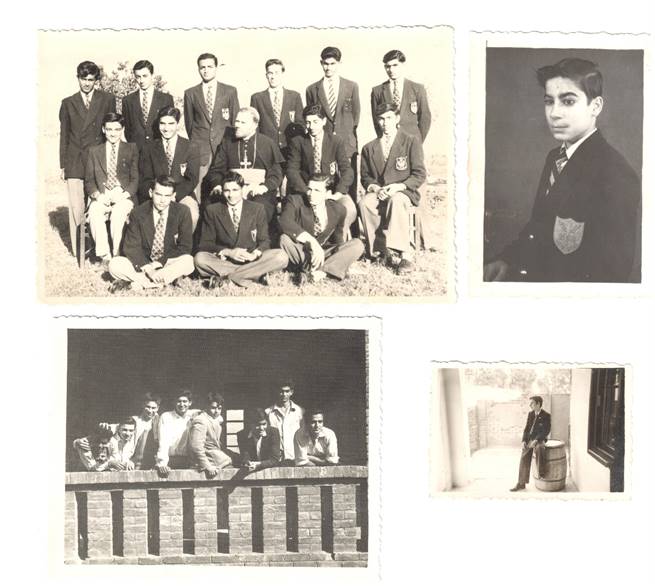
Group picture on left top: Hasan Akhtar (second from left), Akbar Ahmed (fourth from left) and Ahmed Shah (front row on right) -- with Bishop Hetinga
Group picture below: Class relaxing in dorms--from left Ahmed Shah, Akbar Ahmed and fifth from left Wasim Sajjad
Two pictures on right are of Akbar Ahmed
hit the ball high in the sky so that he would be blinded for a few seconds and miss the ball. Not good tennis nor sportsmanlike behavior, but just to hear him bellow with anger as he swore and hit his tennis racket on the ground in fury was worth it. He would often yell a Dutch phrase with the word which sounded very much like “damn” in it, and which we knew priests were not supposed to use. On the court, in the heat of the battle when the blood was up, I too felt like a Muslim warrior facing the Crusaders, a feeling heightened by the fact that my middle name was Salahuddin. Defeating Terpi thus assumed an almost atavistic significance. The noble game of tennis had somehow been compromised for me.
Hasan Akhtar, my class fellow, was also on the tennis team and when we recently discussed our tennis encounters from almost 70 years ago, he recalled he would see the game with Terpi as a clash between two cultures. Hasan, who like me was a devoted P. G. Wodehouse fan and had settled in England, said, “We came from a political family and the idea that years after independence we were still being bullied by the white man from Europe infuriated me. We had to fight back.”
Others in school saw it in the same fashion and invariably students would start gathering around these matches, first a dozen or so and some three to four dozen by the end of the game. Perhaps we were reading too much into these games. Perhaps Terpi simply enjoyed playing tennis. Perhaps his antics on court were more to do with his difficulty to control his anger than any hatred of Asians. But the encounters, even when I won, brought me little joy. I also felt a twinge of guilt looking back on those days as I began to realize that Terpi was obviously fighting some inner demons. Our behavior may have led him to believe we were the personification of those demons. Can we ever understand the inner struggles of any human?
In case people get the wrong impression based on the behavior of one man, I hasten to add that I always found the other Dutch priests, like Father Klaver and Father Eindhoven, the models of dedicated, moral and compassionate teachers, true father figures. And though the boys complained incessantly about the food and conditions, Burn Hall was not quite out of a Charles Dickens novel. It had been described as one of the top public schools of Pakistan, even the Eton of Asia. The President of Pakistan, the ambassadors, the senior bureaucrats and the feudal lords sent their children to school here. The Christian school was a product of the European colonial era which now existed in an independent Muslim nation.
We were cut off from the rest of the world when I was at school. Television had not come to Pakistan and newspapers were rare. Later someone read a Time magazine article about Catholic nuns being raped in central Africa. We understood then that the priest had equated us with the perpetrators of that disgraceful and shameful deed. We were, on one continent, conflated with people on another in a deed which we would have strongly condemned had we even known of it. Clearly, Terpi’s outburst was an expression of some deep-rooted prejudice and ignorance.
Father Terpstra had evidently created a binary set of categories in his mind: there was his own identity based primarily in race and also religion and against that a category into which he placed all others, such as Africans and Asians. While the former implied “civilization,” the latter meant “barbarism” with its attendant violence. It was the crudest form of “us” versus “them,” the sort of deep-rooted prejudice that had colored the encounter between Europe and Africa and Asia for centuries. It is well to keep in mind that my early encounters with Europe were being conducted before writers like Edward Said would provide us a frame within which to understand them. But Said’s seminal book Orientalism (1978) would be written two decades after I left Burn Hall.
Later in life, I often thought of how Father Terpstra saw the different peoples of Africa and Asia with their varied racial, ethnic and historical backgrounds, and was able to lump them together in one simple category. The Africans with their sophisticated pyramids, cities, empires and trading cultures that spanned the continent and we, the descendants of the creators of the Taj Mahal and poets like Ghalib and Iqbal and leaders like Sir Sayed and M. A. Jinnah, were reduced to “black bastards.”
Burn Hall also taught me about the attitudes of the European races towards each other. The English thought little of the Dutch and even less of the Irish. When Father Terpstra was transferred to Borneo, Father Johnson, who was English and famous for his sense of humor, solemnly praised the wisdom of Rome in sending Terpi to the “land of the head-hunters” because, he said, with a twinkle in his eye and a puff on his pipe, “they would make short work of him.”
The high moral caliber of the priests is illustrated in the following story. When the first martial law was declared in Pakistan in 1958, there were rumors circulating about plans to shut down Christian schools and ask the priests to leave the county. Not long after, one of the top generals turned up in Abbottabad and rang Father Scanlon, the principal, to demand that his son be allowed to spend the weekend with him. Scanlon, popularly referred to as Scally when he was not around, refused as it was against school policy. The general threatened to shut down the school. Dark hints about Muslim boys being converted to Christianity were made. Scanlon stood firm, saying he just required 24 hours after which the priests would be packed and ready to leave the country. This is where the matter was left. But as the general, no doubt, received the information that the school was particularly close to the heart of President Ayub Khan—considering several members of his family including his sons attended it—he decided it was best to beat a retreat. Scanlon received another phone call from the general humbly requesting a meeting and adding for the record how grateful he was to the priests for the education they were providing to the future leaders of Pakistan.
The tennis court where we faced priests like Terpi was noteworthy because it was outside the confines of the school buildings—hence it was a zone in which we were able to push the boundaries and test the patience of authority. The fathers were quick to impose order in school, but it was difficult to do so on the sports field. In matters of religion and breaking rules of course there was swift and harsh action.
One day the stern and unsmiling Father Scanlon called me into his office and warned me: Leave the worship of boys alone. He had found out that with my other class fellow Ahmed Shah we had started a prayer gathering specially during the month of fasting. It was 1957 and we were preparing for the final Senior Cambridge exam. We were supposed to be studying, but instead we challenged authority—recklessly in this case I might add.
A corridor ran through the building and our classrooms were on either side of it. To supervise the students and ensure there was no rowdiness or talking during study a senior priest walked slowly up and down the corridor reading the Bible. The scenario, we often joked, was redolent of the POW German camps supervised by the Gestapo in countless American movies. Our plan was simple. Every time the priest passed our class, and he was visible through the window, one of the boys would slip out of class and shoot across the corridor onto the stairs upstairs and disappear. Upstairs in the dormitory we prayed on sheets we had spread on the floor, and then returned with a glow of pride and satisfaction. Our return would be timed so that the priest had just walked by along the corridor. There was a major flaw in the plan, however, we were not in a Second World War POW movie. But enthusiasm of those determined to say prayers overcame cold logic. It appeared as much the thrill of challenging authority as the desire to prostrate before the Almighty. As a result, along with a small group of friends, I was asked by Father Scanlon to leave school during the summer break rather than remain as I had planned. The other students were as baffled as we were as nothing in writing was ever given to us and speculation and conspiracy theories were rife. But after summer break was over, we were allowed to come back and proceed as normal. It later emerged that other priests had opposed Father Scanlon’s decision on the case, where I imagine he thought he was enforcing the rules, and he carried on completely as usual when we returned. In any case, the prayer scheme collapsed not long after we started it as someone had leaked the information to the authorities.
While challenging the priests in such a manner was perhaps foolhardy, there is a background from whence our action originated, once again having to do with the interactions of the different religions and cultures in the school. Our curriculum was entirely European and Western in origin and content. We were not taught the subject of Islamic history, literature, religion, or culture. We were also actively discouraged from speaking Urdu, the national language—at one stage, so that we would have a better grasp of English, a fine was imposed if we were caught speaking Urdu. There was no time allotted for Muslim prayers, and while many students kept the fast during the month of fasting, there were no special arrangements by the kitchen. Our act of praying during study hour was therefore a double act of defiance. We had to find ways to assert our identity which expressed itself in different ways—from the tennis courts, to jokes about being in a POW camp, to actions such as the prayers.
The turmoil over the prayer episode did not prevent me from obtaining a first division in the exam—one of two in our entire class, the other being Wasim Sajjad who would go on to become President of Pakistan. The next year I was cast in the big annual play in the role of Mortimer Brewster in Arsenic and Old Lace, a role immortalized by Cary Grant in the movie. In Arsenic and Old Lace Ahmed Shah was playing the role of Teddy Brewster, the brother of Mortimer, who believed he was Teddy Roosevelt, and had to deal with the Panama Canal—hence he was constantly blowing a bugle, brandishing a sword and yelling “charge!”
During our rehearsals for the play, which was directed by Father Johnson, another episode occurred which captures the sense of constant rebellion among the boys. While as students we were given very basic, rudimentary food without much flavor or substance and thus felt constantly underfed, the priests, we were aware, would gather separately and eat much better food such as lamb and duck. The pattern was that after dinner at midnight the fathers would have their food put away in a special hot cupboard and lock it with a padlock. So, one night I decided along with Ahmed Shah and other boys to launch a midnight raid to obtain the hidden delights of the fathers’ meals by breaking the padlock. We sneaked down, and as we began to pry open the lock, Father Johnson stepped out of the shadows and said, “got you
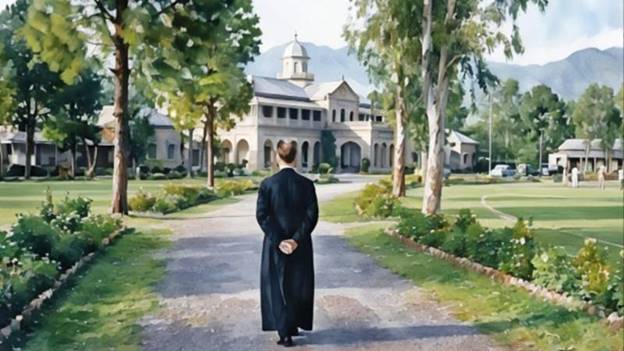
As students we learned several lessons from the priests—of always taking a moral position, a commitment to do the right thing, to, as the priest put it, play the referee, the capacity to sacrifice for others and to always show compassion. As for exerting pressure to convert to Christianity, never in my entire long stay in school was there ever any such pressure put on me. Our teachers just wanted us to play by the rules – Image The Friday Times
all!” We had been betrayed. It was a shock, especially to see Johnson there, up in arms furious at this breach. All of you report to Father Scanlon’s office first thing in the morning, he told us dramatically, for your inevitable expulsion—but then he noticed Ahmed Shah and I, two of his key actors in the play, and added, “except you two.” In an instant, he changed his attitude. Realizing that the play must go on Johnson had made the decision to exempt us, showing his practicality, and ordered us to go back to our rooms. In the end, the show did go on, successfully, and the other boys got off with a warning from Scanlon.
It was the same Scanlon who later went out of his way to honor me. When I got married and brought my wife along with my mother to meet him, my mother, with great pride, said look what a beautiful princess we have got. Scanlon replied yes but look what we gave them, our best boy. Of course, there were far better boys than me, but it was heartwarming to hear old Scally say something so nice in front of the two most important women in my life. When Scanlon died, I was serving in Peshawar with the Civil Service of Pakistan. As fate would have it, I was asked to write the obituary for him which was read out as a sermon at his memorial. I was deeply honored that I had been asked to commemorate and pay tribute to Scanlon in this manner.
As students we learned several lessons from the priests—of always taking a moral position, a commitment to do the right thing, to, as the priest put it, play the referee, the capacity to sacrifice for others and to always show compassion. As for exerting pressure to convert to Christianity, never in my entire long stay in school was there ever any such pressure put on me. Our teachers just wanted us to play by the rules. Later in life, several senior Burn Hall boys who had joined the Civil Service of Pakistan would joke privately that the priests had “ruined our careers” because we were so much out of step with those around us. We played by the rules, while others ignored them.
It was easy to spot Father Terpstra’s simplistic world view long after I left school. When I arrived at Cambridge University as the Iqbal Chair in the late 1980s, I often appeared in the media and I would receive mail at the porter’s lodge of my college. Most of it was positive and encouraging, but there would be the invariable anonymous, badly written note saying, “go home you black bastard.” Today, we see the examples of Africans in Europe, even in high places such as government ministers being called “monkeys.” The Dallas radio host Chris Krok called the Muslims of the US and Europe “cockroaches” on his show. After seeing the immensely popular film American Sniper people tweeted openly murderous Islamophobic sentiments (“American sniper: anti-Muslim threats skyrocket in wake of film’s release” in The Guardian by Nicky Woolf, 24 Jan 2015) “American sniper makes me wanna go shoot some fuckin Arabs,” said one. “Great fucking movie and now I really want to kill some fucking ragheads,” said another. Muslims were being freely called “vermin.”
Europe then has formed an important part of my identity from my very birth. I was born a subject of the King of England in what was then British India; I spoke and wrote in English, a European language; played tennis and cricket, European games; loved European literature and was educated at schools and universities run by Europeans. I also benefited from another aspect of European culture, when our teachers introduced us to the great European writers and especially poets like Keats, Coleridge and Tennyson and playwrights like Shakespeare, Wilde and Shaw. I fell in love with these poets and playwrights. Over the decades they became my friends, especially in difficult times in various postings in lonely stations in Baluchistan and the Tribal Areas of Pakistan. In addition, I learned a great deal about the tribes and their history and culture from the British officers who wrote about their charge with affectionate diligence.
The cartoons of Charlie Hebdo routinely depicted Arabs as penurious, comical beggars with bulbous noses and wearing a rough long shirt and open slippers. And after the tragic deaths in Paris in January 2015, President Hollande and former President Sarkozy publicly rallied their allies in what they declared was a war against “civilization” (that is, “us”) launched by “barbarians” (that is, “them”). The criminal acts of individuals would again be equated to entire civilizations. President Bush after 9/11 had already propagated this global worldview with his motto: “You are with us or against us.”
Europe and Asia, Christianity and Islam, the past and the present, were meeting in unexpected ways in unexpected places for me. Clearly, issues of race, immigration,
empire and religion were directly linked to those of my identity. In Europe, for some like those who thought anyone who was not white was therefore black, and because they did not admire foreigners, a barbarian, or in the words of Father Terpstra, a bastard, dealing with the
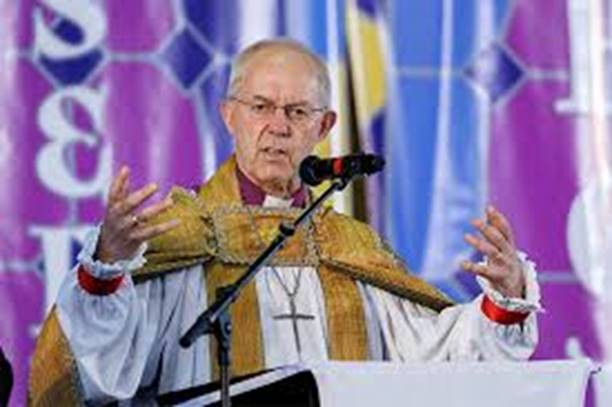
In his first public message to the Muslim community on the occasion of the end of Ramadan in 2013, Justin Welby, the new Archbishop of Canterbury, talked of the “joyful” work of building Christian-Muslim relations. “There is much in our world and in our history,” said the Archbishop, “that tries to divide us. Negative events, prejudices and fears build walls that are hard to break down. But God is greater!” Similarly, Pope Francis sent a letter to the Muslim community during the same month, emphasizing what was common between them and pointing to the need for “Mutual Respect through Education.”
other was a problem. I saw the attitude of some of the priests that they must never compromise on their European rules and customs lest they be challenged by non-Christians reflected in some anxious Europeans.
On the other hand, there have been extraordinary leaders promoting goodwill and understanding between the faiths. In his first public message to the Muslim community on the occasion of the end of Ramadan in 2013, Justin Welby, the new Archbishop of Canterbury, talked of the “joyful” work of building Christian-Muslim relations. “There is much in our world and in our history,” said the Archbishop, “that tries to divide us. Negative events, prejudices and fears build walls that are hard to break down. But God is greater!” Similarly, Pope Francis sent a letter to the Muslim community during the same month, emphasizing what was common between them and pointing to the need for “Mutual Respect through Education.” Lord Jonathan Sacks, the Chief Rabbi of the UK, had already published The Dignity of Difference: How to Avoid the Clash of Civilizations (2002), probably one of the finest works pointing to the common spiritual sources of the Abrahamic faiths, and the need for respect between them. Prince Hassan of Jordan by then was also active in building bridges, and President Khatami of Iran had raised the idea of a “Dialogue of Civilizations” in opposition to that of the “Clash of Civilizations” at the United Nations. King Charles who has always shown a compassionate empathy with those of other faiths hosted an iftar dinner for members of the Muslim community in Windsor Castle in the month of Ramadan.
In the meantime, the Pakistan of my youth had changed beyond recognition. The unimaginable was happening: Burn Hall could no longer attract European priests and, depleted of teachers, it was handed over to the army; a Bishop committed suicide in the 1990s to protest at what was happening to his community; Churches and Christian groups were frequently and openly attacked; about 200 worshippers on a Sunday morning were killed and wounded in the main church in Peshawar and a Christian and his pregnant wife were burnt alive in a kiln by a Muslim mob. The Christian community once seen as teachers and benefactors were now being cast as suspicious aliens. The perpetrators were violating not only the vision of the founding father of Pakistan, Mr Jinnah, but the very spirit of compassion in Islam itself.
But the killers believed in equal opportunity crime. They slaughtered Muslim women, children and men wherever they could with impunity. In December 2014 they attacked the main Army Public school in Peshawar, not far from the church which had been attacked the year prior, and killed some 150 students and teachers and wounded many more. No one was safe from the insane violence. A solution had to be found, and it was not located in simplistic binary equations.
We are, in the Muslim world, the West, and the world in general, desperately in need of knowledge about our own traditions, those of others, and fostering connections between us as human beings who are part of a single human race. Looking back at my time at Burn Hall, it was precisely this gap in my education that spurred me to acquire information on Muslim history and culture. In the end, this passion to learn drove me to become a scholar of the subject and I understood the importance of building bridges between different cultures and religions. I would meet later in life some of the most inspiring Christian spiritual figures like Dr Rowan Williams, Dr George Carey—both former Archbishops of Canterbury—and Bishop John Chane, Episcopal Bishop of Washington DC. I understood them because of the great lesson that the priests had taught me. They were there in their devotion to their religion and I learned of their grand efforts to find faith through piety, sometimes struggling like Fathers Terpstra, Scanlon and Johnson, but in the process, they were spreading education to students like me. It was that early exposure that fired my passion for understanding other faiths. There was something that I understood years later—the great Muslim spiritual masters like Hazrat Ali, Maulana Rumi and Sheikh Ibn Arabi in my tradition had opened a path whereby I could see those of other faiths in their own quest to find the mercy of the Almighty.
(Akbar Ahmed is Distinguished Professor and the Ibn Khaldun Chair of Islamic Studies, School of International Service, American University, and former Wilson Center Global Fellow, Washington DC. He was the former Pakistan High Commissioner to the UK and Ireland.)
