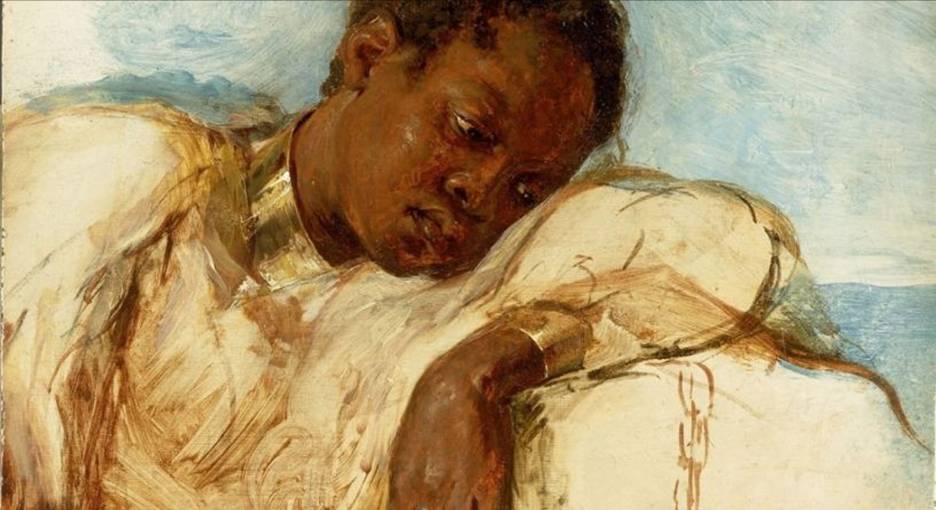
As America celebrated ‘Juneteenth’ last month, followed by the Fourth of July and the 250th anniversary of the nation’s independence, a poet and writer based in Hull, birthplace of the British abolitionist William Wilberforce, recalls a universally beloved hymn-like anthem. Image: An unidentified British artist’s oil painting of a young African, in a brass neck collar with shackled wrists – Photo via the National Maritime Museum, Greenwich, UK
Amazing Grace: The Story behind a Universally Relevant Redemption Song
By Aamir Butt
Hull, UK

Amazing grace! How sweet the sound
That saved a wretch like me!
I once was lost, but now am found;
Was blind, but now I see.
’Twas grace that taught my heart to fear,
And grace my fears relieved
Over the past nearly three decades that I’ve lived in England, I have attended half a dozen or so Christian funerals. Something common among them – besides the bereavement, of course – is that they always play the popular hymn ‘Amazing Grace’, leaving not a dry eye in the house.
This is such a powerful song that once when it played on the public address system of an HMV record store I was in, everyone stopped what they were doing and stood silent listening. When the song ended, they just resumed their activities.
On the surface, it is a Christian religious song that praises God. Some mistake it as a song from the Bible. In fact, it has nothing to do with the Bible at all. It has long been popular in Black American churches for its theme of redemption but is also often sung at civil rights gatherings.
The lyrics are by John Newton (no relation to Issac Newton), an Englishman born in 1725. He led quite an eventful life, having been forced to work in the Royal Navy as a sailor. When he tried to escape, he was brutally flogged and humiliated. He worked on many ships and eventually ended up on the Ivory Coast. There, working for a white slave trader. Newton was kept in bondage for two years, starved and mistreated. His biographer Dr Michael H. Yeager refers to this period of his life as being the ‘slave of slaves!’ (John Newton: Grace That Saved a Wretch Like Me: The Astonishing Journey of the Man Who Wrote Amazing Grace, Independently published, 2006).
Eventually a British ship rescued him. As they sailed back to England, there was a severe storm. The sailors were convinced the ship would sink. Newton, who had not been religious, prayed to God to save him. As if by a miracle, the storm receded.
This was the start of Newton’s spiritual awakening. He renounced drinking and gambling and became a practicing Christian. However, he remained entangled in the highly profitable slave trade, making three voyages as a captain of slave ships between Africa and Americas. The difference was that he made sure the slaves he was transporting on his ships were treated well.
He stopped working in the slave trade in 1754, and a few years later joined the clergy. By this time, he was a vocal supporter of abolition and repented his own participation in the slave trade.
By 1754, he repented his own participation in the slave trade and renounced it, becoming a vocal supporter of abolition. A few years later, he joined the clergy.
It was as a clergyman that Newton first met William Wilberforce. Following the death of his father, Wilberforce at the age of 11 or 12-years old was sent to live with family near Milton Keynes, and attended the church pastored by Newton. Wilberforce admired Newton, prompting his mother to bring him back to Hull for fear he might become a clergyman.
Years later, during a spiritual crisis, Wilberforce sought Newton’s counsel. When they met in December 1785, Wilberforce had already served five years in Parliament but was considering leaving politics for the ministry.
Newton agreed to mentor him and urged him to remain in public life, encouraging him to see political service as a Christian calling. Many historians believe this advice helped direct Wilberforce toward the campaign to abolish the slave trade, giving his parliamentary career a renewed sense of purpose.
Born in 1759, Wilberforce was a native of Hull, where I have lived for over 26 years.
In September 1780, at the age of 21, while still a student, Wilberforce was elected Member of Parliament for Kingston-upon-Hull.
Wilberforce passionately and untiringly worked towards the abolition of slavery within the British Empire. For the next 20 years he lobbied extensively and introduced bill after bill in the parliament aimed to abolish slavery. He was defeated each time, but he refused to give up.
In February 1807 Wilberforce witnessed the British Parliament pass the Slave Trade Act of 1807 by a vote of 283 to 16, tears streaming down his eyes. Newton died in December that year.
The British Royal Navy, which then controlled the world’s seas, established the West Africa Squadron in 1808 to patrol the coast. Between 1808 and 1860 they seized approximately 1,600 slave ships and freed 150,000 Africans who were being taken to the New World for slave labor.
The Act was a major breakthrough as it abolished the inhuman trade in slaves throughout the British Empire. However, it did not abolish slavery.
Wilberforce and his allies continued to work towards that goal. Along the way in 1824, Wilberforce also became a founding member of the Society for Prevention of Cruelty to Animals.
On 26 July 1833 the House of Commons passed the Slavery Abolition Act 1833 freeing all slaves in the British empire. As if his mission in life was now complete, Wilberforce died three days later, on 29 July, at age 74.
In the US, 19 June is commemorated as ‘Juneteenth,’ marking the day in 1865 when American slaves in Texas were finally told of their freedom – three years after then President Abraham Linclon signed the Emancipation Proclamation on 1 January 1863. Slavery officially ended across the US with the passage of the 13th amendment on 6 December 1865. On 4 July 2026, the US marked the 250th anniversary of the signing of the Declaration of Independence.
In 2006 when a group of American and British filmmakers collaborated to make a movie on the life of William Wilberforce, they appropriately named it Amazing Grace . And for the soundtrack of the movie lines were added to the song including “My chains are gone, I’ve been set free.”
(Aamir Butt, a retired consultant and medical academic from Pakistan, is the author of two books, Lahore: Places, People, Stories (2024) and Evolution of Progressive Urdu Poetry in Lahore (2025), both published by Aks, Lahore.
https://www.sapannews.com .)

