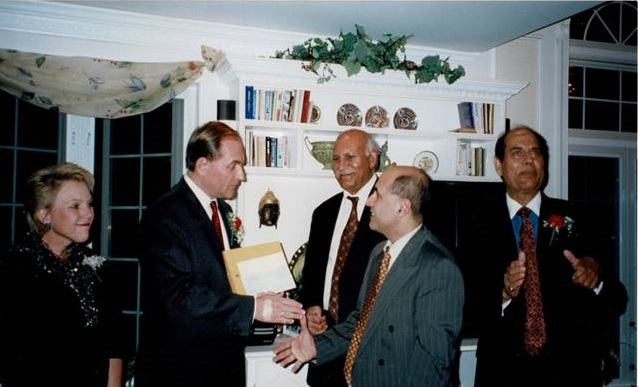
Author and Chaudhry Allah Bakhsh with Governor Jim Gilmore of Virginia in 2002
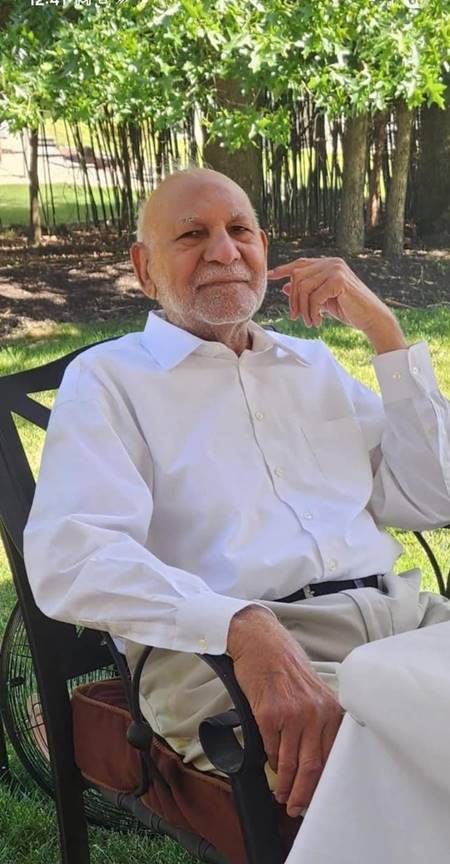
Among the quiet, steadfast individuals who held up that early community, Chaudhry Allah Bakhsh stood in the front rank. A man of quiet dignity, genuine warmth, and constant good humor, his life offers a telling window into the immigrant journey of an entire generation
Pillars in the Shadows: Remembering Chaudhry Allah Bakhsh and the Early Pakistani Diaspora in Washington
By C. Naseer Ahmad
Oakton, Virginia
Every enduring structure relies on pillars that bear weight quietly, seeking neither spotlight nor acclaim. In the same way, the deep roots and sturdy trunks of mature trees anchor them against fierce winds, providing shade long after storms pass. The Pakistani diaspora in the Greater Washington area during the 1970s and 1980s was very much like a young sapling. Over the past half-century, that community grew and branched across Northern Virginia and Maryland. Among the quiet, steadfast individuals who held up that early community, Chaudhry Allah Bakhsh stood in the front rank. A man of quiet dignity, genuine warmth, and constant good humor, his life offers a telling window into the immigrant journey of an entire generation.
I arrived in Washington, DC, in 1972, and Chaudhry Sahib moved to the area a few years later. Our formal acquaintance began in 1981, when my late father, Lt Colonel Aziz Ahmad, visited from Pakistan. During Friday prayers at the local mosque, my father and Chaudhry Sahib met, and an immediate connection emerged. They shared mutual lifelong friends in Pakistan: Dr Ameer Muhammad, the renowned former Vice-Chancellor of the Agricultural University in Faisalabad, and Dr Muhammad Rashid, the founder of Fountain House in Lahore. Chaudhry Sahib had worked closely with Dr Ameer Muhammad during his years in Faisalabad with the Family Planning Department, and he shared family ties with Dr Rashid. Both families belonged to the Gujjar community with deep roots in District Gujrat.
Shortly after that initial meeting, Chaudhry Sahib invited my parents, my late sister Shahida Aziz, and my young family to his home for dinner. What began as a hospitable evening turned into hours of engaging conversation spanning memories of Punjab, mutual acquaintances, and shared cultural heritage.
My children were very young then, resting peacefully in their mother’s lap, while Chaudhry Sahib’s four young daughters were equally well-mannered and attentive. That single evening laid the foundation for a close family bond and an enduring friendship that spanned four decades until his passing. Despite being roughly twenty years my senior, Chaudhry Sahib never let the age difference stand in the way of mutual respect and camaraderie.
In the late 1970s, I worked at the World Bank in the Economics Research and Mining Divisions, where senior Pakistani statesman M. M. Ahmad held a prominent executive position while I was early in my career. Chaudhry Sahib had also worked briefly at the World Bank during his early days in the United States. Through common circles—including Air Marshal Rahim Khan, former World Bank Executive Vice President Moeen Qureshi, and noted cardiologist Dr Riaz Haider—our paths crossed regularly.
Later, my career took me to Florida as a software engineer for NASA’s Space Shuttle program at the Kennedy Space Center. When the Space Shuttle Challenger disaster occurred in January 1986, the project was put on hold. My visiting parents and sister needed to return to Washington by air while my wife, children, and I drove up with our belongings a few days later. Knowing my parents would be arriving alone, I wrote to Chaudhry Sahib. True to his generous nature, he received them warmly at the airport, handled their logistics, and looked after them until we arrived.
When my family settled in the Franklin Farm development in Fairfax County, Virginia, in 1984, very few Pakistani families lived in the area. Over the subsequent years, Chaudhry Sahib moved to a neighboring community, and other Pakistani professionals—including former auditor Abdul Khaliq, late Sahibzada Tahir Latif (who worked for a long time at US Department of Treasury before moving to DHS), Syed Abdul Majid Shah, Malik Khalil-ur-Rehman, and Ijaz Ghumman—settled nearby. Together, this small circle formed a close-knit support network. We gathered regularly at each other's homes, prayed together, shared meals, and helped new immigrants find their footing.
Chaudhry Sahib’s professional background reflected the adaptability of his generation. In Pakistan, he had held senior, influential government posts in public administration. Yet upon immigrating to the United States, he showed zero hesitation or false pride in rebuilding his career from the ground up, eventually serving for many years with the District of Columbia local government. His office in downtown Washington was only a short walk across the street from mine, allowing us to meet frequently for coffee and consultation.
Whenever new immigrants arrived facing administrative, economic, or legal hurdles, Chaudhry Sahib quietly stepped forward. He assisted hundreds of families with paperwork, settlement, and practical guidance without expecting anything in return.
His civic engagement extended to broader community outreach. Through longstanding connections with political figures such as longtime Virginia Congressman Frank Wolf and his Capitol Hill staff, Chaudhry Sahib helped coordinate high-level receptions and community briefings. Following the tragic events of September 11, 2001, when a hijacked aircraft struck the Pentagon in Arlington, Virginia, our local network coordinated relief efforts. Alongside our mutual friend Hanif Akhtar of Vienna, Virginia—a well-connected Pakistani-American community figure from Kasur—we arranged for a charitable contribution of $10,000 to be formally presented to Virginia Governor Jim Gilmore at a dinner reception to assist the families of the victims.
Reflecting on those early years, the faces of men like Chaudhry Allah Bakhsh stand out not for grand speeches, but for everyday decency, practical wisdom, and selfless public service. They built the cultural and social bridges that later generations of Pakistani-Americans walk upon today. His life remains an enduring testament to what immigrant communities can achieve through quiet perseverance, genuine humility, and boundless goodwill.

