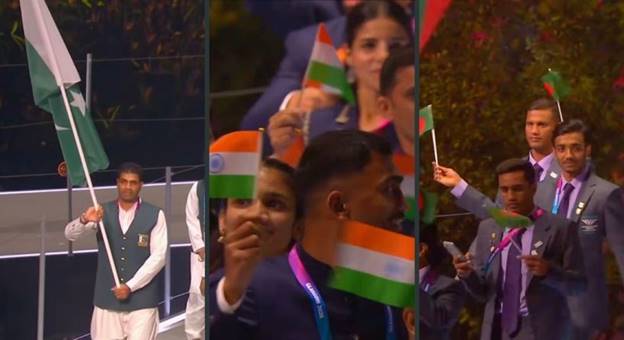
 Athletes from Pakistan, India, and Bangladesh participate in the opening ceremonies of the Glasgow 2026 Commonwealth Games. For decades the Commonwealth Games have brought nations together through sport. But beneath the celebration is a painful colonial history prompting a growing question: Should the Games continue? Photos via Commonwealth Games YouTube
Screen over an Ugly Past
By Kamila Hyat
Lahore, Pakistan

The Commonwealth Games, are one of the events which most avidly display the Commonwealth of Nations set up by the British as the empire they ruled over came to an end with one nation after the other gaining independence.
This year the games were held in Glasgow, 23 July to 2 August, and it was noted by many commentators that the veneer of gold which once hung over them seemed significantly subdued. In the first place, only ten sports were included in the 2026 events and six para-games for athletes who were not fully physically abled. This compared to 19 sports in 2022, the last time the games occurred in Birmingham with eight para-events. It is also a fact that initially Australia was the host of the 2026 games but backed out at some stage, either due to a lack of interest or a lack of sufficient resources. The question to ask then is if the Commonwealth is beginning to wane and gradually disappear.
It is also notable that the countries which occupied the top slots on the medal table were those which belonged to the developed world and are a part of the ‘soft power’ displayed by the structure of this peculiar organisation. Australia took first place, followed by the UK and then Canada. India did come in fourth but this is not a good showing for a country with the world’s largest population, most of it young. Pakistan with one bronze medal to its name, with the female boxer winning a bronze medal, put off its worst performance in 36 years and finished in 36th place along with at least 10 other countries. It was joined in that place by countries like Rwanda, Tonga, Malta and several others, including Bermuda. There were countries lower down the order, including Bangladesh, Seychelles, and of course a marked number of others.
In other words, these countries have not developed their infrastructures very far, at least in sports. Even a basic look at the United Nations Development Plan’s Human Development Index , which is a measure of the average achievement in key dimensions of human development: a long and healthy life, being knowledgeable and having a decent standard of living would suggest this is also true for other areas such as education, health and social welfare. Of course, Pakistan falls towards the bottom of this list in both spheres.
The issue over the Commonwealth of Nations, as it is now called, is why it continues to exist and to what extent it is at all relevant. Historians argue that it is a soft cover for the real issues of the damage caused by colonial rule and the extraction of wealth from the nations which were ruled over by the British Empire. India, Pakistan and Bangladesh are of course examples of this theft of resources which were never returned. The scholarships and cultural programs offered by the Commonwealth, as well as events such as the Commonwealth Games , cannot make up for the wealth and resources that were taken away and used to build Britain, with cotton being an example from the Indian subcontinent along with a great many other items.
There is also the issue of reparations for this loss of resources and British actions in the colonies, including a lack of respect for the people who live there. The argument goes that the Commonwealth places a shield over this issue which has begun to come up more and more often, notably when countries quit the Commonwealth as Barbados did in 2021. Only a few countries, out of the 56, which make up the Commonwealth and were once under British rule decided not to join the organization, including Myanmar which gained independence in 1948 and Sudan which gained independence in 1956. Others have been in and out over various periods including Pakistan .
The Commonwealth ostensibly punishes nations for a lack of democracy and the abuse of human rights. But again the criticisms suggest that it does not do so often enough and does not show any real degree of even-handedness in choosing these options.
The issue of the Commonwealth will then continue to be debated. There is really little to say in favour of its continuing to exist. It is true that we have all benefited from the proficiency in the English language that British rule has granted a few individuals in the Indian subcontinent and in other nations. But far too many are left out of this small segment of society.
There then needs to be far more thought about whether events such as the Commonwealth Games are in any way beneficial to the nations which take part or whether they should be abandoned as part of a broader effort to give nations which once fell under British colonial power their dignity and rights. As nations which in fact deserve to be offered an apology for the atrocities committed in most of them by the British. This of course has not happened so far.
In Britain the debate is raging. It is also raging in other countries including the eleven realms which still recognise the British sovereign as their own sovereign. These realms of course include Australia and Canada as well as a host of other countries. But why the Commonwealth exists and what its purpose is needs to be considered given that events such as the Commonwealth Games really give a soft cover to the events which should really be taken up by history.
Most important amongst this past is the damage colonial rule has inflicted on developing nations across the world. It is this shared past that needs to be highlighted. Events such as the Commonwealth Games simply act to cover history up.
(Kamila Hyat is a freelance columnist and former newspaper editor, based in Lahore.
This is a Global South Asia, formerly Sapan News. sapannews.com.)

