|
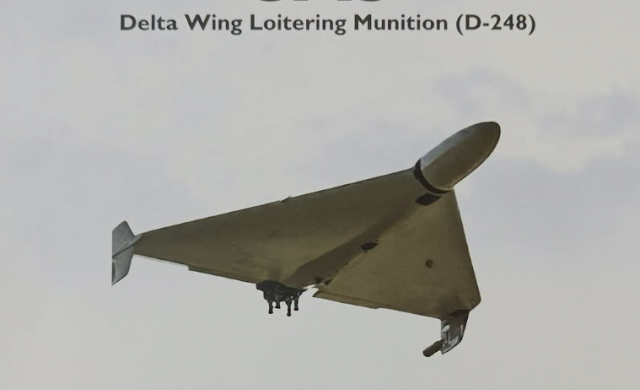
Pakistan's Long Range Drone D-248 |
Is the Pakistani Military Ready for Modern Drone Warfare?
By Riaz Haq
CA

The Russia-Ukraine war and the US-Israel-Iran war have recently demonstrated the effectiveness of drone warfare. Is the Pakistani military learning lessons from them to prepare for future conflicts? Let's examine an answer to this question based on recent announcements.
Pakistan revealed a 3,000-kilometer range one-way drone in July this year. The state-owned Heavy Industries Taxila (HIT) displayed two new long-range loitering munitions – the D-248 and the S-369 – at the 2026 Indus Robotics and Autonomous Systems (RAS) Expo on July 22–23, 2026 in Islamabad.
The D-248 drone uses a tailless delta configuration – similar to Iran ’s Shahed-136 – and carries a maximum take-off weight (MTOW) of 240 kg, a wingspan of 3.3 m, a payload of 30-50 kg, a maximum speed of 225 kph, a cruise speed of 185 kph, an endurance of 12-14 hours, and a flight ceiling of up to 4,500 m. Iran's Shahed drones have been used in both the Ukraine-Russia war and the US-Iran conflict. Shahed-136 is relatively inexpensive. It
has a swarm capability, and a precision-strike capability at extended ranges.
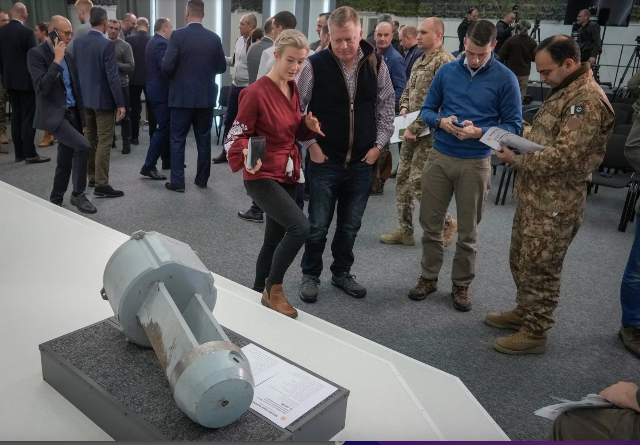
A Pakistani Military official in Ukraine - Source New York Times |
Pakistan is also in talks with Ukraine's Fire Point whose long-range drones have launched spectacular strikes deep inside Russia in recent weeks. Fire Point is promoting its FP-1 Deep Strike, a loitering munition with a range of 2,600 km, as well as FP-2 Front Strike, a loitering munition with a range of up to 200 km.
During a recent exercise, called Combined Resolve, Ukrainian drone units easily spotted and defeated US troops and armored vehicles on rotation from Fort Hood in Texas, according to people familiar with the events, reports the Wall Street Journal . It's not just the Americans who fared badly against Ukrainian drones; the British and the Swedes have also witnessed easy Ukrainian triumphs in military exercises. The US has also struggled to defend against Iran’s long-range Shahed drones, which have killed and injured many American soldiers and destroyed aircraft.
The exercising troops from the United States sent heavy armored vehicles into battle that threw up dust and were easy for Ukrainian reconnaissance drones to spot, according to a participant. Those drones were followed by drones dropping explosives and first-person-view drones, which smash into targets in combat, this person said.
Drones are becoming an important part of modern warfare, as demonstrated by ongoing conflicts in Europe and the Middle East. Gaining military advantage in future conflicts will increasingly depend on how well states conduct technology-driven multi-domain operations by integrating aircraft, drones, electronic warfare, cyber operations, intelligence, and AI-assisted analysis.
(Riaz Haq is a Silicon Valley-based Pakistani American analyst and writer. He blogs at www.riazhaq.com)

