Pakistan Embassy Hosts Policy Dialogue on Indus Waters Treaty, South Asian Security
By Elaine Pasquini
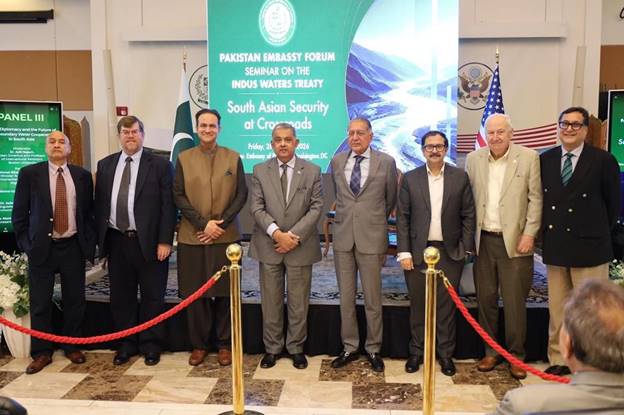
Washington, DC: The Embassy of Pakistan hosted a program on August 28, 2026, titled “The Indus Waters Treaty: South Asian Security at Crossroads,” bringing together US policy experts, leading think tank scholars, academics, representatives of international organizations, water and legal experts, along with members of the diplomatic community, to examine emerging challenges to the Indus Waters Treaty, regional water security and the future of hydro-diplomacy in South Asia.
Welcoming the participants and formally opening the dialogue, Rizwan Saeed Sheikh, Ambassador of Pakistan to the United States, underscored the importance of the Pakistan Embassy Forum Series as a platform for informed and constructive discussion on issues of regional and global significance.
Highlighting the strategic importance and enduring resilience of the Indus Waters Treaty, the ambassador noted that the agreement had survived wars, crises and periods of heightened political tension between Pakistan and India.
Addressing the seminar virtually, Deputy Prime Minister and Foreign Minister Senator Mohammad Ishaq Dar emphasized the legal sanctity of the Treaty, warning against unilateral attempts to undermine an international agreement governing a vital shared resource. “The Indus Waters Treaty is not merely an agreement about water,” he said. “It is a legal framework governing a vital shared resource, an instrument of regional stability and, today, an important test of the sanctity of international agreements.”
Rejecting India’s unilateral decision of April 2025 to place the Treaty “in abeyance,” Dar stressed that such an action had no basis in the document. “Any attempt to deprive Pakistan of the waters rightfully allocated to it under the Indus Waters Treaty would have profound consequences for regional peace and security,” he cautioned.
Outlining Pakistan’s guiding principles for the future of the Treaty, the deputy prime minister called for the restoration and strengthening of technical engagement, transparency and data-sharing between Pakistan and India in accordance with the agreement’s provisions.
The program comprised three substantive sessions examining the Treaty’s legal foundations and dispute resolution mechanisms, emerging challenges posed by climate change and water stress, and the broader role of hydro-diplomacy in maintaining regional peace and security.
The three sessions were moderated respectively by Michael Kugelman, Director of the South Asia Program at the Atlantic Council; Jon F. Danilowicz, Senior Fellow on South Asia at the Atlantic Council; and Adil Najam, Dean Emeritus and Professor of International Relations at Boston University.
Panelists highlighted the historical role of the Treaty as an important conflict-management mechanism that has insulated water cooperation from wider political tensions. They expressed concern that unilateral disruptions could transform a shared resource into an instrument of bilateral competition and place additional strain on regional stability.
Legal experts underscored the importance of adherence to international law and established dispute resolution mechanisms. Participants emphasized that sustainable regional security depended on respect for treaty obligations, institutional processes and peaceful resolution of differences rather than unilateral political action.
In concluding remarks, Ambassador Sheikh reaffirmed Pakistan’s longstanding preference for dialogue and diplomacy and extended an invitation to India to engage constructively and peacefully towards dispute resolution.
The ambassador highlighted Pakistan’s peaceful orientation and record of conflict mediation reiterating commitment to resolving disputes through diplomatic and peaceful means. “There is no crisis of content in the Indus Waters Treaty …. there is a crisis of intent in implementation,” he emphasized.
The seminar concluded with broad recognition among participants of the importance of sustained dialogue, adherence to the Treaty framework and continued regional engagement for security and stability in South Asia. Speakers emphasized that despite political and geographical complexities, cooperation over shared water resources remains essential for economic security and the well-being of future generations.
Ambassador Sheikh thanked the participants, moderators and panelists for contributing to the substantive discussions and noted the Embassy would continue to convene constructive policy dialogues on issues of regional and international significance under the Pakistan Embassy Forum Series.
(Elaine Pasquini is a freelance journalist. Her reports appear in the Washington Report on Middle East Affairs and Nuze.Ink.)