Abderrahim Foukara
William Lawrence
Abdullah Baabood
Kenneth Katzman
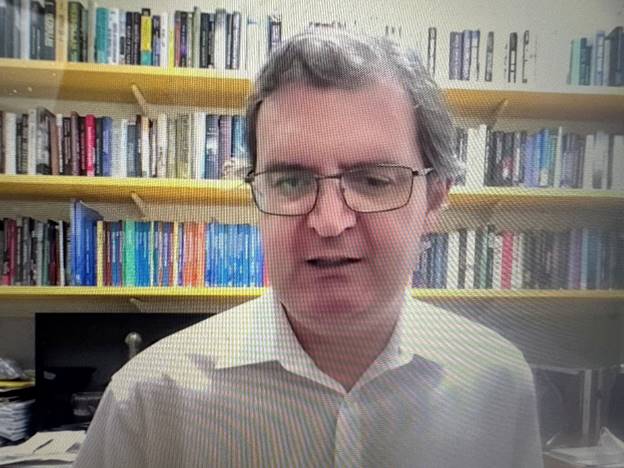
Kristian Coates Ulrichsen
National Council on US-Arab Relations Debates US-Iran Diplomacy Dilemma
By Elaine Pasquini

Washington, DC: The diplomacy dilemma between the United States and Iran was the topic of a webinar hosted by the National Council on US-Arab Relations (NCUSAR) on August 20, 2026.
Nearly six months into this conflict which began on February 28 when the US and Israel launched coordinated bombing attacks on Iran, the situation “oscillates from hot to lukewarm to cold in somewhat predictable and somewhat unpredictable escalatory and de-escalatory moments and cycles,” said William Lawrence, senior academic and research fellow in residence at NCUSAR, in opening comments. “Each side appears to be settling into or posturing that they are settling into a long blockade to try to outlast the other and pressure them into better diplomatic outcomes.”
Moderator Abderrahim Foukara, distinguished fellow for US-Arab affairs and media leadership at NCUSAR, noted the 60-day Memorandum of Understanding between the United States and Iran expired August 17 without a final settlement that has left the two sides deadlocked over core issues such as maritime transit rights and Iran’s nuclear program.
Days later, President Donald Trump announced new sanctions against Iran which he described as “the most crushing economic operation ever taken against a country.”
Abdullah Baabood, Chair of the State of Qatar for Islamic area studies, visiting professor at the Faculty of International Research and Education at Waseda University in Tokyo, stressed that President Trump’s announcement of sanctions was an “important development” in that it’s not just sanctions against Iran but against other third countries and parties. “This has much wider implications… because it will have huge implications on Iran’s trade partners. We’ve seen that the United Arab Emirates has already started to take some measures to stop trading with Iran. Most important is China. We are talking about a global power that is going to be subjected to secondary sanctions.”
The Iranians, Baabood opined, will not capitulate to the US because of sanctions or renewed attacks. “I think we should learn that war, threats, conflict or sanctions do not resolve the situation in the Middle East.”
For a longtime, the Gulf states’ security has been provided by the United States, but it has become a liability where the Gulf states are paying a high price now for hosting American bases, he said.
In addition, he continued, “the Gulf states do not have one policy towards Iran; they don’t have one policy towards anything. There are six different states that created the Gulf Cooperation Council with six different foreign policies, but there is a lot of coordination between them.”
Wars are not going to be the answer to conflicts in the region. “We have seen so many wars, and they have never provided an answer,” he emphasized. “There are many Gulf states happy to be involved in trying to get the US and Iran to talk to each other and to bridge this trust gap. We have no other options but to actually get back into dialogue…to create collaborative arrangements in the Gulf rather than just showing power and using sheer power.”
Kristian Coates Ulrichsen, fellow for the Middle East at Rice University’s Baker Institute for Public Policy, pointed out that the Gulf states must live with Iran. “There’s never been a single Gulf unified GCC position towards Iran. Some states have reasons to co-exist with Iran, very legitimate reasons. Qatar has a gas field part of which is in Iranian waters so there’s a very strong pragmatic need to at least maintain a working relationship with Iran. I think the Gulf states will be monitoring the situation trying to determine if there is any consistency in US policy proposals.”
The Iranian economy was in bad shape even before the war began six months ago, he said. With the US midterm elections coming up, the Iranians may feel they can outlast any economic pain for another three months. They may be thinking in terms of a calculation based on political timeframes as well as economic ones.
Sanctions are a blunt instrument and generally have not been effective against Iran, Kenneth Katzman, senior fellow at the Soufan Center, said. President Trump is trying to get out of this and get back to the Memorandum of Understanding signed June 17. The war hasn’t gone the way he thought and “he’s trying to get out of it,” he argued.
With respect to the future trajectory of GCC states, Katzman noted the “billions of dollars flowing into new projects that would potentially make the Strait of Hormuz either irrelevant or much less relevant than it is.”
In terms of integrating with Iran, the Gulf states, he opined, have decided they cannot deal with this regime and must separate from it and will try to reduce dependence on the Strait of Hormuz.
But the bottom line for the US and Gulf states is “to get back to what was agreed in June and work from there,” Katzman said.
(Elaine Pasquini is a freelance journalist. Her reports appear in the Washington Report on Middle East Affairs and Nuze.Ink.)