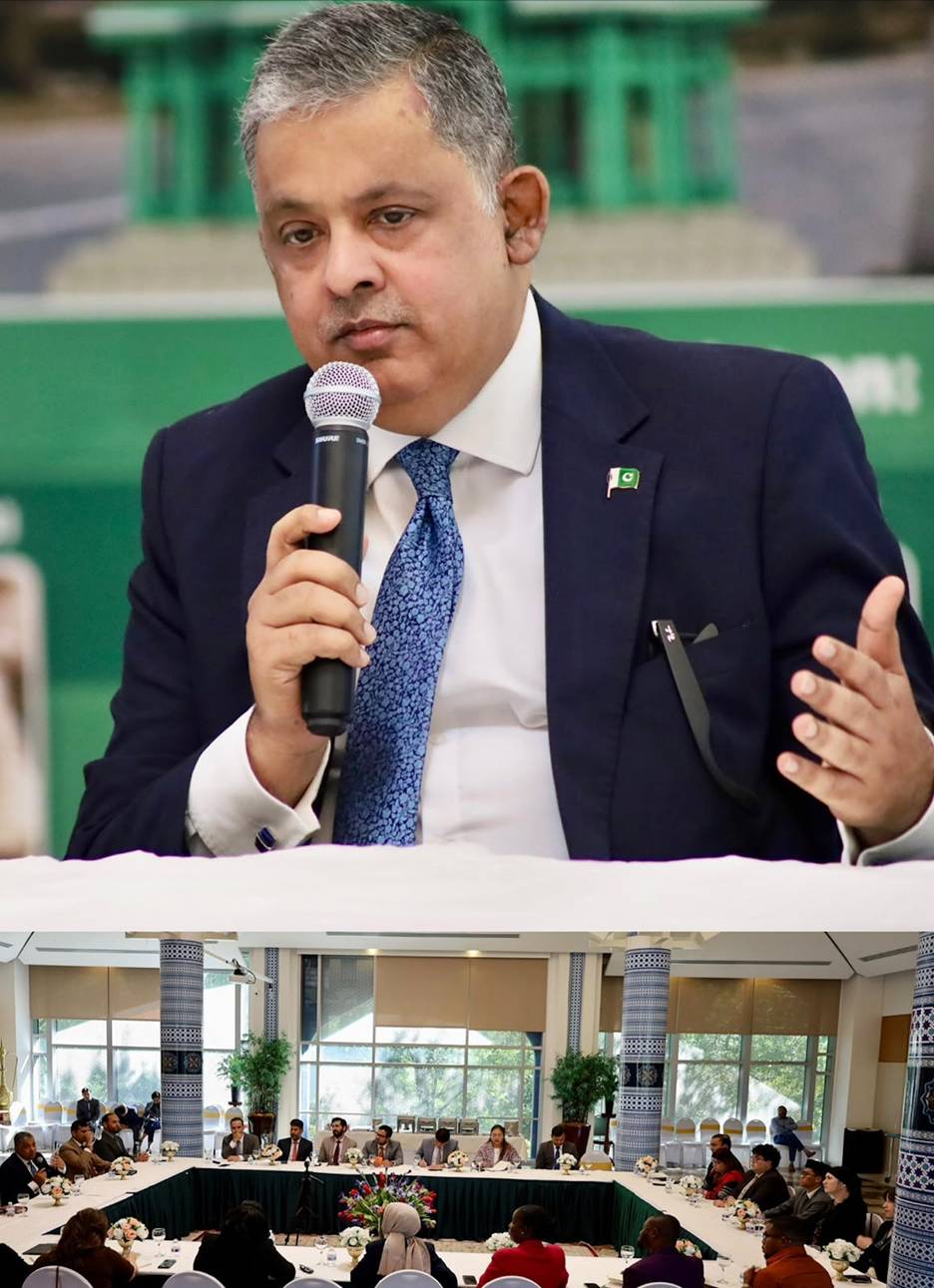
Ambassador Rizwan Saeed Sheikh Hosts University of Hartford Peacebuilding Students
By Elaine Pasquini

Washington, DC: Rizwan Saeed Sheikh, Ambassador of Pakistan to the United States, hosted a delegation of students from the Master of Arts in International Peacebuilding (MAP) program at the University of Hartford at the Pakistan Embassy on October 1, 2026.
Always eager to host students at the embassy, the ambassador enjoyed an interactive discussion on diplomacy, peacebuilding, conflict resolution, and Pakistan’s role in advancing regional and international peace.
The delegation was led by Phoebe Milliken, director of the Master of Arts in International Peacebuilding program, and Hina Athar Khan, assistant director of the program. The international student cohort included participants from Albania, Ghana, Indonesia, Lebanon, and the United States, with professional backgrounds spanning United Nations peacekeeping, interfaith harmony, public policy, community-building, and nonprofit leadership.
Welcoming the delegation, Ambassador Sheikh briefed them on Pakistan’s diplomatic priorities, with particular emphasis on the country’s longstanding commitment to peace, dialogue, and conflict resolution. He also highlighted Pakistan’s continued partnership with the United States across multiple facets and underscored the ascendant significance of further strengthening the eight-decades-long Pakistan-US relationship.
“Peace is something that is of interest to us, and that has to do with our genesis as a nation state carved out of a subcontinent,” Ambassador Sheikh told the students. “Owing distinct identity to the religion that signifies peace by its name, we were born with the intent of peace, with the aspiration to peace, and that is what we have strived for both within and without.”
Reflecting on Pakistan’s diplomatic history, the ambassador highlighted his country’s role in facilitating dialogue among major powers and recalled Pakistan’s contribution to the historic rapprochement between the United States and China in the early 1970s. “When we brought the two top economies of today, the United States and China, together in 1971, we made a sterling contribution to global peace as evidenced by last week’s summit featuring the US and Chinese leadership in Washington,” he noted.
Ambassador Sheikh also discussed Pakistan’s recent mediation efforts between the United States and Iran resulting in the Islamabad Memorandum of Understanding, emphasizing the value of quiet, sustained, and effective diplomacy geared to conflict resolution in its pristine form. He stressed that Pakistan continues to facilitate diplomatic engagement under the Islamabad MoU framework as a trusted and successful mediator.
“Our consistent quest for peace has dictated our diplomatic effort as evidenced by our role in peace making, peace-keeping and peace-building for almost eight decades now,” he said. “Our urge for peace is an integral part of our national history. In the current role of trying to resolve one of the most consequential crises in modern times, our leadership has approached the matter with both a sense of history as well as a sense of responsibility, being the mediator trusted by the two sides.”
Phoebe Milliken also briefed attendees on the University of Hartford’s Master of Arts in International Peacebuilding program and its emphasis on scholarship, dialogue, and practical approaches to peacebuilding. She highlighted that the program equipped students with practical skills in dialogue, mediation, reconciliation, and constructive community engagement alongside their academic studies.
Against the backdrop of Pakistan’s recent mediation efforts in the US-Iran conflict, the visit provided students an opportunity to gain firsthand insights into the practice of diplomacy, mediation, and peacebuilding along with learning more about Pakistan’s approach to conflict resolution.
During the discussion, the students showed keen interest in Pakistan’s diplomatic engagement on the international stage and exchanged views with the ambassador on mediation, peacebuilding, and contemporary global challenges. They utilized the opportunity to learn about Pakistan’s geography, politics, economics and diplomacy through the lens of the country’s current role in facilitating constructive dialogue between the United States and Iran.
Concluding the visit, Milliken thanked Ambassador Sheikh for hosting the delegation and sharing his perspectives on diplomacy, mediation, and important global issues.
The ambassador also interacted with the students individually responding to their comments and questions. Thanking the delegation for visiting the embassy, he wished them success in their academic and professional pursuits and future endeavors.
(Elaine Pasquini is a freelance journalist. Her reports appear in the Washington Report on Middle East Affairs and Nuze.Ink.)