
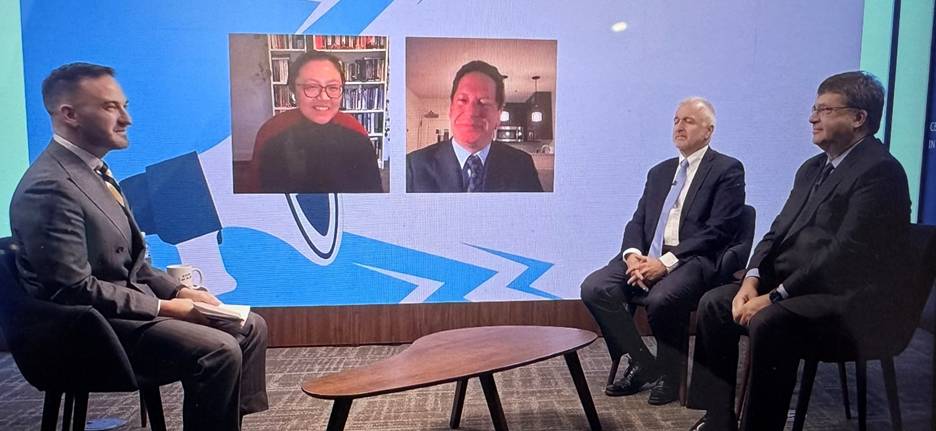
Top left Bonny Lin; top right Scott Kennedy, bottom left Will Todman; bottom near right Ambassador Edgard Kagan; bottom far right Thomas Christensen
CSIS State of Play on Xi-Trump Summit
By Elaine Pasquini

Washington, DC: On the September 25, 2026, episode of State of Play at the Center for Strategic and International Studies (CSIS), host Will Todman led a discussion on the White House meeting of President Xi Jinping of China with President Donald Trump.
“We’ve seen a big turn in the relationship between the US and China since the last summit between the two global leaders in May in Beijing,” Todman said. “It has transitioned from confrontational to stability although there is still friction on the economic and security sides as it relates to Taiwan, Iran and the South China Sea.”
President Trump, he said, wants stability and an increase of Chinese exports of rare earths. The Chinese want to avoid any more tariffs and maybe see a deal on Chinese investment and is trying to undercut morale in Taiwan.
Ambassador Edgard Kagan, former US ambassador to Malaysia, commented on the “striking” degree of warmth that the president has shown for Xi Jinping and the extraordinary level of ceremonial at the White House. “This is President Trump’s way of showing his desire for a strong relationship with Xi Jinping as a way of trying to stabilize the relationship with China.”
In general, the White House doesn’t host many state visits because they take up a lot of time, he said. “And time is the most precious commodity that any White House has. So, this is rare.”
Professor Thomas Christensen of Columbia University, also head of the Geopolitics and Foreign Policy Department at CSIS, views the current relationship between the US and China as “quite fragile.”
The Chinese are not very satisfied with the flow of high-tech from the United States and the restrictions on high-tech, he said.
The US, on the other hand, is not satisfied with China’s flow of rare earth and rare-earth magnets nor is the United States fully satisfied on agricultural purchases. “So just on economics you have friction,” he observed.
In addition, AI is a topic of important discussions between the United States and China but “it doesn’t really seem that we’re on the same page about the content of those discussions,” he said. “It does seem a place where we do have actual common interests. I don’t think either country has an interest in seeing the AI models break out of the control of the engineers who created them.”
He went on to say that the Chinese want to use these meetings with President Trump to undercut morale in Taiwan.
Bonny Lin, senior advisor and director of the China Power Project at CSIS, noted President Trump is under a lot of pressure from Congress to sell defensive arms to Taiwan. Four Republican senators, she said, wrote a letter to President Trump highlighting the $14 billion in Taiwan arms sales that is waiting his approval to move forward. In addition, there is $300 million in terms of State Department foreign military financing as well as $1 billion that Congress approved for the Department of Defense to also give to Taiwan for the Taiwan security cooperation initiative.
Beyond Taiwan, Lin pointed out tensions between China and the Philippines over the summer, and “we’re also continuing to see significant anti-Japanese rhetoric surging throughout China,” she said.
And while China is strengthening its relationship with North Korea, “We also know that Trump is interested in meeting with Kim Jong-un,” she said. “But it is predicted that this meeting will be more difficult to arrange than six months ago.”
Scott Kennedy, senior advisor and trustee chair in Chinese Business and Economics at CSIS, emphasized that President Trump wants “stability, the pomp and circumstance, and a close personal relationship with Xi Jinping.”
The Chinese want stability as well, he added. “They’re facing a lot of restrictions from the US. Although tariffs are down from where they were before, they are still high and higher than on other countries and export controls are still on a lot of Chinese technology.
China is making effective use of its rare-earths card and pushing back against the highest tariffs and export controls, he said. “And that’s why this is a central part of the conversation right now.”
The Chinese are increasingly concerned about the risks related to AI, with respect to regime security, employment, deep fakes and loss of human control, he stressed. In meetings in New York, the Chinese announced they would be developing a notification system of serious incidents.
Lastly, as a goodwill gesture to the United States, the Chinese have sent pandas, PingPing and Fu Shuang, to the Atlanta Zoo.
(Elaine Pasquini is a freelance journalist. Her reports appear in the Washington Report on Middle East Affairs and Nuze.Ink.)
