
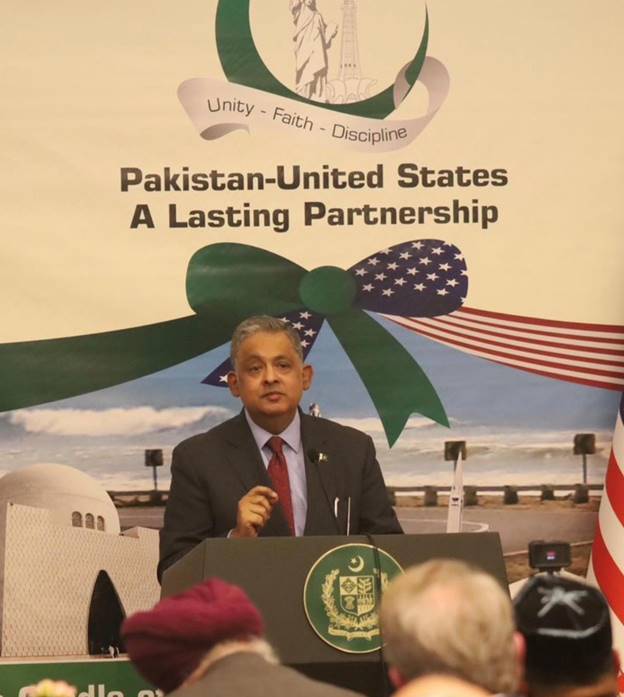
Referring to Pakistan’s diverse heritage and historical foundations, Ambassador Rizwan Saeed Sheikh reiterated the vision of Pakistan’s founder, Muhammad Ali Jinnah, emphasizing freedom of worship and religious tolerance as articulated in Mr Jinnah’s August 11, 1947, address
US, Pakistan Officials Highlight Religious Freedom and Mutual Respect at Embassy Interfaith Iftar
By Elaine Pasquini
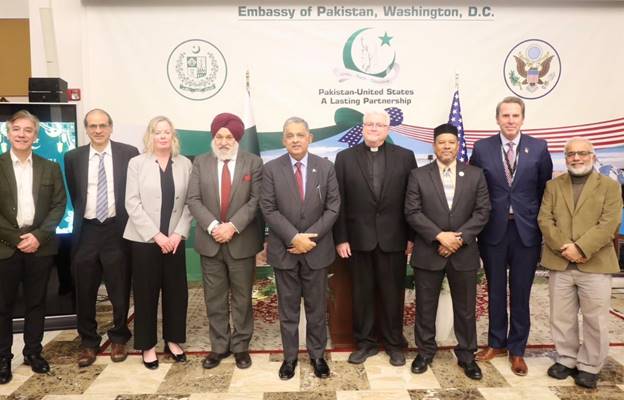
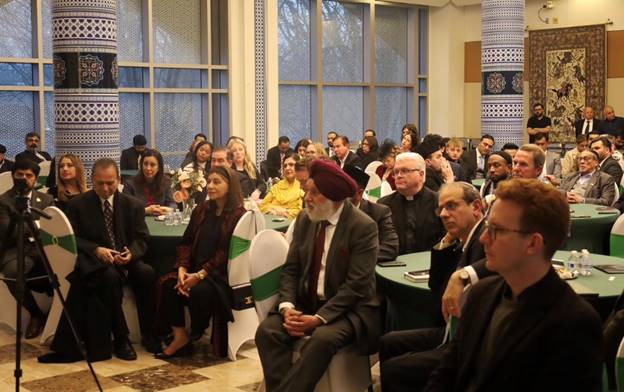
Washington, DC: The Embassy of Pakistan in Washington, DC, hosted its annual Interfaith Iftar on February 26, 2026, bringing together government officials, diplomats, faith leaders, community representatives and members of the media aimed at promoting peace, harmony and mutual understanding among diverse faiths and cultures. The event reaffirmed the shared commitment of different religious communities to dialogue, coexistence and collective efforts toward global peace.
Addressing the attendees, Rizwan Saeed Sheikh, Ambassador of Pakistan to the United States, described the gathering as a “celebration of interfaith harmony” and highlighted Pakistan’s contributions to global interfaith diplomacy.
“Pakistan continues to play a leading role at the United Nations Human Rights Council in advancing initiatives related to religious harmony, tolerance and freedom of religion,” the ambassador said.
Underscoring the philosophy of acceptance, Ambassador Sheikh emphasized moving beyond tolerance toward genuine mutual respect.
“Acceptance acknowledges our differences while affirming equal human rights for all. It says: I am different, you are different, yet we share the same dignity and rights as human beings,” he said.
Referring to Pakistan’s diverse heritage and historical foundations, the ambassador reiterated the vision of Pakistan’s founder, Muhammad Ali Jinnah, emphasizing freedom of worship and religious tolerance as articulated in Mr Jinnah’s August 11, 1947, address.
“Our founder recognized from the outset that Pakistan is home to multiple faiths and traditions and that the state must ensure freedom of worship for all citizens,” Ambassador Sheikh noted. “This principle remains a cornerstone of our national ideology.”
He also highlighted the spiritual significance of Ramadan, describing fasting as both a spiritual and physical process of reflection, discipline and renewal.
A message from the President of the Islamic Republic of Pakistan, Asif Ali Zardari, delivered during World Interfaith Harmony Week, was read to the audience, underscoring the importance of interfaith cooperation and mutual respect in addressing contemporary global challenges.
Faith leaders representing diverse religious traditions participated in the program, including Daisaku Leslie, Director of Soka Gakkai International USA; Daniel Spiro, President of the Jewish-Islamic Dialogue Society; Dr Alok Shrivastav, representing the American Hindu Coalition and United Hindu Jain Temples of the DMV; Surinder Singh Gill, Director of Sikhs of USA; Father Dan Rooney, Director of the Office of Ecumenical and Inter-religious Affairs for the Catholic Diocese of Arlington and Pastor at Saint Bernadette Catholic Church; and Imam Talib M Shareef, President and Imam of Masjid Muhammad, The Nation Mosque, among others.
Speakers collectively emphasized messages of peace, cohesion and harmony, encouraging sustained interfaith dialogue as a pathway toward resolving global conflicts. They highlighted the importance of moving beyond doctrinal differences and addressing shared humanitarian challenges through unity and cooperation.
Addressing the gathering, Nicole Chulick, Principal Deputy Assistant Secretary at the US Department of State, highlighted the partnership between Pakistan and the United States in advancing peace and religious freedom.
“Pakistan’s engagement demonstrates the important role it can play in promoting peace, not just in its own region but globally,” Chulick said. She also expressed appreciation for Pakistan’s participation in the recently convened Board of Peace initiative.
“The United States and Pakistan also share a commitment to security,” she added. “Our cooperation in this area remains strong. We have a common goal of keeping our people safe.”
In his remarks, Mark Walker, principal advisor on Global Religious Freedom at the US Department of State, described the iftar as a communal tradition that transcends religious observance and strengthens unity across faith communities.
“Tonight, many faiths are represented in this room, brought together by a shared conviction that every person has dignity and every conscience deserves respect,” Walker said.
Emphasizing the importance of unity and religious freedom, he added: “When people of different belief systems choose unity over suspicion, communities grow stronger. That kind of unity sends a powerful message and represents the solution the world needs today.”
Walker also noted the evolving nature of US-Pakistan relations, stressing the importance of mutual respect and cultural engagement.
“The United States and Pakistan share a long relationship that continues to evolve in an upward trajectory,” he said. “When we strengthen mutual respect, protect the rights of religious communities and invest in cultural ties, both nations benefit.”
Concluding the special evening, the ambassador expressed gratitude to participants for fostering dialogue and reaffirmed the Embassy’s commitment to continuing interfaith engagement initiatives in the future.
(Elaine Pasquini is a freelance journalist. Her reports appear in the Washington Report on Middle East Affairs and Nuze.Ink.)
