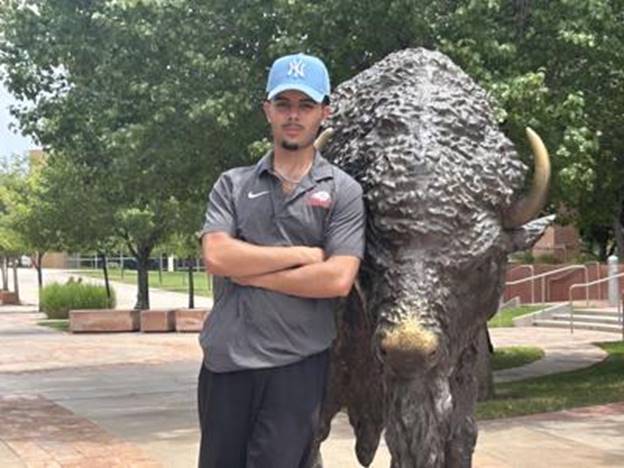
At 20 years old, Zaid Sajjad, an immigrant to St George from Karachi, Pakistan, founded two companies before taking on his current role as a research assistant at Utah Tech University - Photo by Nick Fiala
By Nick Fiala
'I Hope My Story Inspires': Pakistani Immigrant Celebrates Personal Success in St George
“Karachi is like the New York of Pakistan — loud, chaotic and the city never sleeps,” he told St George News. “There's an energy to it that's hard to describe unless you've experienced it yourself. One city raised me, the other changed me.”
Sajjad received what he called “a standard education” in Karachi but said he always felt like the real learning was happening outside the classroom.
“I was naturally curious about technology from a young age and started teaching myself things that weren't being taught in school,” he said. “So, on paper it was typical — but in reality, I was always self-directing, always building, always chasing the next thing I didn't know yet.”
Sajjad ran his social media marketing agency, Clarity Quill, throughout 2024 into 2025.
“It was my first real taste of entrepreneurship — managing clients, delivering results, and running something entirely on my own,” he said. “Most of my day would go by cold calling people and getting rejected. But that never really stopped me because I knew I just needed one good client who would pay me well.”
He eventually signed what he described as a handful of good clients.
“It taught me more about business, people and sales than any classroom ever could,” he said. “It also showed me that I was capable of building something from nothing, which gave me the confidence to keep going and eventually cofound an AI automation company.”
That company, called Piplit, offered AI automation software designed to help businesses automate repetitive tasks and workflows. He said co-founding the company was a completely different experience from running Clarity Quill.
“This wasn't just me selling a service — this was building an actual product from the ground up,” he said. “It taught me what it really means to be a founder. We eventually shut it down when I relocated, but the experience was invaluable, and it only made me hungrier to build the next thing.”
When asked how he decided to come to Utah Tech, Sajjad said the university found him more than he found it.
“I was looking for a university that would give me the right environment to grow — academically and personally,” he said.
The young man traveled from a city of over 20 million people to one with just over 100,000 . Coming from Karachi to St George was a massive shift, he said, to a different culture, a different pace, a “different everything.”
“The difficulties were real — leaving my family, navigating a new country alone, figuring out how everything works from scratch with no road map,” he said. “And I'll be honest, my cooking skills definitely took a turn — I can now cook more than just scrambled eggs.”
He said those challenges are exactly what pushed him to build, to create, and “to prove that where you come from doesn't define where you're going.”
After questioning himself for a long time about what he should study and what he wanted to be, Sajjad said he realized two things about himself: he loves to innovate and he loves to manage people.
“That's exactly why my course of education, information technology with a management minor, perfectly aligns with my future endeavors,” he said. “Technology gives me the tools to build. Management gives me the tools to lead. Together, that's everything I need.”
Sajjad now works as a research assistant conducting trade network analysis at Utah Tech.
“Specifically, we are studying water trade on a macro level, trying to understand how water is distributed outside of the United States and how tons and tons of water is exported every year across the globe,” he said. “Most people don't think about water as a traded commodity, but at a macro level, the numbers are staggering.”
This work excites him because it combines data collection with real-world impact.
“I'm not just crunching numbers — I'm helping build a picture of how one of the world's most essential resources actually moves across borders,” he said. “Working alongside faculty at Utah Tech on something this substantial as a 20-year-old is something I don't take for granted.”
Sajjad said he is “deeply grateful to be here in St George,” adding that it has given him opportunities he couldn't have imagined while growing up in Karachi.
“Nikola Tesla once said, 'If you want to find the secrets of the universe, think in terms of energy, frequency and vibration,'” he said. “I believe in that deeply. Energy is contagious.”
He also cited a common saying that people are the sum of the five people they spend the most time with, saying this is energy that is transferred to a person, whether they realize it or not.
“That's why I don't just want to thrive for myself,” he said. “I want to elevate everyone around me. I want to radiate the kind of energy that makes the people in my life better just by being near it.”
Sajjad said he is just getting started and has “so much more” he wants to build. “St George might be a small city but it's teaching me that big things can come from anywhere,” he said. “And I hope my story inspires other young people, students and immigrants to know that where you start doesn't determine where you finish.” - St George News