
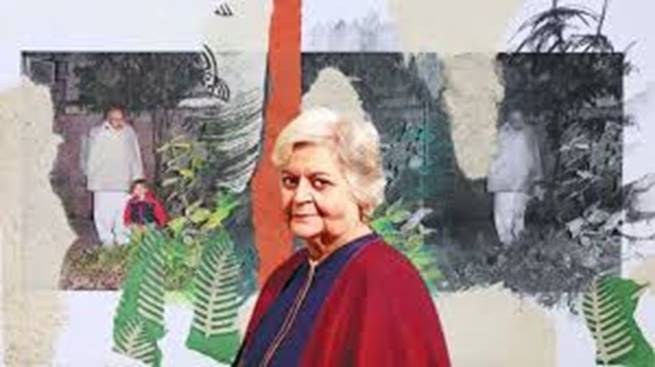
At a birthday exhibition in Lahore, the artist reflects on teaching, memory and the weight of living through history - Images
From Ziaul Haq’s Era to Gaza and Homesickness: The Politics that Shape Salima Hashmi’s Art
By Ayesha Majeed
Salima Hashmi — artist, writer, social activist, and educator — wears many hats with rare ease, and her influence extends far beyond the canvas. She has played a formative role in shaping the landscape of contemporary art in Pakistan and beyond, while consistently initiating vital conversations around social justice, education and cultural discourse.
For a long time, it had been my wish to interview her and review her solo body of work, but I never had the opportunity. Hence, there was no second thought when I received a personal invitation to attend her exhibition at Rohtas 2 Gallery, Lahore, which also marked the celebration of her birthday.
When I ask Hashmi how her journey as an artist began, she reflects on her childhood and the people who shaped her early life, “I was a reticent child, so drawing became a refuge, though I didn’t realize it would become my career path. I always knew I wanted to teach.”
Later, at the National College of Arts (NCA), Lahore, it became clear that her future lay in the art and design fields that she had always seen as being deeply intertwined.
Hashmi’s father, the renowned poet Faiz Ahmad Faiz, was a profound influence on her. “His life was mirrored in his poetry, which became my own experience of life,” she says, before quoting him: “‘My people are the whole of mankind.’” Reflecting on the impact his words had on others, she adds, “It helped me understand the artist’s role, as he saw it, as the voice of the people.
“My father was always a guiding presence, a touchstone of values, and so was my mother — a strong woman who supported him when others left. We were a close yet expansive family. My parents and my constant exposure to creative people — artists, musicians and poets — had the strongest influence on me.”
Hashmi recalls being politically conscious from an early age, though she says her distinct voice and style evolved naturally. Her major concerns took shape in her forties, during Gen Ziaul Haq’s era, when she realized that her “voice was also the voice of others.” Her work confronts patriarchy and social injustice, placing women’s experiences of resistance and survival at the center, while also addressing the plight of innocents such as Palestinians. For her, art is not merely decorative — it is a form of protest and a call for change.
Hashmi discovered her favorite collage medium during her student years in England, through her teachers Adrian Heath and Howard Hodgkin. “I enjoyed it immediately,” she says. Though trained in classical techniques and the study of old masters, she found collage and mixed media more natural and expressive: “From ink and charcoal to acrylic, powdered pigment and bits of paper, I collect from all over the world, everything can become part of my work.”
Our conversation broadened when I asked about the art scene in the region. “It’s not surprising,” she says, “that when everything seems dark, it is often the poet, the painter, the musician, the creative voice that sustains people’s imagination.”
Her work certainly does that. But, upon entering Rohtas 2 Gallery, one notices a shift in Hashmi’s work toward a more personal, intimate exploration of self and human experience. The works on display trace a significant span of her artistic journey, marking a time period from 2010 to the present, reflecting how personal memories, solitude and separations have shaped her practice.
The Sunless Light series was developed during her recent visits to Sri Lanka for Ayurveda treatment. There, hours spent in solitude amid scenic surroundings allowed her to focus, reflect and “discover an inner light.” The series partly pays tribute to painter Zahoorul Ikhlaq’s Sunless Days but moves in a more introspective direction, exploring her evolving relationship with herself and her environment.
Executed on indigo-dyed handmade paper, works such as Sunless Light XV use diptych compositions: a vast ultramarine field evokes night skies or waves, while the other panel features delicate forms of paper, threads and paint — suggestive of drifting coastlines, inspired by her surroundings.
Hashmi notes that her engagement with abstract landscapes deepened during her time in the US, where homesickness heightened her awareness of her immediate surroundings. She records these observations in notebooks, which are also displayed at the exhibition.
In The Letters of Your Name I and II, using photographs, collage, charcoal and graphite, she turns to a personal subject: her husband Shoaib Hashmi and their grandson Faiz. On the other hand, A River Dies of Thirst references the violence in Gaza, while The Family series reflects on isolation during Covid through masked family portraits and collaged images.
But despite her continued prolificacy, Hashmi quips, “My greatest accomplishment is still being sane at my age.”
Salima Hashmi’s open studio was held at Rohtas 2 Gallery, Lahore, from December 14, 2025, to January 15, 2026. - Images
