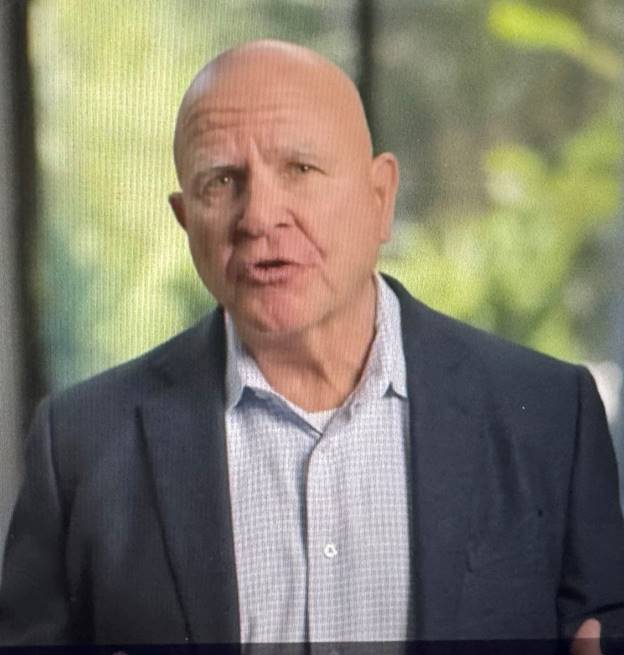
HR McMaster

Ali Ansari
HR McMaster and Ali Ansari Analyze Iran’s Challenges and Future
By Elaine Pasquini

Washington, DC: On his December 4, 2025, Battlegrounds program, Lt Gen HR McMaster (retd), former US national security advisor and currently a senior fellow at Stanford University’s Hoover Institution, hosted Ali Ansari, professor at the School of History, University of St Andrews, for a discussion on Iranian history and what comes next for the Islamic Republic.
Before analyzing the many problems the country is facing, Ansari pointed out the importance of distinguishing the Iranian regime from its citizens.
Iran’s political system is excellent at presenting itself as very strong, he said, but, as evidenced by its conflict with Israel over the last two years, it “became apparent that Iran’s air defenses were not quite as strong as they claimed them to be.”
According to Ansari, if you dig a little bit under the surface and see what is going on inside the politics of Iran today in terms of its economy, the environment, and a series of domestic crises, “the bombast is there to cover up for the fact that it's very anxious.”
One of Iran’s domestic urgencies, McMaster pointed out, is the water shortage in Tehran, that, according to him, was not caused by US sanctions.
Many problems, Ansari said, will “pale into insignificance” compared to what is coming on the ecological front, including the water shortage crisis. “I mean, they're running out of water.” While some Iranians say “Oh, we must pray for rain. And what we need is a few days of rain, and it will all be solved,” environmental scientists contend the problem is not drought, it is water bankruptcy and the consequences of that will be very serious.
Iran, he continued, is probably the world's “best case study of what happens when you screw things up ecologically, and nobody's paying any attention to it.”
McMaster interjected that Iran and the People's Republic of China are “great examples of what happens when you destroy your environment.”
Another problem is lack of foreign investment in Iran. Ansari related that Western companies complained to him that Iran’s “political economy is not built around long-term investment, so nobody invests.”
In terms of the future, the situation in Iran will eventually reach a bad state of affairs, Ansari predicted, but with its potential in terms of human capital and resources “there will be a group of patriotic individuals who will step up to the plate and say, enough is enough, we have to sort this out.”
Asked by McMaster about the type of government that will ensue upon the eventual death of Iran’s Supreme Leader Ali Khamenei, age 86, Ansari predicted the country would move towards a “more nationalistic, less religious type of government that will be centered around probably someone in the military…with a coalition of the willing.”
The next government will need to change the nature of its relationship with the outside world, he stressed. “So, the Islamic Republic could stay in name only, but it won't really be an Islamic Republic anymore. You could see a popular revolt, which then catalyzes and encourages the elites to come in and sort of find a way through.”
“Whatever happens, the process of rebuilding will be slow and hard work,” Ansari noted. “It’s going to be a process of rebuilding almost from the ground up.”
In response to McMaster commending the “fantastic Iranian diaspora who contribute so much to our societies…across the West,” Ansari stated the Iranian diaspora is “living proof they can function in a democratic society. They function very well in European and American societies and the wide Commonwealth and others. So, that also tells us that the problem in Iran is not the Iranians, the problem in Iran is their political system.”
“The Iranians in the diaspora want to live a normal life,” he added. “They don't want to go around having this endless antagonism with the United States, Britain, Europe. Actually, the West is what they look to. They're certainly not looking to Russia and China.”
In conclusion, Ansari said that “a better grounding and a better understanding of the history of the relationship, along with the history of Iran itself and the way the Iranians relate to that history,” would provide a much better handle for Washington to negotiate its relationship with Tehran going forward.
“I personally feel optimistic about the fact that, ultimately, the history of the Islamic Republic will be a blip in the history of Iran,” and we will not have this issue of an “eternal enmity between the United States and Iran, and Iran and the rest of the West.”
Sooner or later, there will be a change. “It may not be smooth,” he warned, “but the fact is it will happen…and I think it will happen sooner rather than later. And what we need in the West is to be prepared for change and when that change happens, we need to have a good positive response to it.”
(Elaine Pasquini is a freelance journalist. Her reports appear in the Washington Report on Middle East Affairs and Nuze.Ink.)