
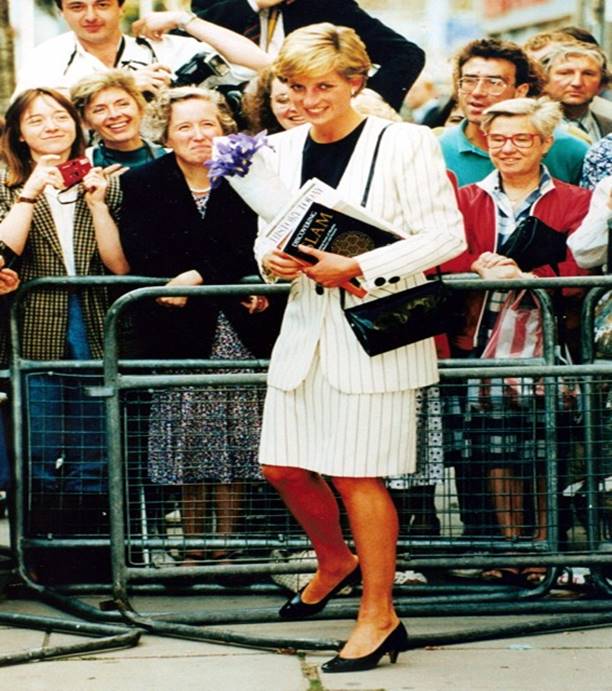
Princess Diana holds Dr Akbar Ahmed’s book ‘Discovering Islam’
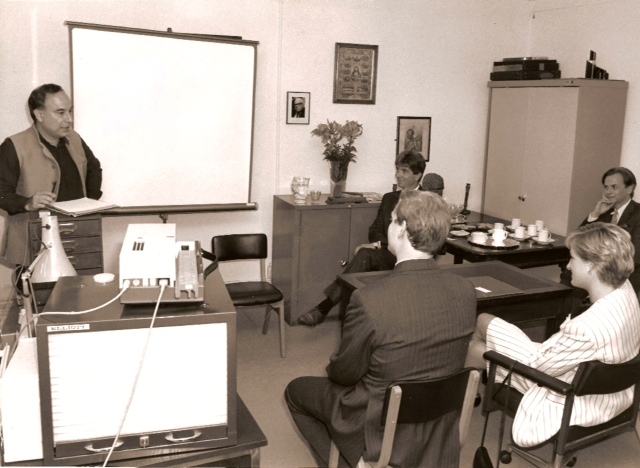
Dr Akbar Ahmed lecturing Princess Diana
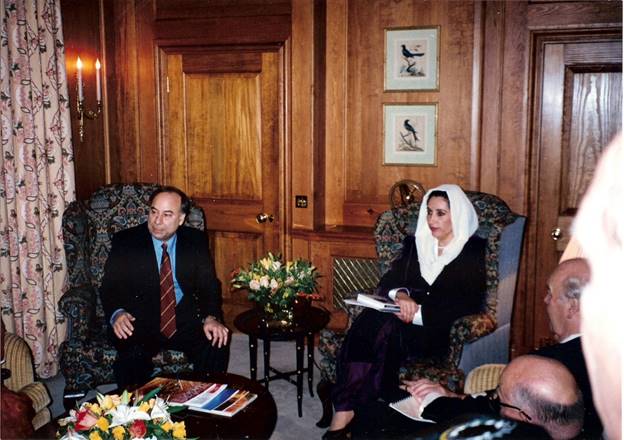
Dr Akbar Ahmed with Mohtarma Benazir Bhutto
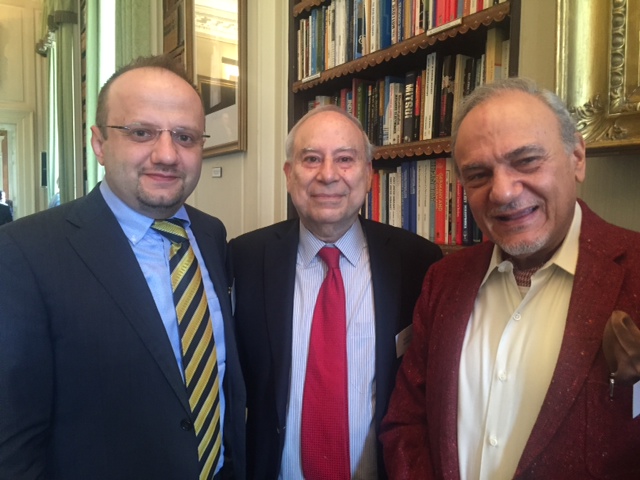
Dr Akbar Ahmed with Prince Turki and Mirnes Kovac, prominent editor from Bosnia Herzegovina
An Ambassador for Islam
By Ian Hawkey
(This article appeared in CAM: Cambridge Alumni Magazine, Easter Term 1995)
Akbar Ahmed inhabits the precarious middle ground, somewhere between East and West, between professor and populist, between academe and action. Since he took up the five-year Allama Iqbal fellowship at Selwyn in 1988, his has become one of the key voices in the often shrill dialogue between modern Islam and the West. It has been the period of The Satanic Verses, of Kalim Siddiqui and the Muslim Parliament, of Hebron and Kashmir, of Bosnia and the-invasion of Kuwait. Intolerant times.
‘Not a sprint but a gallop,’ he says. He is jet-lagged but always urbane and animated. It is the week of the Oklahoma bomb and its fallout. ‘See how people immediately said it must be those terrible fundamentalists. The knee-jerk response frightens me.’ Much of Ahmed’s energy is devoted to such prejudice, to defining the middle path. It is not always a safe road. Besides his distinction as an anthropologist, his decorations as a District Commissioner in Pakistan, he has variously been described as ‘the unofficial ambassador of the Muslim world; ‘a sell-out’ or ‘a Muslim fundamentalist’.
As ambassador he has a vast constituency. There are up to two million Muslims in Britain, twenty million in the West and Islam grows worldwide at a rate beyond all other faiths. ‘Speaking as an academic, I would say Islam is at a crucial point in its history’, he maintains. ‘It is no longer easy to isolate Islam like it was in, say, the nineteenth century, when it was “out there” and was colonized, kept in shackles. Islam has emerged and this exercise in trying to build bridges is very difficult for both sides. The problems I face in the West are mirrored in the Muslim world. There they say: “Look at Bosnia. How can you talk positively about a civilization [West] which has such major double-standards?”’
‘I believe this crisis can, at this moment, be directed away from the great global scenario of confrontation between Islam and the West that some scholars are already writing up. But a lot of work will have to be done. If it doesn’t happen, there will be a very ugly relationship developing into the next century. On both sides, an awareness has to grow. Dialogue, harmony, communication, debate are key issues. Now, this may be all right in rhetoric but in the context of so much racial, cultural and religious prejudice on both sides, it becomes a very difficult struggle. It can be very uncomfortable, even dangerous, to stand in the middle.’
Witness the response to Living Islam, the recent BBC television series written and presented by Ahmed, that was widely applauded. From the Israeli embassy came the cry that it was the work of a fundamentalist. Simultaneously, from Kalim Siddiqui’s Muslim Institute, sprang the charge that the program was part of a Zionist/Anglo-American conspiracy. ‘This is all a bit scary when you’re living in an intolerant time, when people are throwing fatwas about’, he acknowledges. ‘But I made clear my position: that the middle path was the one I had to take. Academics must follow ideas wherever they take them, and generate debate.’
Ahmed is engaged in that debate across a wide front, an achievement beyond the reach — but not the envy — of many scholars. His academic output is prolific—the last three years have produced Post-modernism and Islam, Living Islam and Islam, Globalization and Postmodernity as well as many papers — and he continues to lecture on both sides of the Atlantic, in the Islamic world and to supervise in Cambridge. But his popular profile is still larger, in broadsheet and broadcast, his voice tuned to the idiom of the times. ‘His anthropological work established a very good reputation in academia’, says John Cooper of the Faculty of Oriental Studies. ‘Now he’s speaking to people beyond that.’
‘Until a few years ago, I had no role in the popular media,’ Ahmed admits. ‘In fact, I’d have been horrified if someone said more than six people read my article on anthropology and enjoyed it. It was the Rushdie affair that really dragged me into the media. The feeling in the Muslim community was passionate. It was confused. It was angry. It made me aware how necessary it was to explain a Muslim position. There are so few Muslims doing that.’
From the Centre of South Asian Studies, Ahmed is involved in two significant initiatives to stimulate the study of Islam in Cambridge. The Ibn Sina Trust, under Nicholas Postgate, will bring scholars from the Muslim world to Cambridge, and vice versa, and the Faculty of Divinity is seeking to establish an Islamic chair in the department. ‘Cambridge, in itself, does not have a very developed “Islamic” presence,’ he says. ‘These initiatives can make up for that. After all, people from all over the Muslim world come to Cambridge to study, and Britain has important links with South Asia.’
Born in what was then India four years before the founding of Pakistan, Ahmed’s education crisscrossed East and West. First, a Catholic-run school in Abbottabad then Punjab University, Birmingham, Selwyn and, later, the School of Oriental and African Studies in London. Coming down from Cambridge in the late sixties, he became a political agent in Waziristan, Baluchistan and the north-west frontier provinces of Pakistan. This was still the territory of Kipling and, occasionally, of Ian Fleming: one adventure, recovering a chieftain from kidnap in Sind, earned him a Baluchistan government decoration for ‘extraordinary endeavor in the field under fire’. He recalls: ‘… I’ve been almost knifed. I was administering some very turbulent tribes. What I did learn was that if you’re able to deal with people face to face, you can convert an impossible situation into something positive. I miss that excitement and I miss interacting with the Muslim tribal populations. The ordinary Pathans, the Baluch are full of compassion. It’s a face of Islam the West doesn’t really know — very unlike the media caricature.’
His own religious observances are orthodox, his faith fortified by instances of ‘ignorance, apathy and even hostility’ towards a Muslim living in Britain. ‘Those things renew my conviction and give me inner strength. My faith as a Muslim derives from my own reading of the Qur’an — the only point of reference — and the examples from the life of the holy prophet. I believe one can live comfortably with one’s traditional faith within another culture. The strength of both societies can be brought out in harmony.’
‘For instance — and I’m talking here as an anthropologist — one of the things that alarms many Muslims living in Britain is the disintegration of the family. Any society can only function on the basis of that nuclear unit, not only in a physical sense but in the sense of normative values being carried from one generation to the next. For Muslims a sense of balance, of purity, stability, love, compassion, piety in the home is very important and they must try and communicate these things to the next generation. When they are surrounded by a society in which all these values are challenged, for whatever reason, Muslim families are under pressure.’
Ahmed’s family — he is married to Zeenat, the granddaughter of the Wali of Swat — is based in Cambridge, where one daughter is a PhD student and another is at King’s College School. He would like more time at home, ‘but there’s a lot happening’. Pakistan turns fifty in 1997and Ahmed is a consultant for its celebrations. His major project now is a television treatment of the nation’s founder, Mr Jinnah of Pakistan, which he will co-produce. He will also write the accompanying book, The Quest for the Quaid: Mr Jinnah, Pakistan and the Modern Media, a study of a leader ill- served, he insists, by history and, in Attenborough’s Gandhi, by Hollywood.
‘Jinnah’s story has not so far been told and, hopefully, this will add to an understanding of events in 1947, not just in the West but in the subcontinent. There’s an important ideological aspect to it, too. In this polarized world, Muslims — and non-Muslims — are asking ‘What are the role models available to us?’ Jinnah, to my mind, is the man who creates the middle path that essentially is Islam. The President of Pakistan said to me when I was there working on the project: “What you have embarked upon is the real jihad. It’s a labor of love and that is the real jihad”.’
(Ian Hawkey (Magdalene 1986) is a regular contributor to The Sunday Times and BBC World Service. Living Islam is published by BBC Books at £16.99.)
