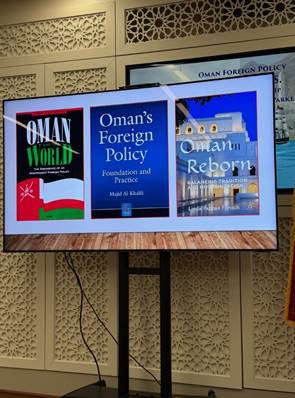
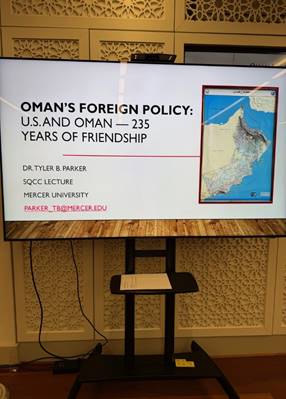
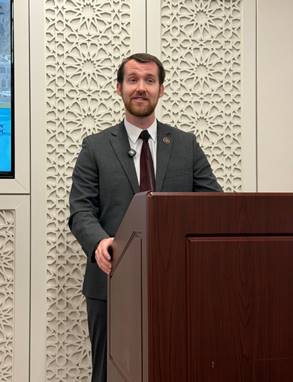
Tyler B. Parker's insights were shared during an educational seminar at the Sultan Qaboos Cultural Center on February 11, 2026. The Center continues its mission of cultural exchange at the historic site previously occupied by Benjamin Franklin University in the 1970s
Navigating the Indian Ocean: The 235-Year Bridge between Muscat and Washington
By C. Naseer Ahmad
Washington, DC

In the quiet, dignified halls of the Sultan Qaboos Cultural Center—situated on the hallowed ground where the Benjamin Franklin University campus once stood in the 1970s—the air recently stirred with the weight of history. On February 11, 2026, Tyler B. Parker of Mercer University stood before a gathered audience to unravel a tapestry of diplomacy that is as ancient as it is essential. For the Pakistani reader, who understands the delicate balance of navigating great-power relations while maintaining regional sovereignty, the story of the US-Oman relationship offers a profound masterclass in "quiet diplomacy."
The Maritime Genesis: A Handshake Across the Seas
The story began not with grand declarations, but with the creak of timber and the snap of sails. In 1790, the Boston Rambler reached the shores of Muscat, marking a moment where a nascent American republic sought to breathe outside the suffocating shadow of British hegemony. Oman, under the visionary Al Said dynasty, provided that breath of fresh air.
By 1833, this maritime courtship was formalized through the Treaty of Amity and Commerce—the first of its kind between the United States and any Arab state. It is a historical footnote that resonates deeply today: while European powers sought to plant flags and claim territory, the Americans and Omanis sought only "freedom of the seas." This established a "most-favored-nation" status built on trust rather than coercion—a model of engagement that many in our own South Asian context might view with a touch of nostalgia and perhaps a lesson for the future.
The Sultanah and the Silk Road of Diplomacy
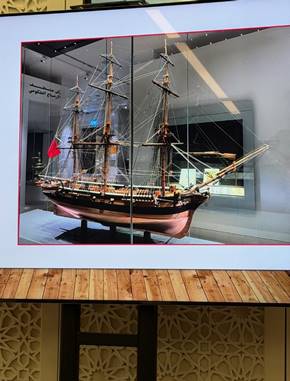
The year 1840 brought a "cinematic" peak to this burgeoning friendship. Sultan Said dispatched the Al-Sultanah to New York City, carrying Ahmad bin Na’aman, the first accredited Arab diplomat to reach American shores. His arrival was more than a cultural curiosity; it was a sophisticated diplomatic maneuver.
As Tyler B. Parker noted during his seminar at the Sultan Qaboos Cultural Center, these early interactions represented a "sophisticated recognition of mutual sovereignty." When the Sultan gifted President Martin Van Buren two Arabian horses and gold-mounted swords, it forced the young American democracy to grapple with its own laws on foreign gifts. It was a meeting of Islamic tradition and Republican restraint—a template of mutual respect that has survived the test of centuries.
The Modern Renaissance and the Pakistani Connection
Following a period of "cordial distance" during the era of steamships, the relationship found a new architect in 1970: Sultan Qaboos bin Said. His accession marked a "Modern Renaissance" for Oman, turning the Sultanate into a strategic linchpin.
For the Pakistani diaspora and observers of the Indian Ocean, the 1980s were a pivotal decade. As the Soviet shadow loomed over Afghanistan, Oman and the US signed the 1980 Facilities Access Agreement (FAA). Crucially, Oman refused to host permanent US bases, opting instead for "facilities access." This nuance allowed Oman to remain a regional interlocutor—a "strategic anchor," as Parker emphasizes, "that prioritized stability over alignment."
It is here that we must acknowledge the deep, fraternal ties between Pakistan and Oman. Our two nations are joined by the salt of the Arabian Sea and the blood of history. The Makran coast of Balochistan and the shores of Muscat have exchanged people, culture, and trade for generations. Just as Pakistan has often found itself at the crossroads of global interests, Oman has mastered the art of being a "discreet mediator."
The Duqm Paradigm: Beyond the Chokepoints
In 2026, the center of gravity has shifted to the Port of Duqm. Located south of the volatile Strait of Hormuz, Duqm serves as a "safety valve" for global commerce. With a dedicated Government Berth capable of servicing US aircraft carriers, Duqm allows for "over-the-horizon" deterrence while avoiding the tactical hazards of the Persian Gulf’s narrow corridors.
Strategic Metric (2026) |
Significance to US & Regional Interests |
Bilateral Trade |
~$4.3 billion (A testament to the 2009 FTA) |
Port Depth (Duqm) |
18–19m (Carrier accessible; bypassing Hormuz) |
Diplomatic Role |
The primary "backchannel" for regional de-escalation |
The "Omani Bridge" and the Path Forward
Oman’s "no enemies" policy is not a sign of weakness, but a sophisticated instrument of power. From facilitating the talks that led to the JCPOA to mediating the release of detainees, Muscat provides the "quiet consistency" that the world so desperately needs. Parker aptly observed during his talk that "Oman’s diplomacy is not merely passive neutrality; it is an active, curated bridge-building that serves as a regional pressure valve."
Under Sultan Haitham bin Tariq, "Vision 2040" is steering the Sultanate toward green hydrogen and data centers, ensuring that the partnership evolves from oil to innovation. For the Pakistani reader, seeing a brotherly nation succeed in maintaining its sovereignty while hosting the assets of a superpower provides a blueprint for sustainable, non-coercive diplomacy in a multipolar world.
As we reflect on the 235 years of this journey, we find that the true strength of the US-Oman bond lies not in the thunder of cannons, but in the silence of the "Omani Model." In the halls of the Sultan Qaboos Cultural Center, the dialogue continues—a reminder that in the complex theater of the Indian Ocean, a steady hand and a quiet voice are often the most powerful tools of all.