
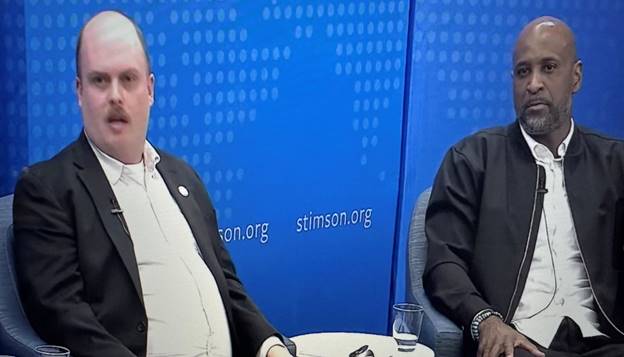
Evan Cooper (right) and Don Davis
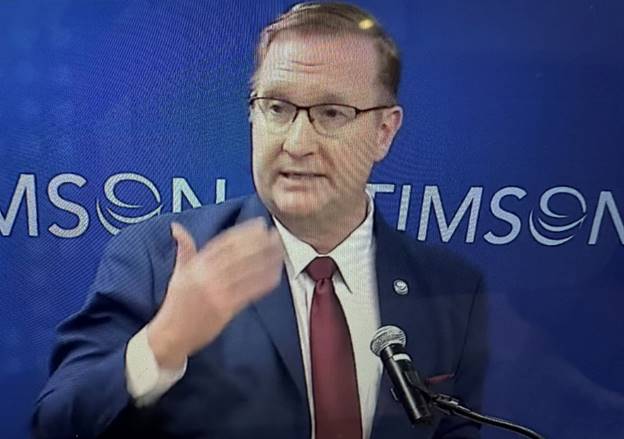
Christopher Preble
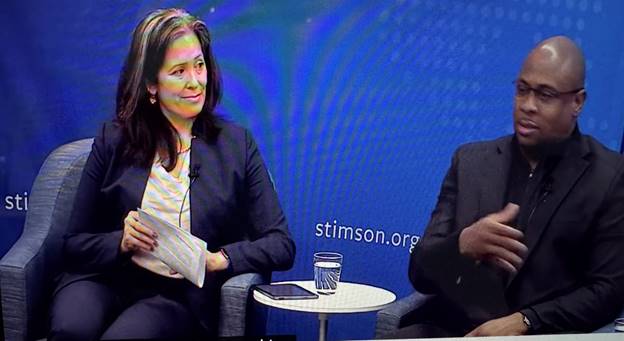
Lindsay Sarah Krasnoff and Troy Vincent
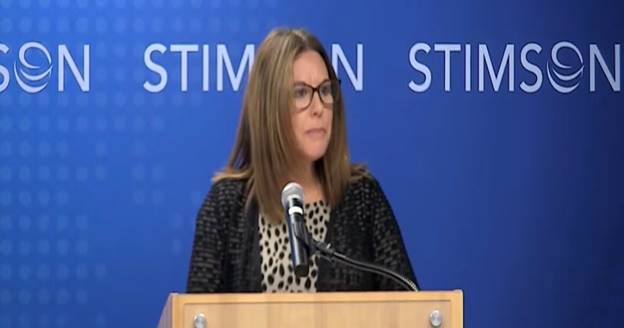
Rachel Stohl
Player-to-People Diplomacy an Opportunity for Improving Global Relations
By Elaine Pasquini
Washington, DC: American football has arguably been called “the most popular thing in America,” Rachel Stohl, senior vice president of research programs at the Stimson Center, told the audience in opening remarks at the Center’s January 13, 2026, program. “With the NFL expanding globally and flag football becoming one of the fastest-growing sports worldwide, a partnership with the NFL and the NFL Players Association seems natural for US diplomatic efforts.”
American athletes serve as envoys of America, “shaping perceptions of the United States and opening avenues for US diplomacy,” she noted. “Over decades, sports have helped to break down barriers and provide opportunities for greater US influence and cultural exchange.”
Lindsay Sarah Krasnoff of New York University’s Tisch Institute for Global Sport said player-to-people athlete-driven diplomacy is perhaps one of the more influential areas of sports diplomacy today.
“It’s an investment in learning something about the other who you are engaging with or playing against or who you’re working with as well as with yourself,” she said.
Troy Vincent, executive vice president of football operations at the NFL, recounted a solo trip he recently made to Mexico City where he saw “diplomacy as I’ve never seen before in my life.” The trip was undertaken following an invitation he received to go there and see flag football being part of the culture.
Flag football, a non-contact form of the sport where the goal is to remove a fabric cloth flag from an opposing player’s waist, has gained global legitimacy by being included as an official sport in the 2028 Summer Olympics in Los Angeles.
During his four-day visit, Vincent saw “love, professionalism, dignity, respect.” People embraced him for just showing up, he said. “I saw what I would consider diplomacy on my own terms truly being lived out.”
Advantages of the flag football game include affordability and accessibility. “I can go to a place and truly relate to a kid with only a flag, a t-shirt, a pair of shorts,” he said. “I can play in dirt; I don’t need a special stadium.”
Asked by an audience member how, in a moment when the United States is retreating from global leadership and has been explicit in terms of pushing an “America First” agenda, athletes should handle the current criticism of United States’ foreign policy by other countries, Vincent responded: Athletes serve as the most authentic messengers because “they just show up as their authentic selves. I think that’s the beauty of the athlete.”
Don Davis, chief player officer of the National Football League Players Association, pointed out that flag football offers players an opportunity to expand their horizons, to be exposed to things beyond their day-to-day activities they are used to experiencing.
“When you do that, you gain information and knowledge, and if you adopt it you can truly advance yourself – your knowledge, your wisdom,” he said. “How you show up, how you have conversations is just different when you are exposed to different things.”
“Any kind of sport is a shared experience,” he noted. “No matter how we differ as people, as cultures, socioeconomics, we can have a shared experience that cuts through all of that. That’s what players offer.”
Evan Cooper, research analyst with the Reimagining US Grand Strategy program at the Stimson Center, pointed out that athletes have a huge social power to capture attention that diplomats or government officials don’t have. “They face fewer constraints than a traditional diplomat does on messaging and how you represent your country,” he said.
Athletes have the opportunity to interact with different audiences and have authenticity in interacting with locals including teenagers who they can share their growing up experiences with, he added. “They can communicate the values, creativity and drive they experienced to get where they are.”
The Olympics in Los Angeles 2028 is an immense wealth of opportunities for sharing cultures and building connections and exchange of ideas. “Having these connections just benefits the country,” he stated. “It is a time when the world is watching. We get the opportunity to show off the best of us.”
In closing, Christopher Preble, senior fellow and director of the Stimson Center’s Reimagining US Grand Strategy program, emphasized that the heart of the program is that “diplomacy does not need to be confined to high-level summits between heads of state.” Indeed, as has been proven, “athletes can serve as credible and trusted envoys of the United States, communicating honestly their lived experiences and opening doors that traditional diplomacy just can’t do. They can carry US influence into places where traditional tools of statecraft are not going to reach.”
While the speakers highlighted the promise of sports as a diplomatic tool, sports diplomacy deserves far more attention than it currently receives, he stated. “So, harnessing this tool more intentionally could support US engagement at a time when other sources of US power are under strain and creative approaches to diplomacy are badly needed.”
Continuing this important work to promote not only sports – but cultural – diplomacy is critical but needs to be strengthened, and “it starts as this discussion has shown at a very personal level, player-to-people right down to all of us as individuals,” he told the in-person and virtual audience. “We hope you will continue to engage with our work on cultural diplomacy.”
(Elaine Pasquini is a freelance journalist. Her reports appear in the Washington Report on Middle East Affairs and Nuze.Ink.)
