
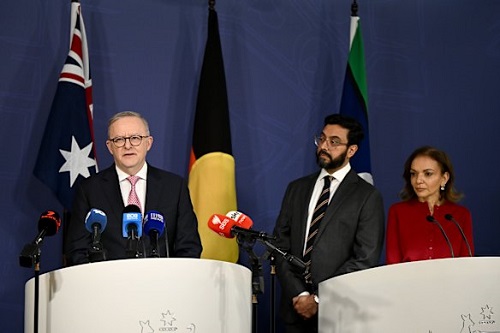
Prime Minister Anthony Albanese with Aftab Malik, the special envoy to combat Islamophobia, and Multicultural Affairs Minister Anne Aly - AAP
Landmark Report Calls for Sanctions over Anti-Muslim Politicians in Australia
Sydney: Federal Australian politicians would be punished for engaging in hate speech and religious discrimination would be banned under sweeping proposals from the nation’s first special envoy for tackling anti-Muslim hate.
The report by Aftab Malik, the special envoy for combating Islamophobia, also calls for counter-terror laws to be reviewed to examine whether they discriminate against Muslim Australians and for all federal police officers to be given compulsory religious sensitivity training.
Prime Minister Anthony Albanese praised Malik’s report, released on Friday, but did not say how many of its 54 recommendations his government would implement.
The call for a federal ban on religious discrimination creates a challenge for Albanese, who also faces calls to protect gay and transgender children from discrimination at religious schools.
The government is also considering its response to a separate report delivered in July by the special envoy for combating antisemitism, Jillian Segal.
“Islamophobia in Australia has been persistent, at times ignored and other times denied, but never fully addressed,” Malik told reporters at a press conference in Sydney.
As revealed by this masthead last week , his report calls for federal legislation to be passed outlawing discrimination on the basis of religion, a move that would protect Australians of all faiths.
Albanese said he would work closely with Malik on the recommendations, while stressing that the special envoy is independent of the government.
“The targeting of Australians based on their religious beliefs is not only an attack on them, but it’s an attack on our core values,” Albanese said.
“We must stamp out the hate, fear and prejudice that drives Islamophobia and division in our society.”
Albanese repeated his previous insistence that he would only pursue changes to federal anti-discrimination legislation if there was bipartisan support.
“I certainly support religious discrimination legislation, but I don’t support starting a debate that leads to rancour,” he said.
Federal legislation currently bans discrimination based on race, sex and age, but not on the basis of religion.
Attempts by the Morrison and Albanese governments to legislate to outlaw religious discrimination flamed out after becoming ensnared in a debate about how to protect LGBTQ students at religious schools against discrimination based on their sexual or gender identity.
Malik said Islamophobic incidents had skyrocketed since Hamas’s October 7 attacks in Israel, including the planting of fake bombs outside of mosques.
“Muslim women in particular … are physically assaulted, spat [on] or shoved or subjected to threats simply for wearing a headscarf,” he said.
His report calls for a commission of inquiry into anti-Palestinian and anti-Arab racism, saying this was a separate but related issue to Islamophobia that was being compounded by what the community saw as a lack of “moral action” from the government.
“I urge the Australian government to take a clear and public stand against the dehumanisation, hate, racism, and silencing directed at Palestinian and Arab Australian, as well as their supporters,” he said.
The Albanese government has moved to recognise a Palestinian state and repeatedly condemned Israel’s conduct in Gaza, while supporting the country’s right to defend itself against terrorist group Hamas.
Opposition Leader Sussan Ley and other coalition frontbenchers said in a statement that the Coalition would carefully consider any proposals the government chooses to adopt from the report.
“The report finds Islamophobia is a feature of life for too many Australians and it is corrosive to the unity and wellbeing that all Australians should enjoy,” Ley and her frontbenchers said. “There has simply been too much hate in Australia in recent times.”
Malik’s report calls for federal parliament “to develop behavioural codes of conduct for all Australian parliamentarians and staff to take a zero-tolerance approach to racism, with appropriate sanctions”.
Politicians and staffers would be given mandatory annual training in “how Islamophobia manifests in society, impacts its victims and undermines social cohesion”.
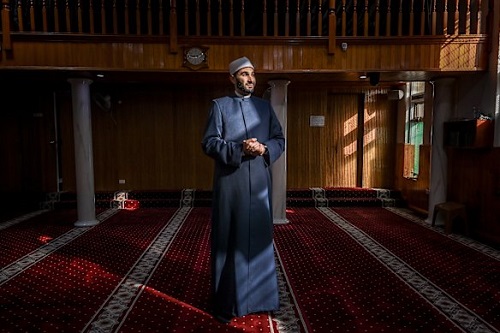
Alaa Elzokm, imam of the Elsedeaq mosque in Melbourne, said Muslim women had suffered particularly intense Islamophobia - Justin McManus
The code of conduct would “introduce clear contingencies for responses to parliamentarians who engage in hate speech or behaviour”, including formal reprimands and temporary suspension from the party room.
A federal judge found One Nation leader Pauline Hanson racially discriminated against Greens Senator Mehreen Faruqi in 2022 when she tweeted the Greens senator should “pack your bags and piss off back to Pakistan”. Hanson is appealing and argues the ruling violates her free speech.
Bilal Rauf, spokesman for the Australian National Imams Council, said the group hoped the government would act swiftly to implement the report’s recommendations, especially federal protection against religious discrimination.
Rauf praised the report for highlighting “the harsh reality of a prejudice that remains all too prevalent, while also exposing the persistent failure to address it”.
Nesreen Bottriell, chief executive of the Australian Muslim Women’s Centre for Human Rights, said every recommendation from the report should be implemented and that women should be central in decision making process.
“Women are by far the biggest victims of Islamophobia and it is only therefore sensible for Muslim women to take an active role in how we address those changes and how we implement those changes,” she said.
Alaa Elzokm, imam at the Elsedeaq mosque in Melbourne’s north, said he had been forced to increase security at Friday prayers after Islamophobic graffiti was sprayed on the building.
He said rising rates of Islamophobia had made some women and children in his community fearful of being in public alone.“Some of the families, all their children … have to be accompanied by the parents when they go [out], because any bad incident could happen to them, and they share that with us as well,” said Elzokm.
He said he hoped the report would “highlight that Islamophobia is not an isolated experience but a widespread challenge that has real consequences on individuals, families and communities.”
Sharara Attai, co-executive director of the Islamophobia Register Australia, called for the recommendations to be implemented in full, saying: “Islamophobia must be treated with the same level of urgency as other forms of racism.”
Angus Delaney is a reporter at The Age. The Sunday Morning Herald
