
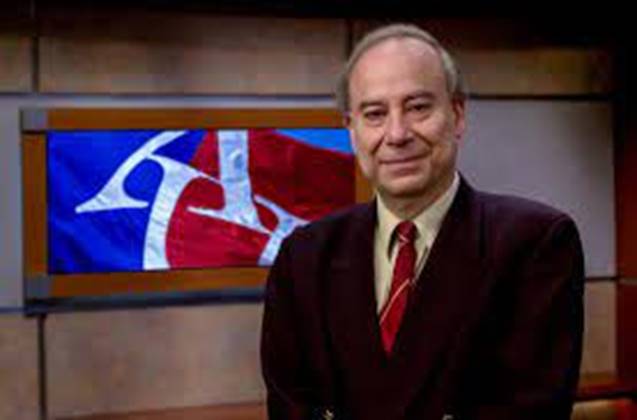
Bridging Civilizations: The Life and Work of Dr Akbar S Ahmed
By Ayaz Morris
The true wealth of any nation lies in individuals who contribute to its progress. In civilized and developed nations, such people are considered assets; those whose ideas, actions, and contribution help shape the future of their society.
In Pakistan's history, there have been many such notable individuals whose exceptional services for the love, development, and progress of the country. I believe they should be remembered and shared with the younger generation. This article introduces you to one such personality who has earned a distinguished global reputation through his creative, diplomatic, and scholarly contributions.
Dr Akbar S Ahmed is a respected name in Pakistan. Writing about him and interviewing him was an honor for me. The sincerity and warmth with which he treated me were truly encouraging. I conducted an online interview with him to complete this article. He responded to my questions with great interest and graciousness and appreciated my work. I am deeply thankful to Dr James Shera, a close friend of Dr Akbar S Ahmed, for introducing me to him and encouraging me to conduct the interview.
Ambassador Dr Akbar S Ahmed currently holds the Ibn Khaldun Chair of Islamic Studies at the American University and is a Global Fellow at the Wilson Center in Washington. Over the course of his career, he has served in many distinguished academic and public service roles. Among his many accolades, he has received the Star of Pakistan Award. He has served as a Senior Fellow at the Brookings Institution, held the first Chair of Middle East and Islamic Studies at the US Naval Academy in
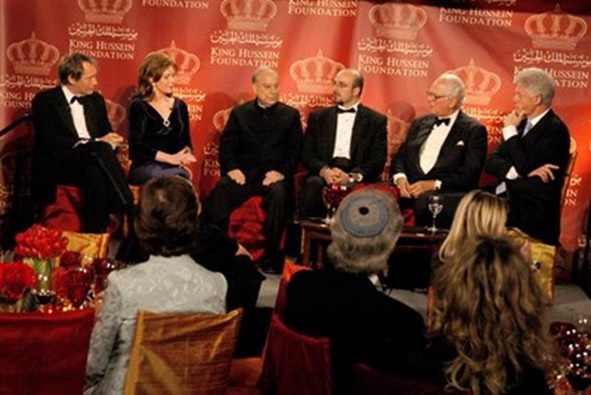
From left: Charlie Rose, Queen Noor of Jordan, Dr Akbar Ahmed, Dr Ghassan Salame, Sir Evelyn de Rothschild, and President Bill Clinton – Getty Images
Annapolis, MD, and was the Iqbal Fellow and Fellow at Selwyn College, Cambridge University. He has taught at Harvard and Princeton Universities.
He also served in Pakistan’s Civil Service for over three decades, including roles as Commissioner in Balochistan, Political Agent in tribal areas, and High Commissioner to the UK and Ireland. His outstanding services and intellectual contributions are widely praised by leading institutions around the world.
The BBC called him “The world’s leading authority on contemporary Islam”, while the Saudi Gazette called him “the most influential living authority on contemporary Muslim societies.” Shaykh Hamza Yusuf described him as “A treasure among self-made Muslims.” Former Archbishop of Canterbury Dr Rowan Williams called him “The most distinguished and versatile Muslim scholar in the English-speaking world today.”
Famous American historian and author of Jinnah of Pakistan Professor Stanley Wolpert, said “Dr Akbar Ahmed is the foremost scholar of Islam in the United States. No one else in the world has such stature of thought. He is the Dara Shikoh of modern Islamic leadership.”
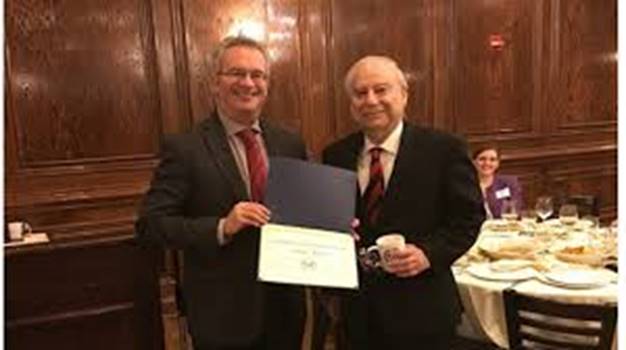
American University honors Dr Akbar Ahmed with Teacher of the Year Award
Dr Akbar Ahmed was born in 1943 in Allahabad, India. His father, a railway DS at the time, used to speak of his meetings with the Quaid-i-Azam. His family migrated to Karachi at the time of Partition. He received his early education from Burn Hall School (now Army Burn Hall College) in Abbottabad from 1954 to 1959. He was deeply influenced by the missionary teachers, especially the priests, who instilled in him discipline, a love for reading, and a unique way of viewing the world.
After the tragic events of 11 September 2001, Dr Ahmed initiated a series of dialogues published by the Brookings Institution Press, addressing issues between Islam and the West
He says, “Our missionary teachers were our real role models. They taught us how to read, think, and analyze.” Later, he studied at the Forman Christian College, Lahore, then Punjab University, and later graduated from the University of Birmingham. He earned his MA from
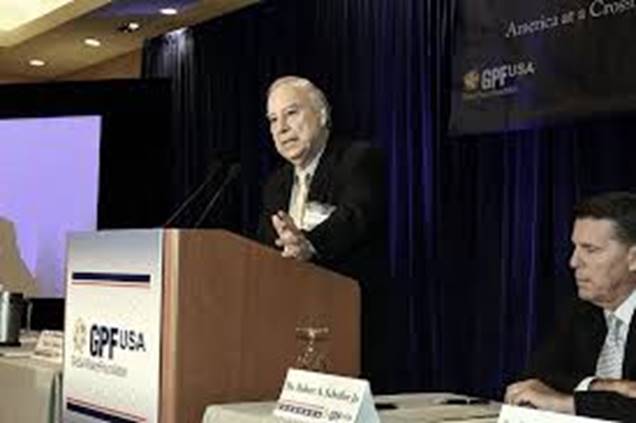
Dr Akbar Ahmed addresses the Global Peace Leadership Conference, 2014
Cambridge University and in 1978, completed a PhD in Anthropology from the School of Oriental and African Studies, University of London.
Dr Akbar S Ahmed’s life spans many dimensions; creative, educational, diplomatic, interfaith, and global dialogue. It’s impossible to capture all aspects of his work in one article, but a few highlights are shared here.
After the tragic events of 11 September 2001, Dr Ahmed initiated a series of dialogues published by the Brookings Institution Press, addressing issues between Islam and the West. He engaged in a wide range of public interfaith dialogues across the US. He was uniquely honored at the National Cathedral in Washington, DC, by the Bishop of Washington, alongside the Senior Rabbi of the Washington Hebrew Congregation, when they dedicated an evensong in his honor. The Gandhi Center presented him with the inaugural Gandhi Peace Award. Together with Professor Judea Pearl, he was awarded the inaugural Purpose Prize.
He also received the Herschel King Award for interfaith efforts and was appointed by the Archbishop of Canterbury as a trustee of the World Faiths Development Dialogue. In 2002, he received the Free Speech Award from the Muslim Public Affairs Council in Washington, DC.
Dr Akbar Ahmed says “Dialogue, harmony, communication, and understanding are crucial between Islam and the West.”
Editor of Preporod Islamic Magazine and author of The Sage of Islam, Mernis Kovac writes “No scholar I’ve studied is as unique as Akbar Ahmed, who unlike traditional scholars, possesses the ability to view the world through ‘two eyes’—spiritual and scientific, emotional and rational. His work on Muslims in Europe is exemplary, and I, as a European Muslim, take great pride in his contributions.”
Former Mayor of Rugby and close collaborator Dr James Shera says, “The main reason for my friendship with Dr Akbar S Ahmed is our shared love for Pakistan. Our hearts beat for Pakistan. We have always worked to uphold the flag of Pakistan and improve its soft image abroad. Dr Ahmed is not just an asset to Pakistan—he is the Akbar the Great of our times. His academic and professional services have made Pakistan proud on the global stage.”
Dr Shera adds: “Despite belonging to different religions and living abroad, we’ve always promoted our shared identity as Pakistanis. The world sees us as brothers because we never allowed our religious differences to create distance between us.”
“Together, we’ve represented the true spirit of Pakistan through our thoughts, character, and values. My heart and Akbar’s heart have always, and will always, beat for Pakistan.”
Dr Akbar S Ahmed has authored several books, worked on notable documentary films and projects. Dr Ahmed said that he not only initiated the Jinnah film project, but also served as its executive producer and co-scriptwriter. The project belonged to him, as the film was owned by Quaid Project Limited, of which he was the sole shareholder. He initiated four projects under the Jinnah Quartet and successfully completed all four.
In recognition of his lifelong services, he was awarded the Lifetime Achievement Award on 30 September 2022 by the Pakistani Ambassador to the US and the Director of the US State Department.
He lives for Pakistan, and his life’s purpose is to see the country prosper and grow. Individuals like Dr Akbar S Ahmed are our true national asset, a source of pride for both Pakistan and the world. He says, “If we want Pakistan to develop, we must give people their rights, establish justice, promote education, and treat our citizens with dignity and love.”
In response to one of my questions, he said, “It saddens me to see Pakistan in its current state, especially considering the sacrifices our forefathers made to create this nation. Due to ego, incompetence, and selfishness, we’ve brought the country to this point. If we still fail to give people the respect envisioned by the Quaid-i-Azam,
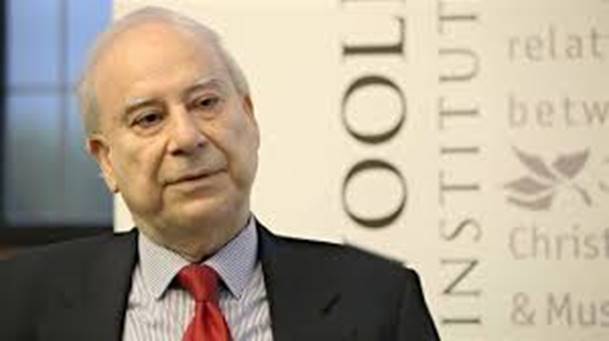
“Dialogue, harmony, communication, and understanding are crucial between Islam and the West”: Dr Akbar Ahmed
we will never be able to progress. We must take practical steps to protect the rights, dignity, and safety of religious minorities; especially the Christian community, which has greatly contributed to education in Pakistan. The entire nation is grateful to them.”
When I asked him how he sees the future of Pakistan, he replied, “Ayaz Morris, when I look at the current state of the country, I do feel sadness and disappointment. But when I see young people like you, who continue to serve society despite difficult circumstances, I feel hope. Youth are the real face and true strength of this country. They just need confidence and guidance.”
“They have the potential to elevate Pakistan to the heights it deserves. We must work together with unity and mutual respect for the betterment of Pakistan. Pakistan is a legacy from our elders, entrusted to us. We must protect and nurture it in every way.”
