Stimson Center Reviews Afghanistan’s Four Years under Taliban Rule
By Elaine Pasquini

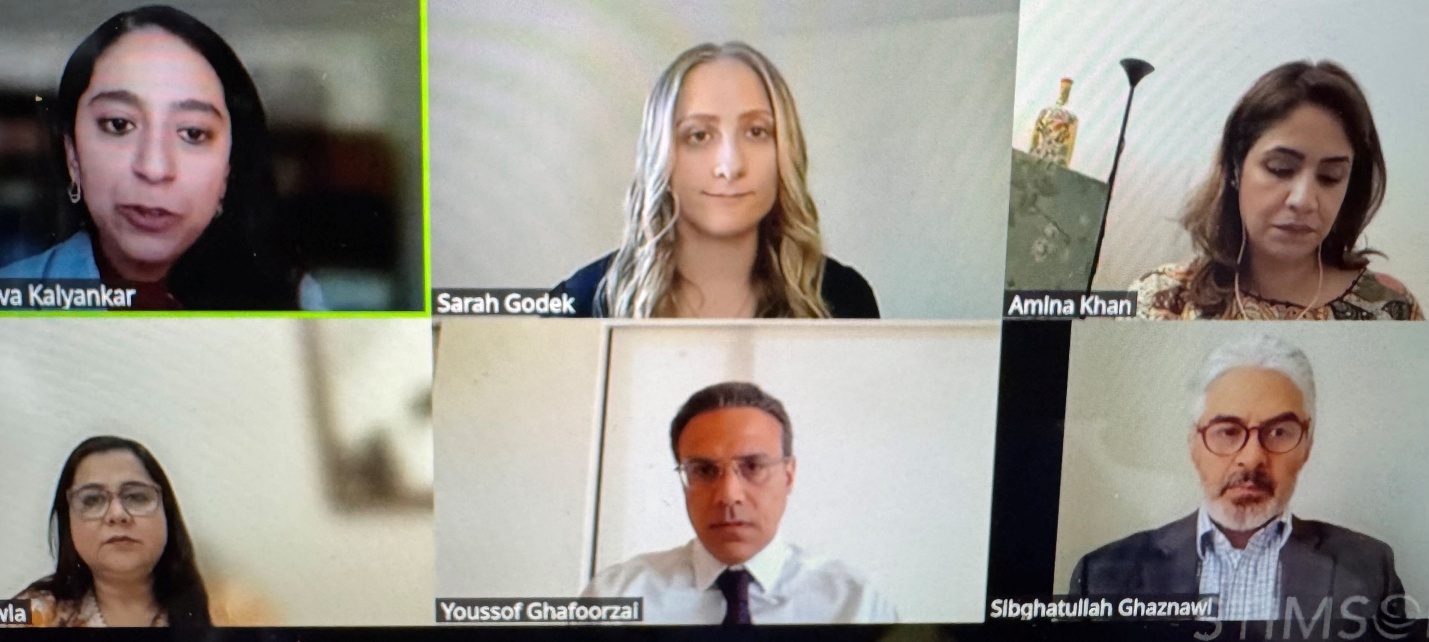
Washington, DC: On the fourth anniversary of the Taliban’s return to government following the US-led withdrawal from Afghanistan in August 2021, the Stimson Center hosted a webinar to assess the dramatic changes in the country’s domestic landscape, the geopolitics and security dynamics across the region, along with the future of Afghanistan’s international engagement.
Moderator Akriti Vasudeva, editor of South Asian Voices, the Stimson Center’s online policy platform of its South Asia program, enumerated the many challenges facing Afghanistan, including a struggling economy and human rights restrictions especially for women and girls. Opportunities for engagement have emerged, however, due to Afghanistan’s relative stability.
Ambassador Youssof Ghafoorzai, former Afghan ambassador to Norway and to Afghanistan’s mission at the United Nations, pointed out that Taliban leaders have met with representatives from China, Russia, Pakistan, India and Central Asian countries to discuss security concerns and economic opportunities.
Western countries, on the other hand, he said, have focused on providing humanitarian assistance, containing the terrorist threat emanating from Afghanistan and trying to find ways to end the repressive policies the Taliban have imposed against Afghan women and girls. Meanwhile, both blocs have emphasized the importance of forming an inclusive government to represent a cross-section of Afghan society.
Politically, it’s obvious that the absence of a legitimate and inclusive government has deepened the crisis, Ghafoorzai noted. Failing to represent all segments of its society has resulted in Afghanistan losing support in the international community and prevented it from maintaining normal state-to-state relations with other countries.
A political message, he said, should be sent to the Taliban that “you can be part of this solution, but not the solution by yourself.”
From a humanitarian standpoint, the majority of the population of some 42 million, including six million internally displaced persons, need urgent assistance. In addition, more than two million Afghans have been forced to return from Iran and Pakistan this year.
Amina Khan, director of the Center for Afghanistan, the Middle East and Africa at Islamabad’s Institute of Strategic Studies, noted since the Taliban came to power four years ago their relationship with the Pakistani government has generally followed “a very, very negative trajectory. We have seen violence across the border; we’ve seen unprecedented military deaths.”
The relationship, she argued, has always been viewed through a very limited prism. For the Pakistanis, the main concern has been security, “whereas for the Afghan Taliban, now it is trade,” she related. “If both these issues are dealt with adequately, I think the relationship can move forward.”
One positive note, however, is Pakistan’s upgrading of its chargé d’affaires in Kabul to the level of ambassador in April of this year.
Sarah Godek, a research associate with Stimson Center’s China program, said that China took a proactive approach and has become a major player in Afghanistan since the Taliban took charge.
The country, she argued, discerned a strategic opportunity in Afghanistan, partly due to its reputation as “the graveyard of empires.”
“If China were to engage the Taliban and help to develop Afghanistan into some kind of Mecca of peace, with trade and commerce flowing through it, that would create a really lovely opportunity to prove the benefits of the Chinese model of international relations, the model of development,” she argued.
Relations between the two countries improved when China became the first nation to send a new ambassador to Afghanistan in September 2023. Reciprocally, China became the first country to accept a Taliban ambassador who came to Beijing in late 2023 and presented his credentials at a formal ceremony to President Xi Jinping.
But now, the Taliban are shifting priorities. They are not just prioritizing China anymore, but also Russia, India, even the United States to some extent, she said. They are also engaging with some of their Central Asian neighbors.
Shalini Chawla, a distinguished fellow at the Center for Air Power Studies in New Delhi, said that India maintains a cautious and pragmatic approach to its relationship with Afghanistan. Recently, she noted, the foreign secretaries of both countries held productive talks in Dubai.
The Indian government, she said, does not believe a complete policy of isolation will work with the Taliban. Hence, India opened its consulate in Kabul in mid-2022 with humanitarian assistance, including food, grain, medical kits and pesticides. “All the steps that India has taken are for the people,” she stressed.
In terms of the trilateral relationship of China, Pakistan and Afghanistan, “we have seen shades of this trilateral in the past,” she said, but how much the three will actually bring to the table is unknown.
“I feel that the Taliban are very keen to engage with all the regional actors… and these are the developments which are watched very cautiously in New Delhi,” she noted, and in Beijing.
Sibghatullah Ghaznawi, currently an associate research scholar at the Saltzman Institute of War and Peace Studies at Columbia University, was formerly Deputy Minister of Municipalities in the Local Governance Department of Afghanistan prior to August of 2021.
Addressing the prospects for Afghan connectivity with the China- Pakistan Economic Corridor (CPEC) and how it would potentially impact Afghanistan’s relations with Pakistan, Ghaznawi was optimistic, calling Kabul’s involvement “a very positive and practically doable approach for improvement of the region’s security and stability.” However, it needs “political will to depoliticize this issue.”
CPEC is practical and can change the political relationship in the national narratives of these countries, according to Ghaznawi. Connecting Pakistan with Afghanistan and Central Asia with the resulting increase in trade will also strengthen Pakistan’s position vis-a-vis India, he argued. “If Pakistan is in a stronger regional position in terms of trade and business, it will have a better opportunity to have good and friendly terms with India.”
(Elaine Pasquini is a freelance journalist. Her reports appear in the Washington Report on Middle East Affairs and Nuze.Ink.)