Prominent Physicist and Educator Professor Dr Azhar Ahmad Ansari Departs
By Dr Ahmed S. Khan
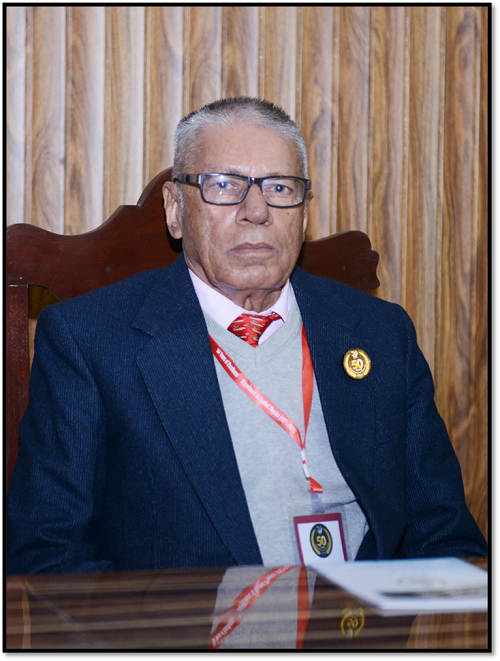
Professor Dr Azhar Ahmad Ansari, former chairman and founding professor of the Department of Applied Physics, University of Karachi, passed away on Thursday, August 28, 2025, at 1 pm in Karachi, after a brief ailment. According to Professor Shahid Hussain Zaidi, Dr Ansari had undergone a procedure to place three stents and had returned home. However, due to a worsening cough, he was readmitted to the hospital, where his condition deteriorated, and he peacefully passed away.
The funeral prayer (Namaz-e-Janaza) was held on Friday, August 29, 2025, after Juma prayers at Masjid-e-Ibrahim, University of Karachi. He was laid to rest at the University of Karachi graveyard.
Dr Ansari was a kind, compassionate soul devoted to the betterment of humanity. He was a beloved mentor to students and colleagues alike, always ready to offer guidance and support—both inside and outside the classroom.
Professor Dr Azhar Ansari Sahib’s demise is a profound loss for the academia. He belonged to a rare and very dedicated group of academics who completed their studies in Physics at the University of Karachi during 1950s-70s, and went to overseas destinations for higher studies, then returned to Pakistan and served in various capacities all over the country. Dr Ansari sahib contributed greatly to the development of intellectual capital of Pakistan and Saudi Arabia.
Dr Azhar Ahmad Ansari was born on August 26, 1943, in Delhi, British India. Following the creation of Pakistan, his family relocated to Karachi in August 1947. Dr Ansari completed his secondary (1958) and higher secondary education (1960) in Karachi. He earned his BSc (Hons) in Physics (1963) and MSc in Nuclear Physics (1964) from the University of Karachi. In 1966, he went to the UK, where he completed a master’s degree in electrical engineering (Electronics) from the University of Manchester Institute of Science and Technology (UMIST). He later received a scholarship to pursue a PhD in Solid State Electronics at Chelsea College, University of London, focusing on III-Nitride Semiconductor Devices.
After completing his PhD, he worked as a research engineer at Plessey Company before returning to Pakistan. He initially joined the Department of Physics at the University of Karachi as an Assistant Professor. Soon after, Professor Aslam invited him to join the newly established Department of Applied Physics in 1971, becoming one of its founding faculty members.
Following Professor Aslam’s departure for a federal role, Dr Ansari assumed the position of Chairman. Under his leadership, the department introduced a modern curriculum with a strong emphasis on semiconductor electronics, transforming it into a nationally recognized center of academic excellence.
Dr Ansari was known for his sharp intellect, gentle demeanor, and refined sense of humor, which he skillfully wove into his lectures. His teaching style fostered a relaxed and engaging learning environment. He actively promoted research and professional development, with interests in semiconductors and alternative energy sources. He supervised numerous undergraduate and graduate projects and dissertations. Dr Ansari also served as a faculty member in the Department of Physics at King Abdulaziz University, Jeddah, Saudi Arabia.
Once, Mrs Ansari was asked to share something unique about her husband. She replied, “He never gets angry, no matter how stressful the situation or how harsh the words—he simply remains silent.”
Indeed, he was a unique person. He truly lived up to his name—Azhar, meaning radiant—illuminating the lives of countless students. Indeed, Dr Azhar Ahmad Ansari was a rare gem—wise, humble, and deeply respected. His legacy will continue to inspire generations to come.
May Allah SWT bless his soul and assign him the highest station in Janet-ul-Firdous for his outstanding efforts and accomplishments in educating the youth of Pakistan and Saudi Arabia. Ameen.
May Allah (SWT) give sabar e jameel and solace to his family members to bear his loss. Ameen.
Dr Azhar Ahmad Ansari is survived by his wife; two sons, Raza and Umer; brothers, Anees Ansari and Jalees Ansari; and sisters, Farzana and Durdana Mehtabdin, MD.
Interview
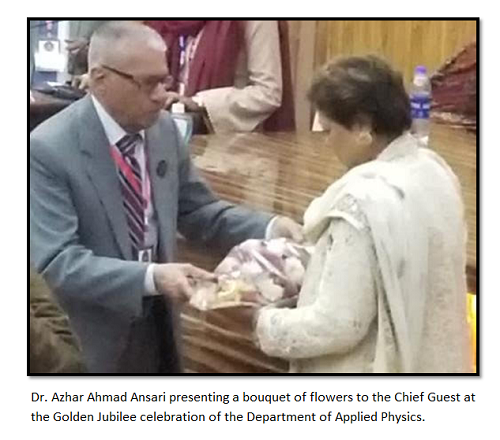
The following interview with Dr Ansari was conducted during the Golden Jubilee celebrations of the Department of Applied Physics in 2021.
Q: Where did you receive your secondary and higher education? What colleges and universities did you attend?
A: I did my matric in 1958 from Karachi Board of Secondary Education. I completed my Inter Science from D.J. Science College, and then did my BSc (Honors) from University of Karachi, with Chemistry, Physics and Math as main subjects. Then I completed my MSc (Nuclear Physics) from University of Karachi.
Q: Where did you receive your higher education? What was the area of specialization?
A: In 1966 I went to the UK and joined the University of Manchester Institute of Science and Technology (UMIST) and did my master’s in electrical engineering with specialization in Electronics. After that I received a scholarship from the University of London for a doctoral program, so I went there and completed my PhD. After completing my PhD in semiconductors for a year and a half I worked at Plessey Company Limited as a research engineer, and then I came back to Pakistan.
Q: When did you join the Applied Physics Department?
A: After my return from England, I joined the Department of Physics, University of Karachi. After a brief tenure of 3-4 months at the Physics Department, a new department of Applied Physics was created for Aslam Khan Sahib, so I came to the Applied Physics Department with four other colleagues. After six months of the inception of the Applied Physics Department, Aslam Khan Sahib was made the chairman of the Defense Science and Technology Organization, so he left, and I became the Chairman of the department.
Q: What were the challenges and obstacles you faced when you became the Chairman?
A: Well, there were no major challenges, but the problem was that there were no buildings and no syllabus. So, I designed the syllabus with the help of others, but I was the main contributor. Actually, I enjoyed developing the syllabi very much. It was fun. When I was at the Physics Department at the University of Karachi, where I completed my BSc and M.c degrees, I noticed that their courses were very lengthy, and when I went to UMIST I discovered their courses to be short. So, for the Applied Physics syllabi, I designed short courses. One of the advantages of designing short courses is that you can go deep in a topic rather than spreading out. Another thing was that since it was not pure science rather than applied science, we could define our goals, so we opted for semiconductors, my background was in semiconductors, and it was the state-of-the-art technology of the time.
Q: What was your favorite course?
A: Of course, my background in semiconductors was semiconductors electronics; when I completed my studies, semiconductors was the cutting-edge technology of the time.
Q: When you became the second chairman of the department, could you please tell us where the classes were held?
A: Well at that time there was no building, we were housed on the second floor of the Physics Department building, which used to be the Geography Department, when they moved to their new building, the second floor became vacant, so we took their space. There was no lab, no equipment; even no typewriter. I used my personal typewriter to draft official communications; we just had our dedication and high spirits to succeed.
Q: So how did you move to the current building?
A: This building used to be the University's central workshop, and I was made in charge of this, so I requested the VC Sahib that permission be granted to us so that we could move the Applied Physics Department to this building. VC Sahib was very kind and he granted us permission to move to this building.
Q: What were the challenges you faced after moving to this building?
A: Actually, I won’t call them challenges, rather we had fun dealing with the issues we faced. Shahid, Qadeer and I wanted to do something; we improvised to seek solutions to the problems; for example back then extension cords were very expensive, so we created our own extension cords; we enjoyed working until late hours; there was no equipment so we went to the cooperative market in Saddar and bought signal generators and oscilloscopes for Rs 1,800; student used to create circuits on cardboard; things did not got developed very quickly, rather slowly; we used to have two lecture rooms; one lab that was shared by the students of MSc (previous) and MSc (final); later additional funding became available through the University and things got better; it was fun, we enjoyed what we did!
Q: What would be your recommendations for improving things in the Applied Physics Department?
A: Well, it is easier to act as “Talqeen Shah,” by telling people do this, do not do that: in reality there is an evolutionary process, and you cannot bypass it; you cannot revolutionize it with a Nobel Prize. Considering the circumstances, they are doing fine, like they are changing the curricula based on the demands of the marketplace. Our students get jobs when they graduate, it is a great testimonial to the success of the department’s curricula.
Q: What kind of books do you read? Who are your favorite writers?
A: I started reading Ibn-e-Safi, then I read comics, and when I came to the University, I started reading second world war battles stories. Then becoming more mature I started reading technology-based books. I have interest in aviation, aeronautics & aerospace; I still read but naming authors would be difficult as searches change quickly, and moreover I just do it for my own learning and pleasure, and I do not have to teach. So, I cannot tell you the name of a specific author; in the old days I liked Ibn-e-Safi, he was the one author who instilled reading habits in a large segment of people belonging to our generation; his Imran series of JasoosiDunya novels were very popular.
Q: Compared to old times, the role of the library has changed, people do not go to libraries to get books. What is your take on this trend?
A: Well, in the old days people used to go to the library to search for books and read very selected chapters of books. Now with the Internet technology one can search for any topic on any subject and even download the required information in no time, and I think it is a very good development. People can read on their tablets. I believe that all libraries must be virtual, it's good to have a repository of books representing knowledge. In Pakistan, there should be a central virtual library, where all students can access all kinds of books; developing such a library will not require a lot of financial resources, rather it would eliminate the requirements for students to buy expensive books, and such a virtual library would provide universal access to all students all over Pakistan.
Q: What are your hobbies? How do you spend your spare time?
A: Well, the best hobby is just to sit, relax and kill time. During my childhood, I used to construct airplane models, I used to take a radio apart and put it together, then I constructed crystal radio, transistor radio, I built an amplifier, and then then I developed the habit of reading books. I read history, war history, and ancient history by that I mean history that is not recorded. Nowadays I just read Urdu poetry.
Q: Who is your favorite poet?
A: All poets are good, but I like Ahmed Faraz.
Q: What message would you give to the present and future generation to achieve success?
A: I won’t because like our generation the current generation is smart too. They can figure out what to do to succeed. When I was your age, we too used to think of ourselves as super smart, and we never paid heed to any advice, but then there were few very obedient ones too. I think that advising someone based on my experience to follow a certain recommendation may not be a viable advice. Because everyone has to deal with his/her own set of constraints and circumstances. Compared to our generation the current generation is very successful indeed, I think our experience as well as their rebellion may have contributed toward it.