
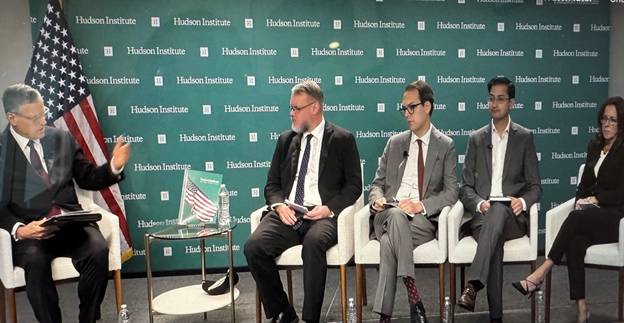
(Left to right): Patrick Cronin, Cameron Johnson, Gerard Di Pippo, Rush Doshi, and Nadia Schadlow
Hudson Institute Spotlights US-China Rivalry
By Elaine Pasquini
Washington, DC: The Hudson Institute hosted a panel discussion on September 24, 2025, titled “Chokeholds and Choices: Securing Supply Chains in the US-China Rivalry.”
Opening the dialogue, Patrick Cronin, Asia-Pacific Security Chair at the Hudson Institute, noted the importance of the planned meeting between Chinese President Xi Jinping and President Donald J Trump on the sidelines of the upcoming Asia-Pacific Economic Cooperation (APEC) summit scheduled in South Korea from October 30 – November 1.
The two leaders spoke in a telephone call on September 19 and appear focused on consolidating trade progress – both limiting tariffs and easing the flow of Chinese rare earths critical to aircraft and electronics. “The APEC summit could open the door to expanded trade and even a measure of great power stability,” he said.
But beyond ongoing trade talks and diplomatic tactics, there’s a larger question about our government’s and China’s government’s action plan for achieving the specific aims of securing supply chains, Cronin pointed out. “How do tactics like withholding rare earth magnets or restricting advanced semiconductors fit into each nation’s plan on supply chain security? And is China succeeding?”
A decade ago, China shifted its approach from pure growth targets to a laser focus on supply chains, he noted. “And they seem to have a coherent strategy.”
Cameron Johnson, a senior partner at Tidal Wave Solutions, who is a long-time China-based executive working across multiple industries, stated that with respect to supply chains China’s first focus is on advanced infrastructure, not just ports and railroads, but things like 5G, the electrical grid and sewer systems.
Of second importance to the country is talent and the educational apparatus for that talent. “It’s not just that you have to have people, but you have to find a way for them to be educated and trained, not just in university or trade schools, but also throughout their career,” he said.
In addition, China offers government support, which in some cases is subsidies and others is tariffs. “It’s also land use regulations,” he added.
Importantly, with respect to the issue of critical minerals, China does not have a lot of rare earths or raw materials, he said, but they have “absolute dominance in the processing.”
Gerard DiPippo, associate director at RAND China Research Center, who formerly served as deputy national intelligence officer for economic issues at the National Intelligence Council, argued that the core of China’s recent economic strategy is self-reliance. “I think…that sometimes people assume that China’s actions are much more externally oriented and focused than they actually are,” he said. “I would always start with the internal and then look at the external. The Chinese leadership believes that techno-industrial or high productivity, new quality productive forces…is the key towards sustainable growth and becoming a developed and advanced economy.”
But in the past five or six years, the focus on self-reliance has been in overdrive, and that’s because they are responding to external actions, namely the actions of the United States, particularly what happened in the first Trump administration with the trade war, he argued.
The areas of self-reliance important to China, DiPippo said, are technology and industry, food, and financial, which is namely building up resiliency to US sanctions.
Rush Doshi, a senior fellow for Asia studies and director of the China Strategy Initiative at the Council on Foreign Relations, discussed how the US is dealing with China’s strategies and increasing advantages, which he termed “quite significant and underestimated.”
For example, China s car production is three times that of the United States. It’s 11 times US steel production and 20 times US cement production, Doshi said, keeping in mind, however, China’s population of 1.5 billion while the United States is a nation of 340 million people.
“If you look at key industries…it’s a pretty significant global market position in a lot of these sectors,” he continued. “And it’s actually ramping up production further. China is not done establishing a commanding position in sector after sector. Right now, if we talked about rare earth and rare earth magnets, that brings American industry to a halt in a very acute way. But there are other choke points, including pharmaceuticals.”
The path forward for the US, Doshi proposed, is American domestic investment and renewal, and also a quick surge in scale for the United States and its allies. “China is so powerful because it out-scales the United States,” he said. “But together with its allies the US could achieve scale [with China]. So, the only path to industrialization, re-industrialization…and to avoiding these dependencies, is going to be in common with others.”
Nadia Schadlow, who served as Deputy National Security Advisor for Strategy during the first Trump administration and is presently a senior fellow at Hudson, also addressed the issue of the US depending upon China, “one of our most serious rivals” and “a strategic competitor for most of our defense inputs,” including “the problem of critical minerals, which has been identified as a vulnerability for close to 30 years.”
“The problem is if you go back further, we’ve identified this problem for many, many years.”
But for the US to deal with competition with China, Schadlow concluded, “you have to approach things in a positive way because you don’t really end up with good outcomes if you approach everything negatively.”
(Elaine Pasquini is a freelance journalist. Her reports appear in the Washington Report on Middle East Affairs and Nuze.Ink.)
