Embassy of Pakistan Reaffirms Commitment to Self-Determination of Kashmiri People on Kashmir Black Day
By Elaine Pasquini

Washington, DC: The Embassy of Pakistan observed Kashmir Black Day on October 27, 2025, by reaffirming Pakistan’s steadfast moral, political, and diplomatic support to the people of the Indian Illegally Occupied Jammu and Kashmir (IIOJK) in their just struggle for the right to self-determination.
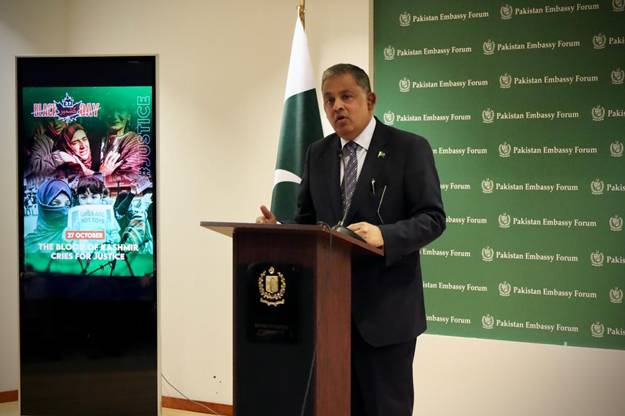
In his remarks to the audience, Rizwan Saeed Sheikh, Ambassador of Pakistan to the United States, called for a renewed global focus on IOJK.
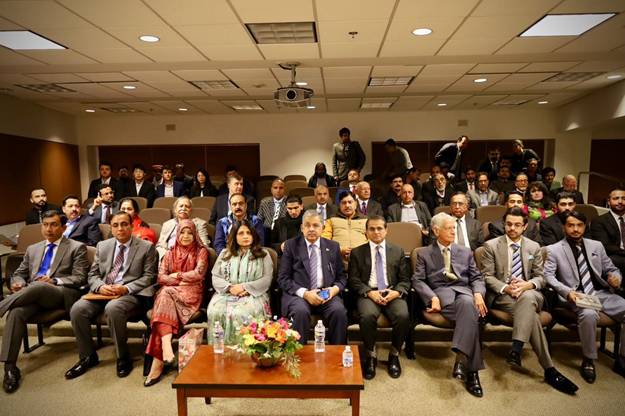
The event drew a diverse gathering from across the Pakistani-American community. Members of academia, think tanks, the media and civil society all came together to express solidarity with the Kashmiri people and highlight the ongoing humanitarian and political crisis in IIOJK.
Messages from Pakistan President Asif Ali Zardari, Prime Minister Shebaz Sharif, and the Deputy Prime Minister and Foreign Minister Ishaq Dar were read, reiterating their unwavering commitment to advocacy for the Kashmiri people at all international forums until the realization of their UN-mandated plebiscite.
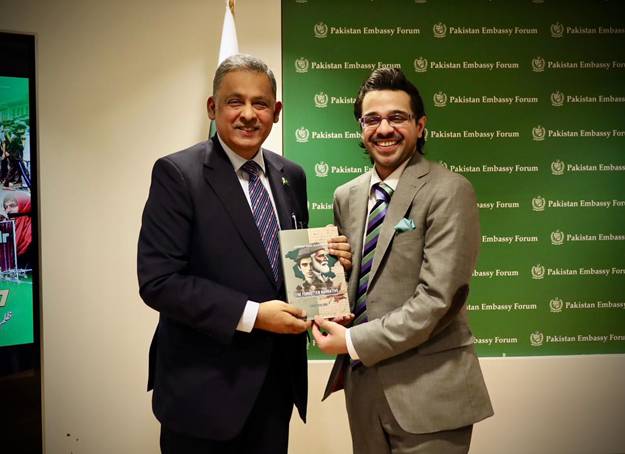
A special feature of the event was the launch of the book Jammu and Kashmir – The Forgotten Narrative: From Distorted Origins to Denied Freedom by Saud Sultan. The author presented his reflections on the origins of the Kashmir dispute and how his work sought to challenge and deconstruct decades of Indian state-led propaganda on the issue. The Forgotten Narrative presents a well-researched and referenced analysis of how the Indian narrative on Kashmir was devised and disseminated through selective omission, manipulation, and concealment as well as distortion of historical facts.
Ambassador Sheikh expressed his appreciation to the speakers and participants for their insightful contributions and reiterated the critical importance of preserving the truth and legality surrounding the Kashmir dispute.
“The fact that Kashmir has the capacity to trigger a war between two nuclear neighbors should not be lost in any analysis,” he said. “What is lawless can never be portrayed flawless through political or economic might.”
He also emphasized that the global perspective on Kashmir had shifted in recent years in light of important regional and global developments, underscoring Pakistan’s long-held position on the disputed nature of IIOJK as recognized under United Nations Security Council (UNSC) resolutions.
Drawing parallels between the issues of Kashmir and Palestine, the ambassador described both as struggles rooted in the inalienable right to self-determination and the fulfillment of the promises enshrined in UN resolutions.
“UN resolutions on Kashmir share a common genesis with those on Palestine,” the ambassador stated. “Both are grounded in the right of people under occupation to decide their own future.”
Commending the role of US President Donald J Trump and his administration in facilitating the ceasefire between India and Pakistan in May of this year, Ambassador Sheikh emphasized the significance of dialogue between the two countries and the mediation proposition that formed part of the ceasefire facilitated by the American administration.
“The solution lies in discussing the dispute, seeking its peaceful resolution in accordance with UNSC resolutions, international commitments, and the aspirations of the Kashmiri people,” he added.
Distinguished speakers at the event paid tribute to the courage and resilience of the people of IIOJK in their struggle against repression and occupation. They praised Pakistan’s proactive diplomacy in bringing renewed international attention to the Kashmir issue, describing the past year as a period of significant diplomatic accomplishment for Pakistan.
Ambassador Tauqir Hussain lauded The Forgotten Narrative as a meticulously researched counter to decades of distorted global perceptions, proving India's 1947 occupation is a premeditated conspiracy. He argued that evolving geopolitics presented opportunities for Kashmir, citing Pakistan's effective response to India's May 2025 Pahalgam aggression that exposed both New Delhi's recklessness and weakness. Ambassador Hussain urged the redoubling of Pakistani and Kashmiri efforts, affirming that true sovereignty stemmed from people's will, not coerced accession documents.
Dr Ghulam Nabi Fai, Secretary General of the World Kashmir Awareness Forum, expressed hope for Kashmiris amid their ongoing struggle, citing President Trump's mediation offer after facilitating a May 2025 ceasefire. In addition, Fai demanded the unconditional release of jailed leaders Yasin Malik, Shabbir Shah, and Masarrat Alam – likening them to "three Nelson Mandelas" who represented Kashmiri aspirations.
Anwar Iqbal, Dawn's Washington correspondent, referred to Saud Sultan's book as a "time machine" revealing Kashmir's raw history. Lambasting India's 2019 "merger" as a "bureaucratic tap dance on millions of heads," and mocking blackouts justified to "reduce confusion," he contrasted Pakistan's advocacy for Kashmiri rights with India's suppression.
Renowned literary figure Dr Arif Mehmood reflected upon the resistance movements in literature and how these expressions had kept the flames of freedom struggles alive.
The ever-popular Noreen Talat Arooba recited one of her poems on Kashmir to the enjoyment of the large audience.
In conclusion, Ambassador Sheikh extended his congratulations to Saud Sultan for his scholarly and objective contribution to the discourse on Kashmir and expressed gratitude to all participants for joining in solidarity with the people of IIOJK.
(Elaine Pasquini is a freelance journalist. Her reports appear in the Washington Report on Middle East Affairs and Nuze.Ink.)