“Le Cas Du Siécle” : Priceless Jewels Stolen from the Louvre
Report and Photos by Phil Pasquini

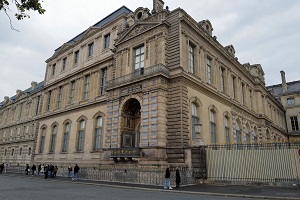
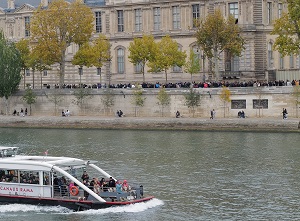
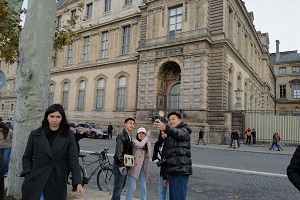
Paris: On the cool and overcast Sunday morning of October 19, a small group of professional robbers utilizing a truck-mounted lift platform parked on the sidewalk below the second-floor balcony of the Galerie d'Apollon (Apollo Gallery) at the Louve museum and entered the building through a window they removed in a wooden door by using a grinder with an abrasive disk. Ironically, this was the same window that in 1976 three thieves removed when they stole a nineteenth-century jewel-encrusted sword that belonged to French King Charles X.
Once inside, the thieves methodically set about smashing glass cases housing the French crown jewels of the Napoleonic jewelry collection estimated to be valued at $102 million. Their entire smash-and-grab fiasco lasted seven minutes before they deftly escaped with two accomplices waiting below on fast Yamaha TMax scooters. During their escape, the museum reported that the thieves dropped and damaged “a crown made from gold, emeralds and diamonds worn by Empress Eugénie.”
Among the treasures taken, as reported, were “a sapphire tiara, a sapphire necklace and a single sapphire earring worn by Queen Marie-Amélie and Queen Hortense, a matching emerald necklace and emerald earrings worn by Marie-Louise (Napoleon Bonaparte’s second wife), a tiara and large brooch that belonged to Empress Eugénie and a brooch known as the ‘reliquary brooch.’”
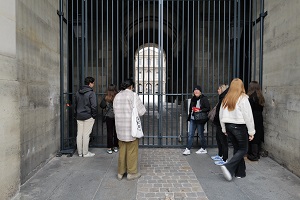
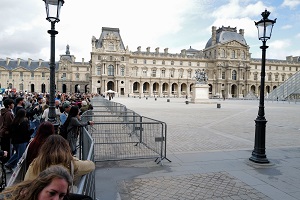
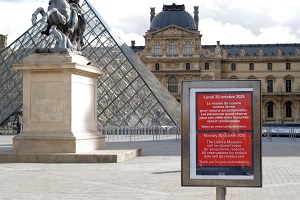
In the aftermath of what is being called “Le Cas Du Siécle,” visitors in the museum were swiftly ushered out, and the museum closed as police began their investigation. Soon afterward, a nationwide manhunt began in hopes of catching the thieves before they had time to dismantle and melt their precious booty.
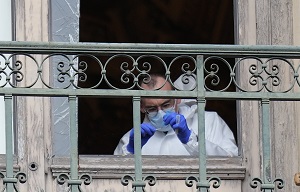
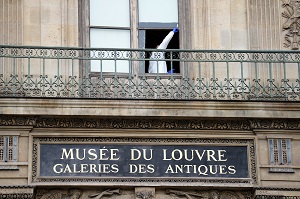
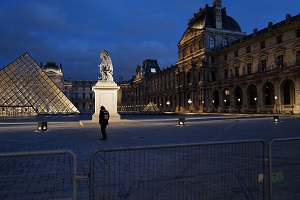
A few hours after the robbery, a crowd of media (including this reporter) and spectators had assembled across the street from the Galerie d'Apollon to watch the crime scene investigators (CSI) examine the window and balcony for evidence. The technicians carefully processed the scene using swabs to gather evidence before placing them in test tubes for laboratory analysis.
The window where the thieves made entry into the gallery showed very precise cuts at the top and bottom of the wooden frame and along the edge of the remaining window glass which, while shattered, remained in situ.
The most famous robbery at the Louvre occurred in 1911 when La Joconde, (Mona Lisa) was cut from its frame by Vincenzo Peruggia, an Italian craftsman who had worked for a short time there reframing and glazing paintings. Historically, the Louvre has had many of its treasures stolen over the years and at one time in the early 20th century the refrain “I’m off to the Louvre; may I pick anything up for you?” was frequently used as visitors liberated small “pocket collections” that were poorly guarded in the galleries.
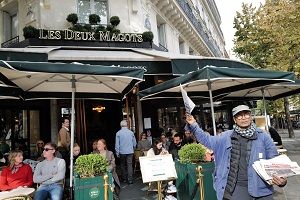
The following day, Paris’ last roving newspaper hawker, Ali Akbar - never failing for a hook in broadcasting the news - was out in the cafés of Saint-Germain-des-Prés selling copies of Le Monde announcing the robbery by referring to it as “Hotel Bijoux” to the delight of the reading public. Akbar, born in Rawalpindi, Pakistan in 1953, has lived in Paris for 50 years.
As of this writing, the museum has reopened after a three-day forensic investigation to the delight of residents and locals alike, while the intense hunt for the thieves and the precious crown jewels remains urgent and ongoing.
(Phil Pasquini is a freelance journalist and photographer. His reports and photographs appear in the Washington Report on Middle East Affairs, Countercurrents, and Nuze.ink. He is the author of Domes, Arches and Minarets: A History of Islamic-Inspired Buildings in America.)