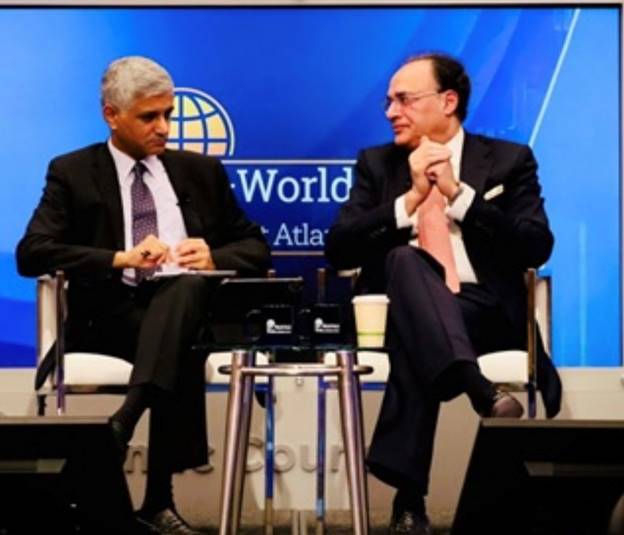
Finance Minister Aurangzeb Addresses Pakistan’s Challenges and Successes at Atlantic Council
By Elaine Pasquini

Washington, DC: Wrapping up his successful visit to Washington for the annual meetings of the International Monetary Fund and World Bank, Pakistan's Federal Minister of Finance and Revenue Muhammad Aurangzeb held a briefing at the Atlantic Council on October16, 2025.
Opening the program, moderator Aasim Hussain, former deputy director of the Middle East and Central Asia department of the International Monetary Fund, congratulated the minister on the successful completion of the first year of Pakistan’s $7 billion assistance program, noting the IMF had high praise for the minister and his economic team for entrenching macroeconomic stability and rebuilding market confidence.
“We have consolidated our gains on the macroeconomic stability front, and all of the indices have been moving in the right direction,” Finance Minister Aurangzeb said. In addition, with the three major credit rating agencies upgrading Pakistan, “from our perspective, it's good external validation.”
Pakistan is still dealing with the devastating effects of climate change, especially major flooding. “The intensity and the frequency is on the rise,” he noted. “So, we have to bring in a real sense of urgency in terms of the action planning that we do. And we have the World Bank Country Partnership Framework funding available…and we can avail some of those without getting into very long-term projects.”
Pakistan ranks among the top 10 nations most vulnerable to climate change, while contributing less than one percent of global emissions. Last month, heavy rains caused deaths in Karachi as the Lyari and Malir rivers overflowed.
One of the key structural reforms presently underway is on taxation. Last year, Pakistan started the fiscal year in terms of the Federal Board of Revenue tax revenue at 8.8 percent and ended the last fiscal year at 10.2 percent. “We are quite committed to take it to 11 percent by the end of this fiscal year and then 13 percent during the course of the program,” Aurangzeb said. This will be accomplished, in addition, by broadening tax on certain sectors including agriculture, retail and wholesale, among others.
The minister went on to note that debt servicing is the single largest expense item for Pakistan’s government, and “we are trying to do what we can from the Finance and Debt Management Office in terms of doing liability management trades and buying back debt, especially on the domestic front.”
“I believe that a free market and a competitive exchange rate is always going to remain important…and there is a productivity element which is critical, too,” he pointed out. “But…I think we're moving in the right direction.”
(Elaine Pasquini is a freelance journalist. Her reports appear in the Washington Report on Middle East Affairs and Nuze.Ink.)