
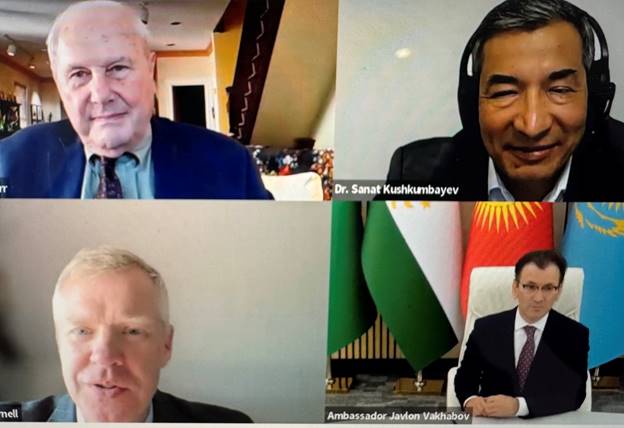
Top, left to right): Frederick Starr, Sanat Kushkumbayev. (Bottom, left to right): Svante Cornell, Amb Javlon Vakhabov
Central Asia-Caucasus Institute Explores the Future of Regional Cooperation in Central Asia
By Elaine Pasquini

Washington, DC: Over the past year, the Central Asian countries have experienced a profusion of significant changes, including creating closer ties among themselves.
Bordering China, Iran and Afghanistan makes the five Central Asian states – Kyrgyzstan, Uzbekistan, Turkmenistan, Tajikistan and especially Kazakhstan – with its 7,644-kilometer border with Russia – of extreme geopolitical importance, along with the region’s abundance of critical minerals.
To discuss these changes and strides made in regional cooperation, the Central Asia-Caucasus Institute (CACI) hosted a webinar on September 12, 2025, moderated by Dr Svante Cornell, director of the institute.
CACI founding chairman Dr Frederick Starr noted there is a lot of work to be done to improve regional integration, “but it’s finally beginning,” he enthused. “This is an extremely constructive moment.”
Sanat Kushkumbayev, a chief research fellow at the Kazakhstan Institute for Strategic Studies, spoke on the history of Central Asian cooperation over the decades, the subject of his recently published paper, Gone, But Not Forgotten: The Central Asian Union, 1990-2005.
This current wave of integration is notably different from past attempts and inspires cautious optimism, he said, “but serious challenges remain on the path toward a unified and prosperous region. To understand Central Asia’s future, it’s crucial to analyze the lessons of the past and the uniqueness of the current moment and realistically assess both external and internal factors.”
The new approach to integration is a “constructivist approach based on fundamental factors like common shared history, geography and common cultural, social and economic models,” he stressed.
In the past, these former Soviet republics made several attempts at regional integration, but the countries chose different paths of development. One example, he pointed out, is “Kazakhstan’s more liberal economic model which contrasted with the more closed and state-controlled economies of Uzbekistan and Turkmenistan.”
“Now, the situation – the atmosphere – has changed,” he observed. “All five countries, and even Azerbaijan, by acting together can more effectively defend their shared interests. The simple conclusion is that disunity and national egoism lead to weakness while unity and integration lead to stronger statehood. The current wave of cooperation is free from ideological euphoria. It is calculated pragmatism.”
Presently, the focus of the international meetings has shifted from geopolitical ambitions to concrete economic benefits, including a rise in intraregional trades, the launch of joint transport corridors and new industrial ventures such as trade zones between Kazakhstan and Uzbekistan, he said. “This is less a move toward a federated union and more about creating a coalition of interests where the benefit of each country guarantees the success of the whole. I think it is one of the lessons our leaders learned from the past, from the first experience. I think it is why we see more cautious steps in regional cooperation. But it is logical behavior, I think.”
Ambassador Javlon Vakhabov, Deputy Advisor to President Mirziyoyev for Foreign Policy, Managing Director of the Tashkent-based International Institute for Central Asia and former ambassador of Uzbekistan to the United States, welcomed the timeliness of the webinar. In November, he noted, the Seventh Consultative Meeting of the Heads of State of Central Asia will take place in Tashkent which “has the potential to be a real turning point for regional consolidation and integration.”
In his recently published paper, A New Central Asia Emerging: Opportunities and Challenges, the ambassador analyzed contemporary developments, recent achievements, ongoing challenges and opportunities for deep economic, political and cultural collaboration, offering a comprehensive understanding of the region’s path forward.
Today, most bilateral problems have been resolved including sensitive border issues that once stood in the way of trust and integration. The Khujand Declaration on Eternal Friendship signed in March this year by Uzbekistan, Kyrgyzstan and Tajikistan “finalized our border settlement and turned the former flashpoint into a platform for cooperation,” he said.
One crucial challenge shared across Central Asia is water scarcity, accelerated by the impacts of climate change which will threaten economic growth, food security and regional stability, Vakhabov said. And, while Kyrgyzstan and Tajikistan are water rich, outdated infrastructure and glacial melt in the Pamir and Tian Shan – the two main mountain ranges in Central Asia – are worsening the situation, he added.
But Central Asia has made important strides in water cooperation with Uzbekistan, Kyrgyzstan and Kazakhstan collaborating on the Kambarata hydropower plant which when completed will be one of the largest in Central Asia. “These steps reflect a new spirit of trust and partnership in managing our shared water resource,” he stated.
Emphasizing that the countries of Central Asia are entering a new phase of regionalism, Vakhabov related that the agenda is no longer “dominated by division but by common projects of enhancing connectivity, strengthening regional security, expanding trade, investments and developing joint responses to environmental and energy challenges.”
The region is moving from “the era of problem-solving to collective action in the region as a whole,” he continued. “This marks a real qualitative shift, one that opens the door to deeper and more institutionalized cooperation in Central Asia.”
Uzbekistan, he said, has set clear priorities of advancing regional economic integration, strengthening cooperation on water and energy, improving transport connectivity and deepening people-to-people ties. Even with progress made over the past years, “full consolidation of a resilient and integrated Central Asia remains a work in progress,” he added. “The region continues to face both inherited and emerging challenges that require collective responsibility and shared solutions.”
While cooperation based only on interests is often temporary, it becomes enduring when grounded in shared history, culture and values, Vakhabov stated. “I believe all five Central Asian states share a unique, interconnected civilization. Revitalizing this heritage is key in building a unifying regional identity.”
(Elaine Pasquini is a freelance journalist. Her reports appear in the Washington Report on Middle East Affairs and Nuze.Ink.)
