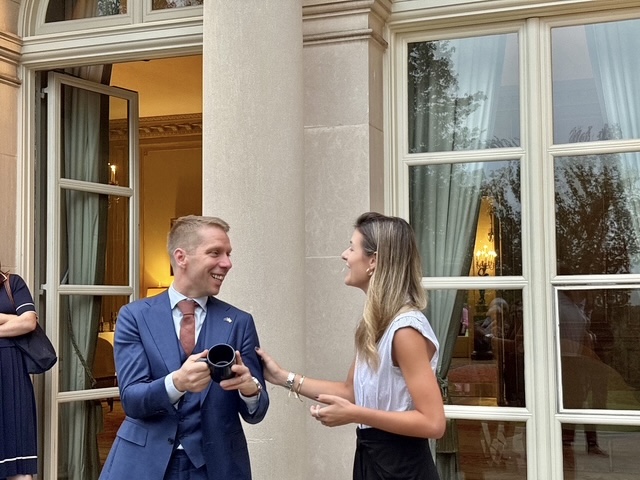
Ambassador Frédéric Bernard and Ms Nicola Wenz
The Ambassador’s decision to speak outside—despite a prepared podium indoors—was a gesture that epitomized the nimbleness of modern diplomacy. Following his remarks, Ms. Nicola Wenz, Chair of the International Correspondents Team, presented him with an official National Press Club mug, symbolizing friendship and continued collaboration between the press and the diplomatic community
An Evening of Diplomacy and History: Belgian Ambassador Welcomes International Correspondents in Washington
By C. Naseer Ahmad

Under a crisp autumn sky, Belgium’s Ambassador to the United States, His Excellency Frédéric Bernard, opened the doors of his official residence on September 29, 2025, to host the International Correspondents Team of the National Press Club. The evening unfolded as a blend of elegance, friendship, and reflection—rooted not only in contemporary diplomacy but also in a rich historical tapestry that connects continents and centuries.
A Warm Welcome on an Autumn Evening
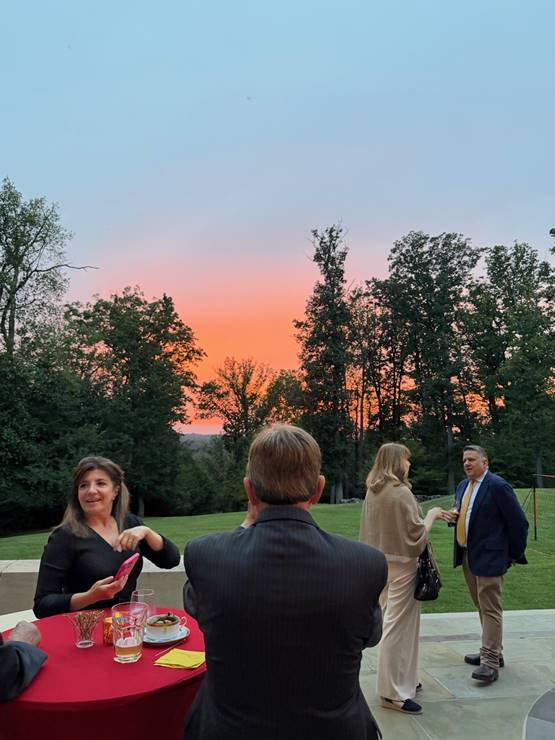
The evening’s atmosphere was both gracious and intimate. Ambassador Bernard, known among colleagues for his warmth and spontaneity, chose to address his guests outdoors, overlooking the residence’s terrace where correspondents gathered to enjoy the breathtaking vista of autumn foliage. The setting sun painted the sky in shades of crimson and gold, casting a serene glow over the gathering—a poetic backdrop to a conversation about journalism, diplomacy, and the shared values of openness and dialogue.
The Ambassador’s decision to speak outside—despite a prepared podium indoors—was a gesture that epitomized the nimbleness of modern diplomacy. Following his remarks, Ms. Nicola Wenz, Chair of the International Correspondents Team, presented him with an official National Press Club mug, symbolizing friendship and continued collaboration between the press and the diplomatic community.
The Residence: A Jewel of Architectural Heritage
History seemed to whisper from every corner of the Belgian residence. The mansion itself—an embodiment of architectural grandeur—has stood as a symbol of European refinement in Washington since 1931. Originally commissioned by Anna Dodge Dillman, heiress to the Dodge automobile fortune, as a wedding gift for her daughter Delphine and son-in-law Raymond T. Baker, the house was designed by the renowned Horace Trumbauer firm. Recent research attributes the design to Trumbauer’s chief designer, Julian Abele, one of the first prominent African American architects in the United States.
In 1945, the Kingdom of Belgium purchased the property, transforming it into the ambassador’s official residence—a fitting acquisition for a nation whose capital, Brussels, would later become synonymous with diplomacy as the home of the European Union and NATO. The irony of reaching this stately Belgian residence only by automobile is not lost—linking its Dodge lineage to Belgium’s forward-looking role in international transport and logistics.
Belgium’s Journey Through History
Belgium’s history is a story of resilience. From the legendary Battle of Waterloo to the fierce struggles in the Ardennes Forest during the Battle of the Bulge - WWII, its soil has witnessed Europe’s triumphs and tragedies. In the aftermath of wars that left much of the continent scarred, Belgium rose—like a phoenix—from the ashes. Today, it stands as a leader in biotechnology, logistics, and diplomacy, playing a pivotal role within the European Union and the North Atlantic Treaty Organization.
Ambassador Bernard’s background reflects that same resilience and adaptability. His diplomatic career, marked by intellect and empathy, captivated correspondents who saw in him both the historian and the strategist — a representative of a country that has learned to transform adversity into advantage.
Bridges Across Continents: Belgium and Pakistan
For readers in South Asia, Belgium’s story resonates beyond Europe. Pakistan and Belgium have shared formal diplomatic relations for decades—Belgium maintaining an embassy in Islamabad, and Pakistan an embassy in Brussels. As Belgium hosts key EU institutions, it serves as a crucial gateway for Pakistan’s engagement with the European Union on trade and policy issues.
In recent years, both nations have pursued efforts to revitalize trade and development cooperation. Though bilateral trade volumes have faced contractions—Belgian exports to Pakistan declined from about €32.3 million to €16.5 million between May 2024 and May 2025—leaders from both sides remain committed to strengthening commercial ties.
Pakistan’s exports to Belgium — dominated by textiles, apparel, and rice — benefit from the EU’s GSP+ trade preference regime, granting duty-free access to key goods. Conversely, Belgium exports chemicals, machinery, and industrial goods, leveraging its advanced manufacturing base and strategic European position.
Shared Challenges, Emerging Opportunities
Trade between the two nations faces familiar hurdles: logistics bottlenecks, regulatory compliance, and global market volatility. Yet, opportunities abound. Belgium’s technological expertise and Pakistan’s growing industrial and green technology sectors could yield mutually beneficial ventures in pharmaceuticals, machinery, and sustainable manufacturing.
Joint ventures such as Pak Belgium Agri Pvt Ltd, Kings Apparel Industries, and Ecommerce Gateway Pakistan exemplify this emerging synergy. Organizations like the Pakistan–Belgium–Luxembourg Business Forum (PBLBF)continue to nurture business linkages that may pave the way for renewed growth.
An Evening that Reflected a Larger Story
That autumn evening at the Belgian residence was more than a diplomatic reception—it was a quiet reflection on the enduring power of history, dialogue, and international cooperation. As the last rays of the sun faded over Washington, the guests of Ambassador Bernard stood witness not just to a splendid view, but to the living continuity of history — where architecture, diplomacy, and shared aspirations intersected beneath the crimson sky.