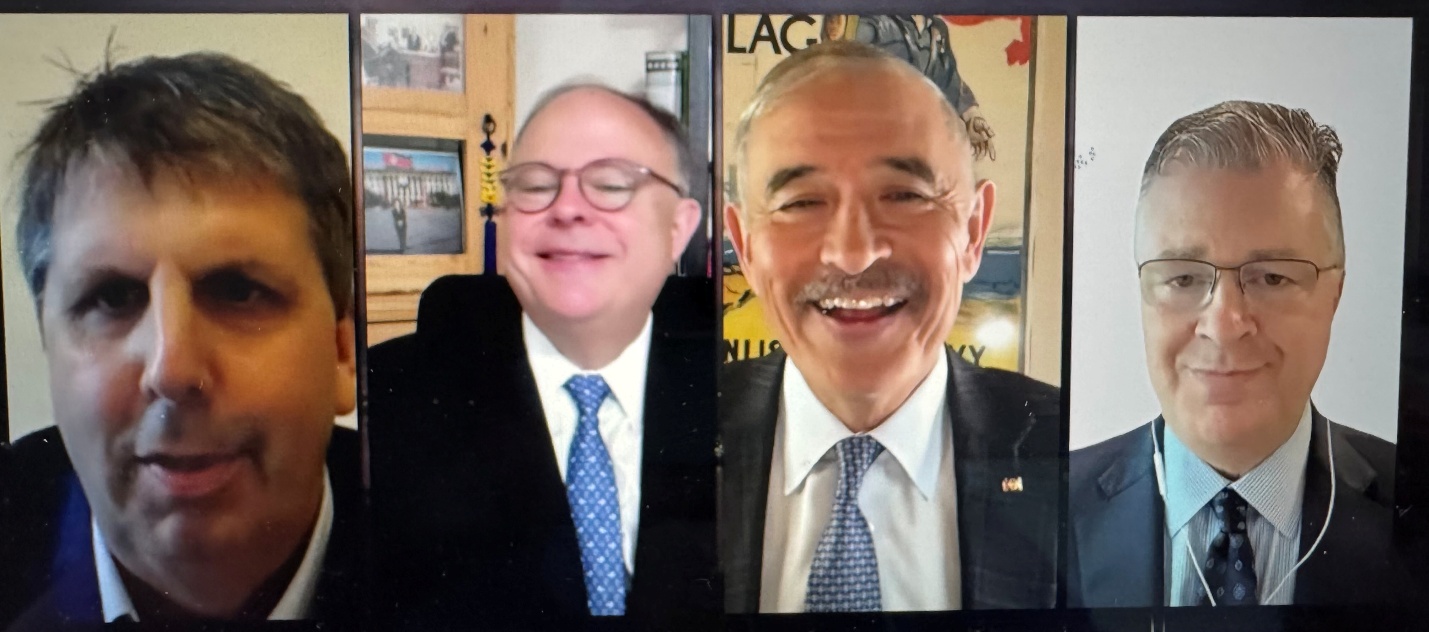
(Left to right): Mark Lippert, Sid Syler, Amb Harry Harris, and Amb Daniel Kritenbrink
CSIS Spotlights Shanghai Cooperation Organization Summit
By Elaine Pasquini

Washington, DC: US President Donald J Trump and President Xi Jinping of China held a highly anticipated phone call on September 18, 2025. Among other issues, the two leaders discussed trade, the future of TikTok and plans to meet in October at the Asia-Pacific Economic Cooperation (APEC) summit in South Korea.
One week earlier, the Center for Strategic and International Studies (CSIS) held a timely program on the recent Shanghai Cooperation Organization Summit (SCO) in Tianjin, China.
Ambassador Daniel Kritenbrink, former ambassador to Vietnam and former assistant secretary of state for East Asia and Pacific Affairs – currently a partner at The Asia Group – began with an overview of the SCO gathering that took place August 31 through September 1.
Of special note was the attendance of Prime Minister Narendra Modi of India with the optics of the Indian leader embracing Chinese President Xi Jinping and Russian President Vladimir Putin receiving the most attention.
Following the summit, China held a military parade to commemorate the 80th anniversary of the end of World War II, which, interestingly, Prime Minister Modi did not attend.
With respect to the SCO and the military parade, “China was trying to buttress its legitimacy both domestically and internationally,” Kritenbrink opined. “I think it was trying to posture itself in part as an alternative to the Western-led order. I think they are trying to position themselves as reasonable actors. Some of the uncertainty and the way they depict the chaos that is purportedly coming out of Washington they think redounds to their benefit. I think they probably thought this summit was successful from that perspective…and that President Xi has to be pleased with how it went…especially with President Putin and Chairman Kim Jong Un there.”
Sid Syler, a former intelligence officer, now at CSIS, gave his perspective on Chairman Kim Jong Un’s appearance at the summit and parade.
In his opinion, China and Russia want to move at a calibrated measure so that they are not openly challenging the global order in re-establishing a relationship.
Kim, who met with Xi five times during the period of active diplomacy in 2018, is showing the world that by “standing up there, getting that place of prominence at the parade, walking into the venue, that he is a world leader of a nuclear power,” he said. “Standing side-by-side with Vladimir Putin and Xi Jinping, no words had to come. China’s behavior and inviting Kim and allowing him this place of prominence essentially did the same. It gave him the image that he projected out that he’s a nuclear power, has friends and he doesn’t need anyone else. Kim has a seat of prominence in the China, Russia, Iran, North Korea grouping and he’s endorsing it because this is the most favorable diplomatic environment for him to pursue his longer-term diplomatic goal of not denuclearizing and gaining some degree of normalization.”
It was a strong image of the three leaders together showing that there is nothing that Moscow and Pyongyang have to hide from Beijing,” Syler observed. “I think this was a symbol from Xi that he wants to woo Kim into some more dialogue, and Kim might want to explore what more he can get from China.”
Admiral (Ret) Harry B Harris, former US ambassador to Korea, believed the military parade was significant because of the visuals of the leaders of China, Russia and North Korea on the world stage and because of China’s display of advanced weaponry.
He also agreed the SCO summit was significant because of Indian Prime Minister Modi’s presence. “I think he conveyed the message he wanted to convey, and he deliberately did not attend the parade which would have created an entirely different visual dynamic,” he said.
Asked by CSIS moderator Mark Lippert if China “had made any progress” with Southeast Asia as a result of the SCO summit and the parade, Harris responded: “It’s too early to tell…time will tell.”
Harris pointed out that one particular problem for the US is not having confirmed ambassadors in place in many countries, including ones that are our allies. “It sends the wrong message, and it creates an opportunity for China to step in…and that’s on the United States to fix,” he stated.
According to the admiral “there is a false narrative out there that ‘America First means America Alone.’ But this false narrative has the possibility of becoming a self-fulling prophecy if we don’t put ambassadors in place and if we don’t engage with other nations at the leader level. I am not pessimistic about all of this – I’m actually optimistic – but there are these pitfalls out there in the world of diplomacy. Diplomacy and diplomats matter.”
(Elaine Pasquini is a freelance journalist. Her reports appear in the Washington Report on Middle East Affairs and Nuze.Ink.)