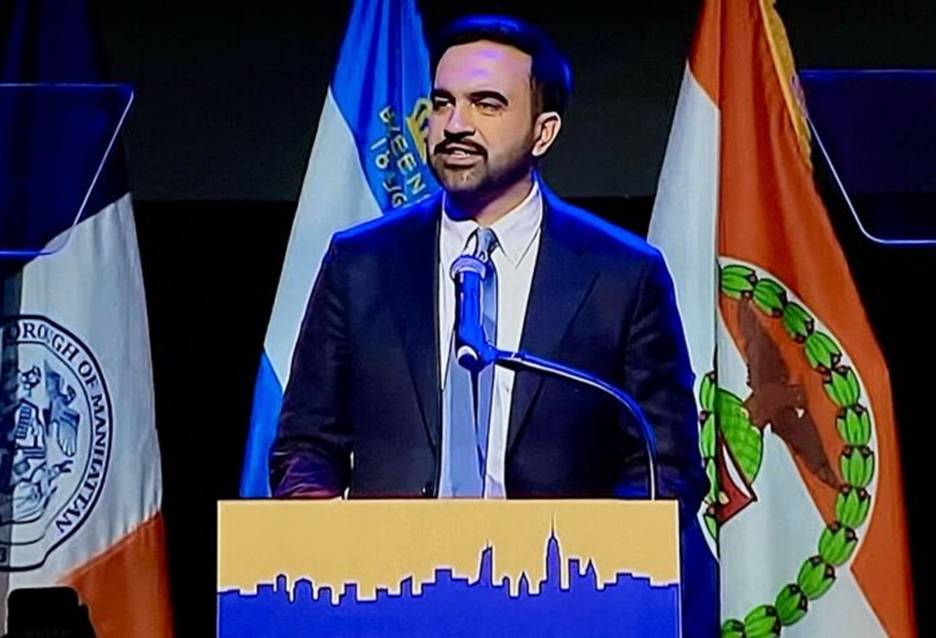
“While Mamdani’s emergence is unprecedented in many ways, I see it as a great development for American democracy consistent with Jefferson’s foundational work on religious pluralism,” Prof Akbar Ahmed said. He particularly noted how Jefferson’s statue at the entrance of University of Virginia shows an angel with a tablet that has names of the creator, God, Yahweh, Allah, and Brahma inscribed on it, symbolizing his vision for America as a pluralist society with respect for all religions
Mamdani’s Emergence Marks Historic Moment for American Democracy – Scholars
By Ali Imran
Washington, DC
The event was the launch of Professor Akbar Ahmed’s newest book ‘America at the Crossroads: Race, Islam and Leadership,’ – a scholarly exploration of what defines a tapestry of identities, and how these identities have evolved since Thomas Jefferson’s foundational ideals of democracy.
However, it was the resounding current context – the meteoric rise of Zohran Mamdani during the NYC mayoral election – that drove into the heart of the discourse among panelists including American, Middle Eastern and South Asian scholars, current affairs and media experts as they weighed on the development.
In the book, Prof Ahmed argues in light of his anthropological study of communities across the United States that the ideals espoused by Jefferson and George Washington, and Declaration of Independence remain at the core of the American identity 250 years after the Republic’s inception.
He also broke down major identities – defined by developments and worldview of people in the country’s different sociopolitical phases – as primordial, pluralist and predator.
The discussion highlighted that Mamdani’s rise represented a hope in Americans’ search for inclusiveness and pluralism at a time of polarizing politics, as the 34-year-old immigrant Muslim overcame racist attacks from his rival former governor Andrew Cuomo, opposition from Elon Musk, the richest man in the world, and President Donald Trump, the most powerful leader in the world and billionaires who financed a campaign against his socialist views.
Mamdani, who is a self-described Democrat Socialist, courted controversy during his grassroots political campaign, when he pledged to take steps like taxing the wealthy, freezing rents and running free buses as part of program to address the cost-of-living issues. He also expressed views on Israeli-Hamas conflict, which sounded different even to establishment Democrats.
The event took place on the eve of the election Ih saw Mamdani become the first Muslim and South Asian mayor of New York City.
“While Mamdani’s emergence is unprecedented in many ways, I see it as a great development for American democracy consistent with Jefferson’s foundational work on religious pluralism,” Prof Ahmed said.
He particularly noted how Jefferson’s statue at the entrance of University of Virginia shows an angel with a tablet that has names of the creator, God, Yahweh, Allah, and Brahma inscribed on it, symbolizing his vision for America as a pluralist society with respect for all religions.
Dr William Lawrence, a professor of International Relations, said Mamdani’s successful rise in New York is “absolutely” a positive development for the American society, and in accordance with the ideals of pluralism.
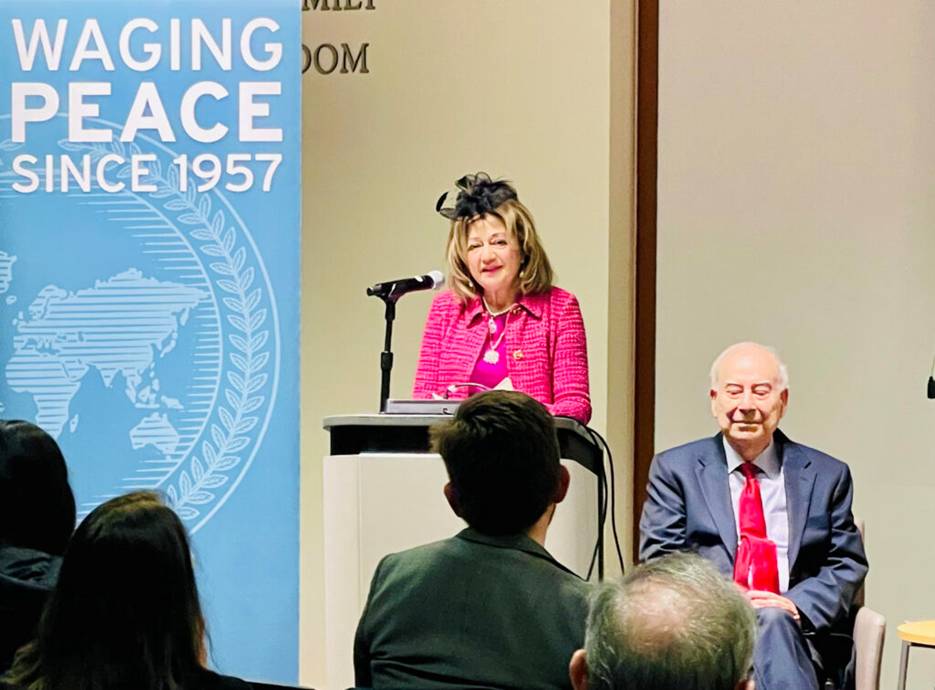
Pakistani American entrepreneur Tehmina Khan, Prof Akbar Ahmed (seated), and a section of the audience
“Like the emergence of other Muslims leaders … in both parties… it is very important. Islam is the second fastest growing religion in the United State. It’s very important for Americans to learn about Islam, to accept Muslims, who participate in the politically system fully.”
Dr Mehdi Heravi, a scholar on Iran, and a member of American University’s Board of Trustees, appreciated the original perspective offered by Dr Ahmed in his book and underlined the importance of stability and humanity as simultaneous factors.
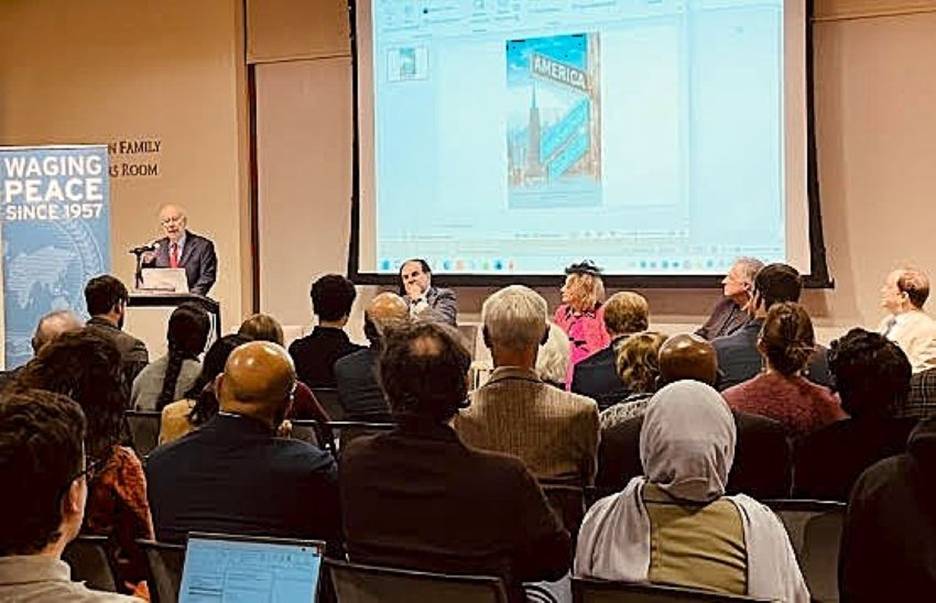
Dr Mehdi Heravi addresses the gathering
“If we understand each other, we will get along well,” he said.
Seasoned journalist John Milewski, who worked with C-SPAN and Woodrow Wilson Center, and American University scholar Frankie Martin highlighted some new dynamics in the political environment, particularly the role that social media platforms play in shaping people’s views, both positively and negatively.
Milewski noted that in midst of competition between narratives social media platforms algorithms can easily stoke fear and lead to fear-driven views.
Martin said his anthropologic work with Dr Akbar Ahmed revealed that there is still a great deal of work that needs to be done to raise a basic understanding of Islam in America.
Pakistani American entrepreneur and poet Tehmina Khan said Mamdani’s successful campaign against all odds is a tremendous development for the community and American democracy.
She deplored the polarizing tactics that some politicians employed to invoke fear of diverse communities and propagate an exclusionary approach in contravention of the basic tenets of American democracy.
Mowahid Hussain Shah, the first Pakistani Supreme Court attorney in the United States, speaking separately to Views News Now, said Mamdani has shown to Muslims that in a vibrant democracy, inaction is not an option and that “if you want to have respect you have to have self-respect.”
Shah, an author and Middle East expert, noted that Mamdani was never shy of proclaiming his identity.
“Speak up and don’t apologize about your identity, and don’t keep your head down,” that is the message people need to pay attention to for a meaningful participation in democracy, Shah said.
(Ali Imran is a Washington-based journalist, who has worked for some of the leading world news organizations as correspondent and in editorial positions. He is a published author and poet. Views News Now)