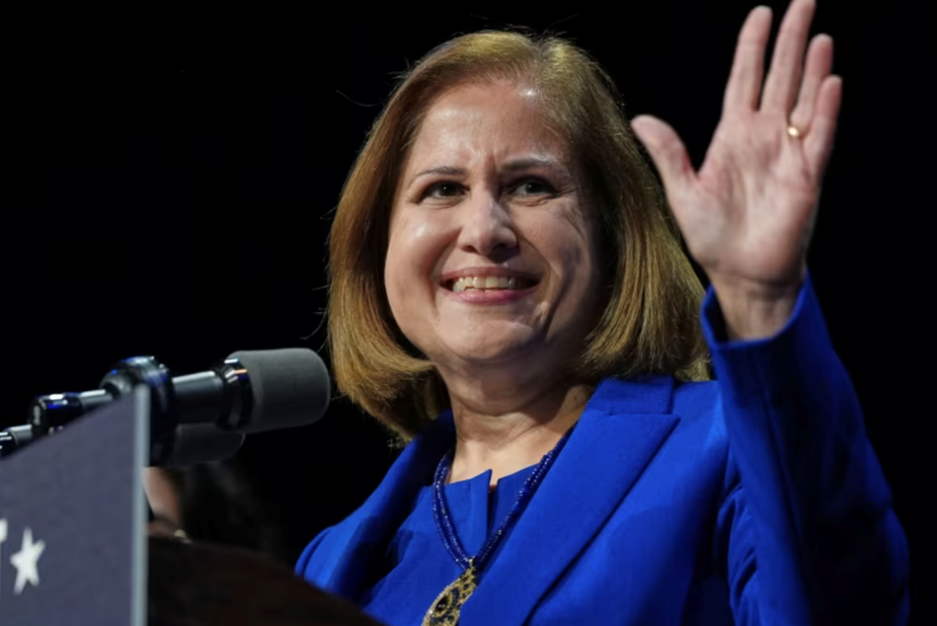
With her victory, Hashmi becomes not only the presiding officer in a closely divided state Senate but also one of the most visible Democrats in Virginia. Supporters argue that her election sends a message that voters are increasingly ready to embrace leaders from all backgrounds — and that the Commonwealth’s political future will be shaped by voices once left out of the room
Ghazala Hashmi Makes History as First Muslim Woman Elected Statewide in Virginia
By C. Naseer Ahmad

Virginia voters on Tuesday November 4, 2025, elected State Senator Ghazala Hashmi as the state’s next lieutenant governor, marking a milestone in the Commonwealth’s political history. Hashmi, a Democrat representing part of the Richmond region, is now the first Muslim woman to win statewide office in Virginia. Her victory comes at a moment when representation and identity have become defining themes in American politics — and when voters are signaling a desire for diverse leadership and a focus on practical governance.
Hashmi secured 55.4% of the vote, beating Republican nominee John Reid, who received 44.3%. A total of 1,868,784 Virginians cast ballots in the race. According to exit polling, Reid performed well with White voters and men, while Hashmi took strong majorities among women and voters of color, coalitions that have increasingly shaped statewide outcomes in Virginia.
In a message to supporters on election night, Hashmi said she was “honored and humbled” by the trust voters placed in her. She pledged to lead with “decency, dignity, and dedication,” signaling a continued focus on the issues that have defined her legislative tenure.
Hashmi, 61, has served five years in the state Senate, where she has prioritized expanding healthcare access, supporting public education, and strengthening community safety resources. Her campaign emphasized the need to rebuild trust in government institutions and maintain stability after what she described as “the chaos” of former administration.
Although the lieutenant governor’s constitutional responsibilities are limited — the most significant being to cast tie-breaking votes in the state Senate — the position has historically offered a pathway to the governorship. In Virginia’s modern political history, lieutenant governors including Tim Kaine, Don Beyer, and Ralph Northam have later sought and sometimes won the state’s top executive office. With this election, Hashmi is now seen not only as a critical player in the Senate but potentially as a future contender for higher office.
Hashmi has carved out a reputation as a progressive voice within her party. She has advocated for rapid expansion of renewable energy infrastructure and has openly supported repealing Virginia’s longstanding “right-to-work” laws, which limit mandatory union membership and have long been a dividing line between the state’s business community and labor advocates. These positions underscore her distinction from Democratic gubernatorial nominee Abigail Spanberger, who ran a more centrist campaign to appeal to swing voters in suburban and rural areas.
Throughout the campaign, Republican messaging attempted to paint Hashmi as aligned with democratic socialist figures such as Zohran Mamdani, a New York state legislator. The comparison raised eyebrows among Democrats, who noted that Mamdani and Hashmi have limited policy overlap and represent different constituencies in different states. Some party leaders dismissed the tactic as grounded more in Islamophobia than substantive critique.
“The reality in 2025 is that you’re going to get attacked for your name and you’re going to get attacked for your religion,” said State Senator Saddam Azlan Salim (D-Fairfax), one of two other Muslim legislators in Virginia’s General Assembly. Salim said Hashmi’s win underscores the growing role of Muslim and South Asian Americans in public life and the importance of visibility in politics.
That representation could be felt throughout the campaign. In Loudoun County — home to Virginia’s largest South Asian population — Hashmi visited a Sikh gurdwara during the final weeks of the race. She spent time in the langar, the community kitchen where volunteers serve free meals to all who enter. The stop wasn’t just symbolic; it was an opportunity for voters to see themselves reflected in leadership.
“I didn’t know someone of South Asian background was running,” said Inderjeet Sagoo, who worships at the gurdwara and spoke with Hashmi during her visit. “Maybe that means she’ll do something for the South Asian community.”
Advocates say that belief — that government can be more inclusive and responsive — may prove one of the most meaningful consequences of Hashmi’s election. Her new statewide platform ensures she will play a significant role in future conversations about economic opportunity, civil rights, and community representation.
With her victory, Hashmi becomes not only the presiding officer in a closely divided state Senate but also one of the most visible Democrats in Virginia. Supporters argue that her election sends a message that voters are increasingly ready to embrace leaders from all backgrounds — and that the Commonwealth’s political future will be shaped by voices once left out of the room.