Caspian Policy Center Spotlights Rising Profile of the Trans-Caspian Region
By Elaine Pasquini

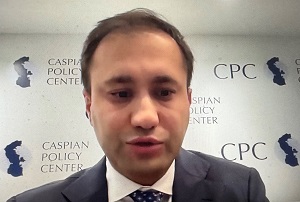
Washington, DC: Since the Russian invasion of Ukraine three years ago, interest in the Trans-Caspian region has greatly increased, fueled in part by its vast supply of critical minerals and energy, Efgan Nifti, president of the Caspian Policy Center (CPC), told an online audience in a May 21, 2025, webinar.
In the last few months, he noted, the region has seen a flurry of diplomatic engagement in the region with visits by officials from the EU, China, Russia and the Gulf. All of this activity shows a “growing prominence of the Central Asia, Caucasus and Trans-Caspian region and its importance,” Nifti said.
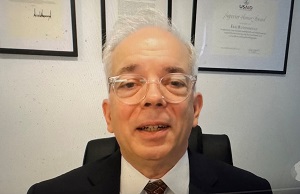
Eric Rudendshiold, CPC senior fellow and previous National Security Council Director for Central Asia under Presidents Trump and Biden, pointed out that despite the many changes in global politics, in the Trans-Caspian region there is a remarkable coming together of the countries, including Azerbaijan, Georgia and what appears to be a reconciliation process between Armenia and Azerbaijan.
“We are seeing a deepening international interest in this crossroads region,” he continued. “Traditional energy certainly has been a draw to Central Asia and the Caucasus but now we also see critical minerals as a tool for the region to enhance its global engagement and to counterbalance Russia and China’s geographic and historic advantages in the region.”
Matthew Klimow, former US ambassador to Turkmenistan, noted the United States has always looked at stability as its priority for Central Asia, and that a politically cohesive Central Asia with five countries cooperating in security matters, infrastructure, trade and commerce allows them to withstand pressures from outside, whether that’s political pressure from Moscow or economic pressure from China.
The second Trump administration, Klimow said, will be conducting a transactional style of diplomacy with mutually beneficial commercial interests. He went on to point out, however, that “commerce, trade and deal-making are the defining hallmarks of the Silk Road and Central Asia and the Caucasus, so that transactional approach may work well for the United States as this administration gains momentum.” But, he added, “Transactional deals are generally bilateral, not regional.”
In regard to the abundance of critical minerals in the Trans-Caspian region, he commented that antimony, gallium, tungsten, thorium, nickel, uranium and copper are all extremely important for America’s national defense. They are used in radar systems, night vision devices, hypersonic weaponry and precision-guided munitions.
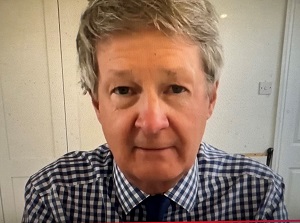
James Sharp, former UK ambassador to Azerbaijan, Kazakhstan and Kyrgyzstan, focused on the broader implications for the region’s future from the European perspective. He raised the issue of the increasing influence of China in the region, noting the Belt and Road Initiative projects in Central Asia, the South Caucasus and Europe. BRICS and the Shanghai Cooperation Agreement are other examples of China’s increasing influence, he pointed out.
With respect to control of telecoms and information technologies, Sharp warned that China and Russia are on the way to “digital domination in the region with the use of Chinese Huawei and Russian equipment and issues over cybersecurity as well.”
“The EU and the West need to take a more coherent joined-up approach in looking at the greater Caspian region,” he said. “They need to be more geopolitical on countering the impact of China and Russia.”
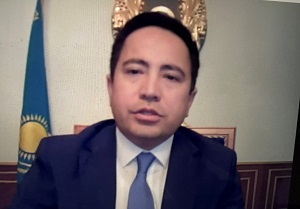
Alim Bayel, ambassador from Kazakhstan to Azerbaijan, pointed out the unprecedented acceleration of comprehensive cooperation in Central Asia and the broader region.
“I think both our peoples and our leaders are now very aware, not only of our common historical identity, but also of the fact that it’s always better to coordinate your actions to get to the better result,” he said. “I also think this is manifest in the success of the C5+1 format whereby Central Asian countries are holding meetings with the United States, China, Japan, the Gulf countries, and we recently held a summit with the European Union.”
This year, Kazakhstan and Azerbaijan are launching the installation of fiber optic cable through the Caspian Sea which is a crucial part of the digital communications corridor between Europe and Asia.
Kazakhstan is also the largest supplier of wheat to Azerbaijan, he related.
“All in all, I would say that Kazakhstan and Azerbaijan stand together, and our intention is to build a just and prosperous future for our peoples and for the region as a whole,” Bayel said.
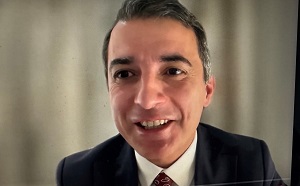
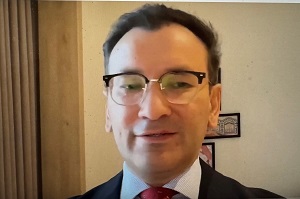
Fariz Ismailzade, member of the Azerbaijani National Assembly and vice rector and professor at the Azerbaijan Diplomatic Academy and IT University, praised the current dialogue between the EU and Trans-Caspian countries. “The meeting with President Aliyev and Ursula von der Leyen, president of the European Commission, hopefully, starts a new page in our bilateral relationship,” he said. “President Trump’s increasing disengagement with Europe has forced the EU to look for alternative partners in the region.”
Javlon Vakhabov, managing director of the International Institute for Central Asia, and former ambassador of Uzbekistan to the United States, stated that the demand for critical minerals is “staggering.” The international energy agency estimates that mineral requirements for clean energy technologies must quadruple by 2040 to meet the Paris agreement targets. Demand for nickel and cobalt will rise by 60-70 percent; copper and rare earths by 40 percent; and uranium demand could be doubled, he said.
The shift from hydrocarbons to minerals is already changing the region’s economic landscape, leading to diversification, industrialization and job creation which is the primary goal the Uzbekistan government has been pursuing over the past few years, he related.
As mineral revenue grows, so does scrutiny over governance, Vakhabov continued. Investment will increasingly be tied to transparency, ESG (environmental, social, governance) standards and respect for labor and environmental rights.
In this regard, Kazakhstan and Uzbekistan are reforming their mining codes and expressing interest in standards such as the Extractive Industries Transparency Initiative. “This is a critical juncture,” he warned. “Either the region moves toward a cleaner more accountable growth, or it risks replicating the extractive rent-seeking models of the oil and gas era.”
As the global economy pivots away from carbons to critical minerals and rare earth elements which are essential to renewable energy systems, electrical vehicles, semiconductors, defense platforms and green technologies, “the control of their supply chains will help define the geopolitical and economic order of the 21st century,” Vakhabov said.
“Let us seize this opportunity to build a new model of mineral development that advances energy security, economic resilience and shared prosperity,” he implored.
(Elaine Pasquini is a freelance journalist. Her reports appear in the Washington Report on Middle East Affairs and Nuze.Ink.)