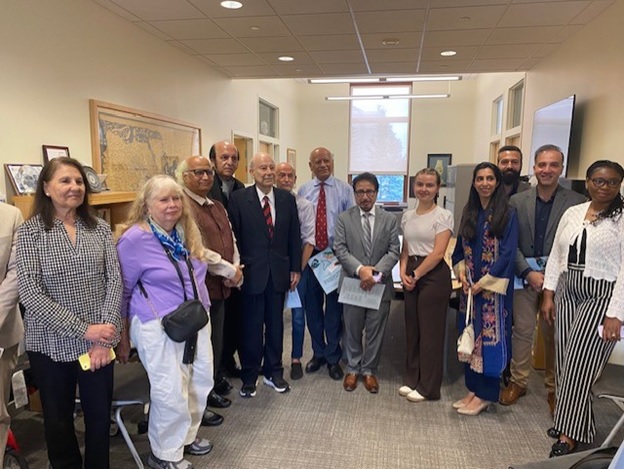
The dialogue was not merely a reflection on South Asia’s past, it was a blueprint for its future. At a moment when threats of war and nuclear escalation are being traded between neighboring governments, Sudheendra Kulkarni and Ambassador Akbar Ahmed offered a radically different vision based on shared history, regional solidarity, and moral imagination. Above a group photo taken on the occasion
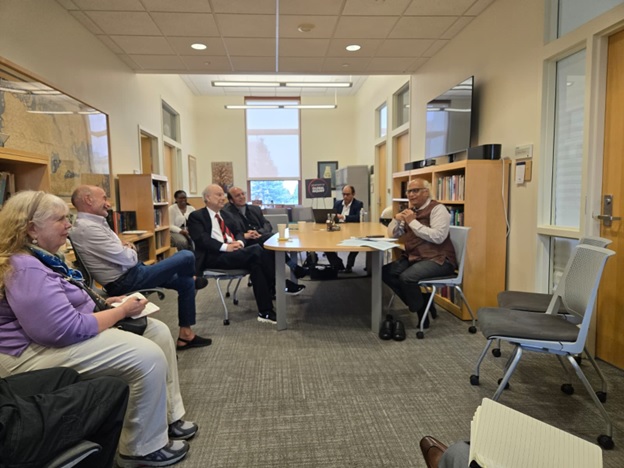
Sudheendra Kulkarni is seated on the right opposite Akbar Ahmed on whose left is Mowahid Hussain Shah
A Dialogue for Peace in South Asia
Speakers: Sudheendra Kulkarni and Ambassador Akbar Ahmed
Location: School of International Service, American University, Washington, DC
Date: July 17, 2025
Overview
American University’s School of International Service (SIS) convened a timely and profound conversation between two prominent figures in global peacebuilding: Sudheendra Kulkarni, renowned Indian public intellectual and follower of Mahatma Gandhi, and Ambassador Akbar Ahmed, esteemed Pakistani diplomat and scholar, currently the Ibn Khaldun Chair of Islamic Studies at American University.
This high-level dialogue took place in the presence of Senior Associate Dean Rachel Sullivan Robinson and former Dean Lou Goodman, both of whom welcomed the speakers and underscored SIS’s deep commitment to international peace and dialogue. The event reflected the enduring influence of Presidents Eisenhower and Kennedy on SIS’s founding values, especially the ideals of education, service, and empathy as pillars of diplomacy and global leadership.
With tensions between India and Pakistan once again on the rise, and in an age when both countries possess nuclear weapons and have already fought four wars, the significance of this discussion could not be overstated. At stake is the peace and security of nearly two billion South Asians, a full one-quarter of the world’s population, living under the persistent shadow of conflict. The speakers sounded the alarm about rising rhetoric from politicians on both sides, including bloodcurdling nuclear threats, and offered a powerful call for moral courage, regional cooperation, and civil society engagement.
Sudheendra Kulkarni
Having flown in from India to serve as the event’s chief guest, Sudheendra Kulkarni brought the voice of a lifelong peace advocate and former senior advisor to Prime Minister Atal Bihari Vajpayee. Kulkarni laid out a framework for sustainable peace based on regional integration, shared history, and Gandhian nonviolence. Calling South Asia “the largest but least integrated region in the world,” he identified missed opportunities to build cooperation between India and Pakistan, particularly between Nehru and Jinnah after Partition.
His key proposals included:
- Respect for sovereignty and territorial integrity
- Mutual condemnation of terrorism and extremism
- Ending unilateral treaty suspensions
- Economic connectivity and cross-border investment
- Reviving SAARC as a platform for peace and development
- Expanding people-to-people diplomacy through exchanges between scholars, journalists, business leaders, and religious leaders
Kulkarni invoked the peaceful example of the US-Canada relationship as a regional model and stressed the urgent need to replace hostility with human connection.
Ambassador Akbar Ahmed
Ambassador Ahmed brought a deeply humanistic lens to the discussion, stressing how the international community often neglects the India-Pakistan conflict because of residual colonial thinking, reducing it to “two brown countries fighting.” In reality, the risks are global, and the suffering is immense.
Ahmed called for a revival of Gandhi’s vision of unity, referencing Gandhi’s statement that “Hindus and Muslims are the two eyes of India.” He reminded the audience of Gandhi’s respectful view of Pakistan and his post-Partition efforts to heal communal wounds. Ahmed also drew from history to emphasize that Hindus and Muslims have lived together peacefully in the past, offering a reminder that peaceful coexistence is not only possible but deeply rooted in tradition.
His recommendations included:
- Annual academic and cultural exchanges
- Interfaith and intercultural dialogue
- Reducing inflammatory media rhetoric
- Promoting narratives rooted in compassion, coexistence, and shared memory
Themes and Takeaways
- A Critical and Overlooked Conflict : Both speakers stressed that South Asia’s volatility, particularly between two nuclear powers, is dangerously under-discussed in global forums. The region’s future has profound implications for global peace and security.
- Return to Foundational Visions : Reclaiming the legacies of Gandhi and Jinnah offers a path toward peace rooted in moral clarity and historical wisdom.
- Civil Society Must Lead : True reconciliation will not come from political elites alone. Artists, academics, religious leaders, and everyday citizens must be empowered to take part in building bridges across borders.
- Integration as Prevention : Reviving platforms like SAARC and investing in regional infrastructure and cooperation are not just economic strategies, they are peace strategies.
Audience Engagement
The event drew a diverse audience of students, faculty, policymakers, and members of the South Asian diaspora. A spirited Q&A followed, with questions ranging from the role of misinformation and nationalism to the practical steps that young people can take to support peace in the region. Many expressed a strong interest in being part of future initiatives, including cross-border academic collaborations and civil diplomacy programs.
Conclusion
This conversation was not merely a reflection on South Asia’s past, it was a blueprint for its future. At a moment when threats of war and nuclear escalation are being traded between neighboring governments, Sudheendra Kulkarni and Ambassador Akbar Ahmed offered a radically different vision based on shared history, regional solidarity, and moral imagination.
American University, with its commitment to global peace rooted in the traditions of Eisenhower and Kennedy, was proud to host such a consequential event. In honoring these voices and amplifying their message, SIS reaffirmed its role as a convener of dialogue, a builder of bridges, and a place where education serves as the foundation for empathy and global leadership.
Prepared by Beth Hanak, Department Manager of SIS’s Peace, Human Rights & Cultural Relations Department, and Giann Desrouleaux