
“I analyze the interaction between the three distinct strains of American identity and how they relate to each other – primordial identity that comes from the original white English Protestant settlers; predator identity which saw a zero-tolerance attitude towards the “other”; and pluralist identity that formed with the Founding Fathers and was enshrined in the Declaration of Independence and the Constitution. Some of the greatest American Presidents belonged to this last category, such as George Washington, Thomas Jefferson, Abraham Lincoln, and John F. Kennedy…”
Exploring American Identity in ‘America at the Crossroads’
By Emma Vitale
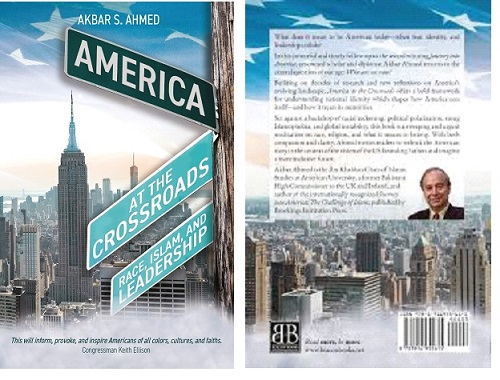
What does it mean to be an American? Amid ongoing debates about national identity, racial justice, and inclusive leadership, SIS distinguished professor and Ambassador Akbar Ahmed’s new book America at the Crossroads: Race, Islam, and Leadership explores this fractured moment in American identity. Using ethnography, historical analysis, and personal narrative, he explores the relationship between America and its Muslim citizens and urges a nation divided by fear and polarization to forge a more inclusive path forward.
To learn more, we asked Ahmed a few questions about how his book unpacks American identity, what he learned from his ethnographic research across America, and what aspects of American society he’d like to study next.
Why is this an important book for our current moment in America?
America at the Crossroads has an origin story which goes back to 9/11. I had just joined American University and was teaching one of my first classes on 9/11 when a plane flew into the Pentagon a few miles from where I was. Muslims were behind it and I knew a large chasm would appear between Muslims and non-Muslims. I decided then to spend as much time and energy as I could to promote better understanding between communities. This book is based on Journey into America, which was one of a quartet of large-scale projects I embarked on, all published by Brookings Institution Press and all examining relations between the West and the world of Islam. These projects were based on extended fieldwork and had a strong group of assistants, such as CAS PhD student Frankie Martin, who also assisted me with America at the Crossroads. America at the Crossroads brings the arguments in Journey into America up to date by analyzing recent trends in American society infformed by new fieldwork.
It is a time of great change and uncertainty in America. Anything to do with Muslim issues can spark controversy and Islamophobia, as we have seen with the emergence of Zohran Mamdani in New York. As a trained anthropologist I believe there can be no greater service to my country than to apply theoretical models to society. Studies like this not only clarify questions for scholars but allow students to have greater insights into the sometimes puzzling events in society.
How do you understand American identity today, and how did you explore that through this book?
I had set out with my excellent and enthusiastic young team of scholars to undertake an exploration of American identity through the lens of the Muslim community. I had dedicated a sabbatical to an extended field trip crisscrossing our vast continent with this in mind. In the end, we visited some 75 cities and towns and 100 mosques. As we traveled, we asked our respondents how they defined American identity. We soon discovered that
identities are constantly debated and discussed. Often, they overlap and even are in a state of conflict. We discovered that however different the communities appeared to be at their core, they had a strong sense of loyalty and belonging to the country, but it was important that each saw the other as part of the whole. American identity, which was dominated by white settlers from England in the first waves, also had other strong identities such as those articulated by Native Americans, Mexican Americans, and African Americans. Several African Americans quoted Malcolm X’s famous quip that, “We did not land on Plymouth Rock, Plymouth Rock landed on us.”
You relied a lot on ethnographic research for your book. How did that help you bring human stories around identity politics to life?
Our study relies heavily on ethnographic research. It constitutes a valuable repository of ethnographic data, including information on individuals and communities acquired through questionnaires, interviews, and field notes. These will be found in America at the Crossroads. I had consciously set out to apply some standard principles of anthropology to our study. One of the strengths of anthropology is “participant observation.” In this method, the researcher spends time with the community to be able to observe how people go about their daily and normal business of living. We came across some inspiring stories. For example, we met an African American Imam who oversaw a small mosque in Las Vegas, and we spent time with him recording his story. He was from the north and in search of religion. He told us of his conversion. He talked to a Rabbi, a Christian priest, and then someone gave him a copy of the Qur’an. He began studying Islam seriously. At that time, he was working as a bellboy in a hotel. He would take the luggage of the customers up in the elevator and read part of a Qur’anic verse and on the way down read the rest of the verse. When I asked whether he was not distracted by the hustle and bustle of “sin city,” wine, women, and song, he said those were the very conditions and challenges of the holy Prophet of Islam. We heard other such fascinating stories as we travelled across this great land.
How does your book explore the relationship between America and its Muslim citizens? Do you see a correlation to how America views undocumented immigrants?
We saw insights into how the Muslim community lives and has lived in America. I had divided the community broadly into the African American community, who I call the First Muslims—immigrant Muslims who came from the Middle East, South Asia, etc.—and converts. I found the Imams especially among the African Americans the most impressive leaders of the community. They were wise and compassionate. This community has produced some outstanding figures such as Muhammad Ali and Malcolm X. Today, too, there are several prominent figures in Congress and in the media. As for the immigrants, once they started arriving after Presidents Kennedy’s and Johnson’s Immigration and Nationality Act, they brought with them their professional skills and middle-class sensibilities. There are some 20,000 Pakistani doctors contributing to American society. The converts, though few, contributed significantly to society. Among the most prominent is Sheikh Hamza Yusuf. On 9/11 when the FBI visited his home in San Francisco and asked to see him, they were told that he was in Washington, DC, for a meeting with President Bush. Each community had stories to relate as to how they adjusted to life in the Unites States as its politics changed. After 9/11 Muslims felt there was intense scrutiny of their community. There was also widespread Islamophobia as the media spread prejudice and distortions about Islam, which I compare and relate to other movements in American society and history targeting immigrants and “others.” But one of the positive consequences of 9/11 was the widespread interest in Islam itself. Many Americans were reading about Islam and themselves concluding that what was being said about the religion was not correct. Many Americans converted to Islam. This was especially true of women. As an anthropologist I found this phenomenon raising many questions and explored it in the study.
What further questions did this book leave you with that you’d like to focus your research on next?
America at the Crossroads is about the current moment in the history of this great land. In it I analyze the interaction between the three distinct strains of American identity and how they relate to each other – primordial identity that comes from the original white English Protestant settlers; predator identity which saw a zero-tolerance attitude towards the “other”; and pluralist identity that formed with the Founding Fathers and was enshrined in the Declaration of Independence and the Constitution. Some of the greatest American Presidents belonged to this last category, such as George Washington, Thomas Jefferson, Abraham Lincoln, and John F. Kennedy. It is also clear from the data that an individual may shift and evolve from one kind of identity to another as the categories are not watertight. A political leader believing in primordial identity may well turn up espousing pluralist identity. This book thus attempts to capture the complexity and dynamism of American society today. It also sets me up for the next study which is to try to relate the great philosophic streams in American society to those that flow in other cultures and continents. How can America be particular to itself and yet provide a universal model for the world? That I believe is a challenge for future studies of American culture, politics, sociology, and international affairs.
