
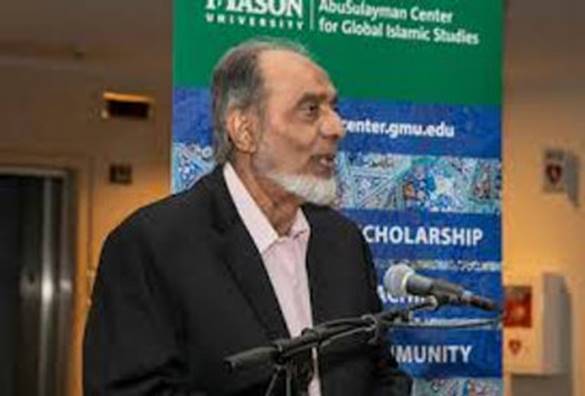
Dr Yaqub Mirza (1946–2024) A Quiet Architect of Modern Muslim Thought in America
By Dr Aslam Abdullah
CA

Dr Yaqub Mirza, one of the most influential figures in the development of Islamic finance and Muslim institutional life in North America, passed away in December 2025, leaving behind a legacy that spans scholarship, philanthropy, organizational leadership, and decades of service to the intellectual and spiritual growth of the American Muslim community. He was 78.
Born in Pakistan in 1946, Dr Mirza pursued his early academic training in the sciences and earned a PhD in physics from the University of Texas at Dallas. Yet his life’s work would ultimately unfold far from the laboratory. Drawn to the challenge of establishing Muslim institutions in the West and inspired by a deep sense of communal responsibility, he devoted himself to building structures that would allow American Muslims to flourish intellectually, ethically, and economically.
He became a central figure in the early years of The International Institute of Islamic Thought (IIIT), working closely with its founders, including the renowned scholar Dr Ismail Raji al-Faruqi, whose intellectual brilliance and tragic assassination in 1986 left a profound impact on him. These early collaborations shaped Mirza’s vision: he believed not only in Islamic scholarship, but in the necessity of institutions that could sustain, publish, and disseminate it.
Over his long association with IIIT, Dr Mirza helped shepherd a movement that produced one of the most extensive bodies of contemporary Islamic scholarship in English. Under his stewardship and support, IIIT became known for its voluminous publications on Islamic social thought, Qur’anic studies, education reform, civilizational renewal, and epistemological frameworks. Generations of Muslim academics, community leaders, and graduate students would learn through books, seminars, and training programs funded or facilitated by IIIT.
Dr Mirza’s contributions were not confined to the intellectual world. He was also one of the earliest and most effective builders of Islamic finance in America. As the founder, President, and CEO of Sterling Management Group, Inc, and earlier as General Manager of NAIT (North American Islamic Trust), he helped design financial structures that allowed mosques, endowments, and Muslim organizations to grow sustainably. His long tenure as Chairman of the Board of Trustees of Amana Mutual Funds further cemented his reputation as a pioneer of ethical and Sharia-compliant investing in the United States.
He was also a founder and later President of the Center for Islam in the Contemporary World at Shenandoah University, where he guided research on Muslim experiences in modern society. His board memberships were extensive, including service on the International Advisory Council of ISTAC (International Institute of Islamic Thought and Civilization) in Malaysia and the Council of Advisors for the Muslim Philanthropy Initiative at the Lilly Family School of Philanthropy at Indiana University.
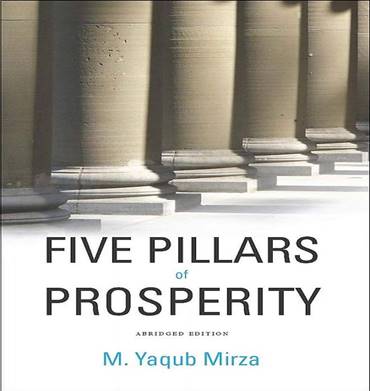
Though best known for his institutional achievements, those who knew him personally describe a man of profound humility and gentleness. He spoke softly, listened more than he talked, and mentored countless younger professionals and scholars without seeking recognition. His writings—including Five Pillars of Prosperity—reflected his belief that spiritual well-being and ethical wealth-building were inseparable pursuits.
His relationship with the late Dr Ismail Faruqi remained one of the most formative of his life. Friends recall that Mirza often spoke of Faruqi’s intellectual discipline, his passion for civilizational dialogue, and his tireless commitment to renewing Islamic thought. The two worked in close collaboration during IIIT’s formative years, sharing both the intensity of institution-building and the idealism of a generation determined to produce knowledge that served humanity. Dr Mirza carried those ideals with him for the rest of his life.
In his later years, he remained active in scholarship, philanthropy, and communal advisory work. His influence radiated through the many institutions he helped build, the literature he helped bring into existence, and the countless leaders who benefited from his support and mentorship.
Dr Yaqub Mirza is survived by his family, whose privacy he cherished and protected. He leaves behind a legacy of integrity, quiet leadership, and visionary institution-building that reshaped Muslim life in America.
A man of deep faith and immense discipline, he lived his life with the conviction that service to God is inseparable from service to community. His passing marks the end of an era—one shaped by immigrants who built the foundations upon which future generations will continue to grow.
May his memory be a blessing and may the institutions he nurtured continue to illuminate the path he helped chart.
(Dr Aslam Abdullah received a Doctorate in Communications from the University of London, England in 1987. He is the Editor-in-Chief of Muslim Media Network Inc that publishes the Muslim Observer. He has served as Director of the Islamic Society of Nevada and Masjid Ibrahim, Las Vegas. Dr Abdullah has also been the Editor-in-Chief of the Minaret Magazine since 1989. He was an associate editor of The Arabia in the 1980's. He also served as vice chairman of Muslim Public Affairs Council. He is the current Vice President of the American Muslim Council. He is involved in interfaith dialogue and has represented Muslims in several interfaith conferences. He has published several books and more than 600 articles and papers in magazines all over the world. He is based on Southern California and has appeared on several TV and Radio shows)
