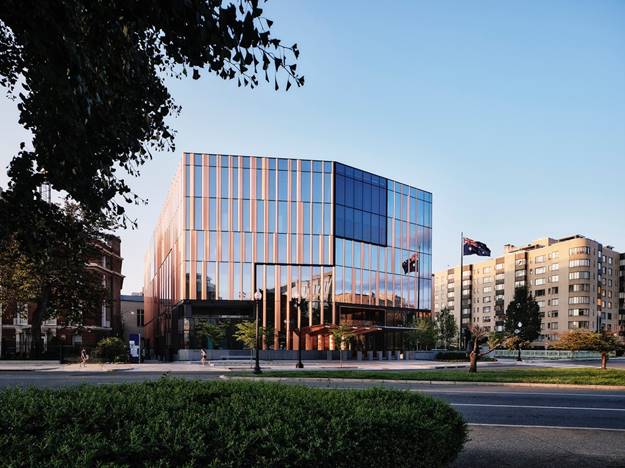
Replacing a brutalist structure that once commanded the site, the new embassy rises as a poem in copper and glass. Designed by the renowned Australian firm Bates Smart, it is an example of “architecture as landscape,” with its defining feature a façade clad in copper panels treated to resist oxidation. Unlike typical copper that patinas over time, these panels maintain their sheen, reflecting the shifting colors of the Australian continent. At noon the building glows in the warm ochre of Uluru; at dusk it softens into the bronze shades of a setting outback sun - Photo Bates Smart
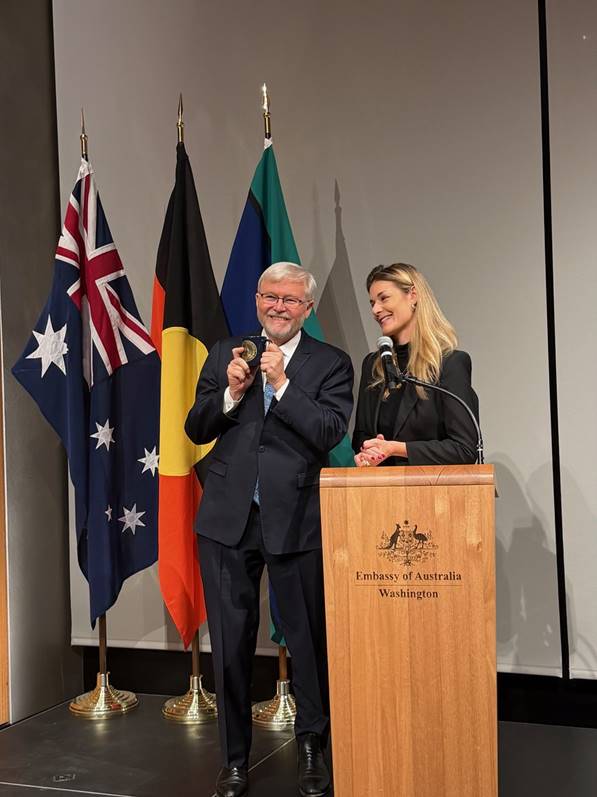
“We are thrilled not to be surrounded by Australian alligators, poisonous spiders, or snakes tonight! Instead, Mr Ambassador, I’m pleased to offer you a different kind of scary—a room full of journalists.”
Embassy Nights and the Architecture of Connection
By C. Naseer Ahmad
Washington, DC

In the high-stakes ecosystem of Washington, DC, where information is currency and access is the ultimate prize, the relationship between the press and the diplomatic corps is often defined by a polite but palpable tension. Journalists hunt for stories; diplomats carefully curate narratives. The dance between the Fourth Estate and the State is continuous, choreographed simultaneously by mutual dependence and professional caution.
Yet the “Embassy Nights” hosted by the National Press Club (NPC) have long served as a gentle corrective to this dynamic. These evenings act as rituals of soft diplomacy—rare moments when notebooks are tucked away and envoys and editors step out of the glare of officialdom and into a softer, off-the-record light. They allow both sides to shed their armor, to listen rather than posture, and to rediscover the shared human terrain beneath geopolitics and headlines.
Among the history of these gatherings, the Embassy Night held on December 4, 2025, at the Australian Embassy shone with particular radiance. It was an evening that lingered like a warm ember long after the final glass was emptied, defined not merely by the caliber of its company but by the extraordinary vessel that held them.
A Different Kind of Scary
The event opened in good humor, a welcome bridge across the professional divide. As the crowd settled, the International Correspondents Team Chair stepped to the podium. With a wry smile, Ms Nicola Wenz delivered a line while presenting the traditional NPC mug to the ambassador—one that instantly dissolved the remaining formality in the room.
“We are thrilled not to be surrounded by Australian alligators, poisonous spiders, or snakes tonight! Instead, Mr Ambassador, I’m pleased to offer you a different kind of scary—a room full of journalists.”
Laughter rippled easily across the audience. It was a moment that acknowledged the complex dance between media and diplomacy while carrying the crowd gracefully into a night that would ultimately be remembered for more than humor. What elevated the evening was the harmony between place, people, and purpose—a rare alignment that only the most thoughtfully crafted gatherings achieve.
The Scholar-Statesman
At the center of this harmony stood H.E. Ambassador Kevin Rudd.
To meet Ambassador Rudd is to encounter a man who occupies several worlds at once: statesman, scholar, writer, linguist, and cultural interpreter. Washington has hosted many Australian ambassadors, but Rudd stands apart in stature and intellect. A former Prime Minister - as well as a former Foreign Minister - of Australia, former president of the Asia Society, and author of The Avoidable War, he brings to the capital a depth of perspective rooted in rigorous intellectualism and global vision.
Fluent in Mandarin and known formally in China as Lù Kèwén ( 陆 克文 ), Rudd has spent decades navigating the complexities of US–China relations. Yet despite his formidable résumé, his presence at the reception was not ceremonial—it was connective. He moved through the room with a spirit of curiosity, engaging not only senior correspondents but also early-career reporters and guests. In doing so, he bridged the gap between high policy and human conversation, embodying the very spirit of dialogue the evening sought to cultivate.
Architecture as Landscape
It is fitting that such an ambassador represents his nation in a building that is itself a masterwork of representation. The new Australian Embassy at 1601 Massachusetts Avenue NW is a striking departure from the fortress-like architecture that defines so many modern diplomatic missions.
Replacing a brutalist structure that once commanded the site, the new embassy rises as a poem in copper and glass. Designed by the renowned Australian firm Bates Smart, it is an example of “architecture as landscape,” with its defining feature a façade clad in copper panels treated to resist oxidation. Unlike typical copper that patinas over time, these panels maintain their sheen, reflecting the shifting colors of the Australian continent. At noon the building glows in the warm ochre of Uluru; at dusk it softens into the bronze shades of a setting outback sun.
A Fortress of Transparency
Along Embassy Row, the building stands as an invitation rather than a barrier. In an era when global security concerns often compel architects toward bunker-like designs, the Australian Embassy embraces radical openness. Its ground floor is transparent to the street, offering passersby a glimpse into a vast, light-filled atrium.
Inside, a glass ceiling rises in a gesture of openness, allowing natural light to cascade through the space and illuminate galleries of Indigenous art. This design choice mirrors the diplomatic ethos between Australia and the United States—two nations linked by treaties and shared strategic interests, but equally by deep, longstanding trust. The building communicates that trust subtly but unmistakably: We have nothing to hide.
Green Diplomacy
Sustainability is also fundamental to the embassy’s identity. The structure has earned LEED Gold certification, employing a thermally efficient façade and rooftop solar panels. Perhaps its most charming feature is the rooftop apiary housing more than 200,000 bees. This is environmental stewardship rendered in architectural form — a quiet but potent diplomatic gesture that demonstrates how nations can express care for local ecosystems and global futures simultaneously.
The Lingering Ember
For those who have not visited, Australia’s embassy belongs near the top of any Washington itinerary, especially during the Passport DC open house tours each May. Whether drawn by the architecture, the art, or simple curiosity, visitors encounter not just a building but a story—a thoughtful expression of national identity through beauty, transparency, and intention.
Ultimately, Embassy Night was far more than a reception with beverages and canapés. It was an experience layered with insight, hospitality, and the quiet poetry of place. It revealed the embassy not just as an architectural triumph but as a living space where diplomacy breathes—where conversations unfold beneath warm copper light, and where even a room full of “scary” journalists can, for an evening, become a circle of connection rather than scrutiny.
Perhaps that is the night’s true achievement: within walls shaped by design and diplomacy, it was the human stories—the laughter, the graciousness, the exchange of ideas—that became the architecture that mattered most.