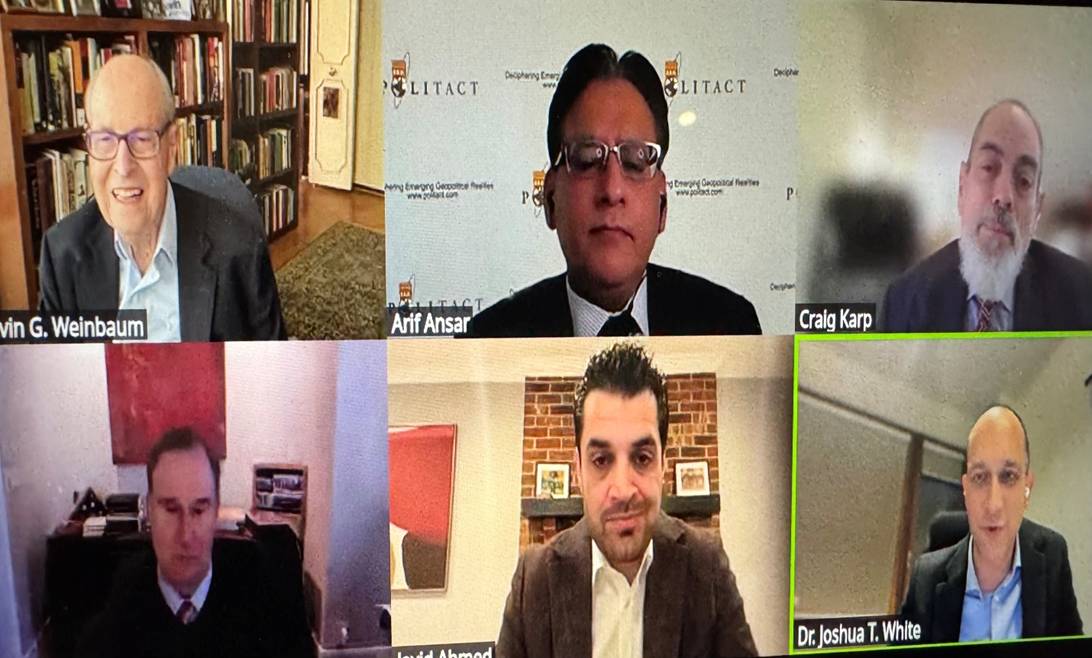
(Top row, left to right): Marvin Weinbaum, Arif Ansar, and Craig Karp. (Bottom row, left to right): David Sedney, Javid Ahmed, and Joshua White
No Full-Scale Afghanistan-Pakistan War in Near Future, Experts Say
By Elaine Pasquini

Washington, DC: As relations between the Taliban rulers in Afghanistan and the government of Pakistan have deteriorated dramatically in the past few months, the Middle East Institute (MEI), together with the strategic advisory firm PoliTact, hosted a discussion on this issue in Washington on November 13, 2025.
Craig Karp, managing director at Karpology Global Advisors, pointed out that the conflict is not with the people of Afghanistan, but the Taliban regime that “seized power by force without the support of the majority of the people of Afghanistan and maintains power through repression rather than domestic legitimacy.”
Pakistan’s relationship with Afghanistan “speaks to one of the greatest geopolitical ironies of our generation because the Taliban would not be sitting in power in Afghanistan if not for the shelter and support from the Pakistani military, government of Pakistan and particularly the Pakistani intelligence, over the years,” he opined.
Dismissing any notion of a full-scale war, he stated: “If Pakistan troops entered Afghanistan, they face the possibility of a guerilla war which they are not prepared to deal with.” In addition, the Taliban acquired all the leftover weapons from the almost 20-year American occupation of the country.
According to Arif Ansar, chief analyst at PoliTact strategic advisory firm, the breakdown of last month’s negotiations between the two sides to ease border tensions was due to the demand of the Tehreek-e-Taliban Pakistan (TTP) – who were only involved in the talks through the Taliban – that the FATA (federally administered tribal areas) merger in Pakistan that was approved in 2018 be fully implemented, and for the Pakistani military to withdraw from the FATA areas. “That’s where the negotiations fall apart,” he said.
David Sedney, former president of the American University of Afghanistan and former deputy assistant secretary of defense for Afghanistan, Pakistan and Central Asia, argued that it’s important to recognize that the Afghanistan-Pakistan conflict is only a sub-plot to the main plot of the India-Pakistan relationship and the associated geopolitical influences that bear on that conflict.
Answering a question about Field Marshal Asim Munir, who President Trump recently called his “favorite field marshal,” Sedney said there is no question that Munir is the driver on Afghanistan policy in Pakistan, noting “he is protected from legal liability for the rest of his life,” following the passage of the country’s 27th constitutional amendment. “I think it is clear that the chief of army staff has played the major role in Afghanistan policy. Now it is going to be clear that it is formally that way and no one is going to question that.”
With respect to a war with the full application of military force, the Taliban know that Pakistan has nuclear weapons, he said, “so there is not going to be a conventional war or anything close to that because the risks to the Taliban are too great.”
The Taliban’s perspective as they made clear in their victory over the United States is long-term. “They believe they are anointed by God to rule not just Afghanistan, but to be the creator of a new emirate that is similar to the emirates and caliphates created in the sixth and seventh centuries,” he said. “To me, this is their long-term strategic goal.”
“US strategic interests with Pakistan are economic at this point and include critical minerals and business opportunities with some sense of valuable counterterrorism cooperation,” he continued. “But I don’t believe…there is a wider geopolitical strategy” for the region.
With respect to the US-Pakistan-China relationship, according to Sedney, “the most important relationship Pakistan has had over the past 75 years is with China.” China tells Pakistan that “you can count on us through thick and thin; you can always count on China.”
Former Afghan ambassador to the United Arab Emirates Javid Ahmed, now an associate fellow at MEI, and a senior fellow at the Atlantic Council, said that Pakistan wants the Taliban to ensure that Afghan soil isn’t used by groups like the TTP and the Baluchistan Liberation Army to attack Pakistan and they want “verifiable action, not promises.”
There are also trade and economic issues that need to be separated from political disputes and Pakistan needs to stop weaponizing the refugee population issue as leverage.
On Russia and China, Ahmed noted that both countries have made significant inroads in Afghanistan with the Taliban and extended their security ties with the group.
“My view internally in Afghanistan is that China and Russia usually inspire confidence among the businessmen – the corporate Taliban – who see potential investment in China and Russia,” he said. “But when it comes to the Taliban clerics and their hardliners – those who are sitting in Kandahar – they are suspicious of engagement because there is no trust or shared language established between the two sides, no common worldview.”
Joshua T. White, non-resident fellow at Brookings and a professor at Johns Hopkins University School of Advanced Studies, a former senior advisor on South Asia at the National Security Council, pointed out that Pakistan’s longstanding support of the Taliban during the 20-year conflict now has created a major headache for the Pakistani leadership.
There are very few points of leverage over the Taliban leadership, he said. “We have a government that really does not respond to the kind of incentives that we are accustomed to governments responding to and that creates a fundamentally unique and difficult problem-solving exercise in looking at the future trajectory of this conflict and what might help abate it.”
In conclusion, moderator Marvin G. Weinbaum, senior fellow at MEI specializing in Afghanistan and Pakistan, stated he does not see a military solution to this confrontation between the two neighbors nor a diplomatic one. “We’re back in that familiar place where we say: ‘Well, as we go along now, we’re just going to have to manage the conflict as best we can.’”
(Elaine Pasquini is a freelance journalist. Her reports appear in the Washington Report on Middle East Affairs and Nuze.Ink.)