
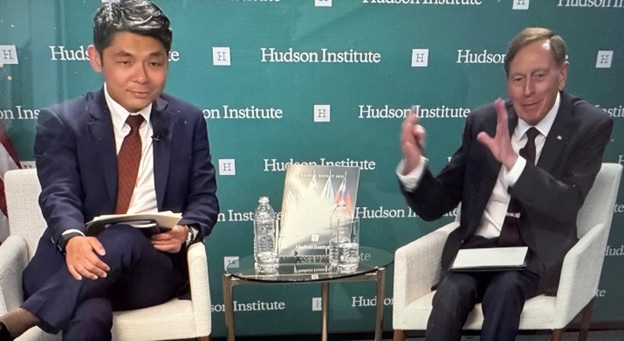
Taiwan Should Learn from Ukraine and “Strengthen Deterrence,” Says Gen David Petraeus at Hudson Institute
By Elaine Pasquini
Washington, DC: As the global security landscape is changing, particularly in light of Russia’s war on Ukraine, many countries are assessing their own vulnerability. Taiwan, in particular, is focusing on updating and improving its strategic deterrence and defense posture as it faces an existential threat from China.
To discuss what Taiwan can learn from Ukraine’s battlefield experience, on July 28, 2025, General (ret) David H Petraeus sat down with Hudson Institute Senior Fellow Jason Hsu, a native of Taiwan where he served as a legislator-at-large in the country’s Legislative Yuan (parliament). Hsu also had a distinguished career as an entrepreneur in Taiwan’s tech sector before entering politics.
Petraeus, co-author with Andrew Roberts of Conflict: The Evolution of Warfare from 1945 to Ukraine, which has been updated in a 2nd edition to include the Israel-Gaza war, is presently chairman of the KKR Global Institute, an investment firm which provides advice on geopolitics, macroeconomics, demographics, energy markets, technology and trade policy.
Disclosing that he was “nonpolitical,” wasn’t registered to vote and not a member of either party, the general said that therefore he can “talk to members of either party in this city, which is rare, without being castigated for one reason or another,” noting that he posts a nightly update on Ukraine on the LinkedIn social media platform with information from the Institute for the Study of War, where he serves as a board member.
The general, who has been to Ukraine six times since the 2022 Russian invasion, said the war is “truly transformative in what is going on, and should inform all militaries everywhere that could end up in the kind of combat that is being waged there.”
In his opinion, Taiwan is learning a great deal from the Russia-Ukraine war, but he pointed out that China is also an “avid observer” of the situation. The Chinese, he said, “have increasingly been providing vast quantities of components that are enabling the military-industrial complex of Russia to revive and to begin to produce the kinds of weapons systems and so forth that are relevant in this war.”
The first lesson Taiwan should learn from Ukraine is “don’t let deterrence fail,” Petraeus warned. Taiwan needs to make some substantial improvements to its capabilities, some of which should be informed by the lessons from Ukraine, to shore up deterrence, he argued, adding: “Money spent on deterrence is generally very well-spent because if you skimp on deterrence, you’re going to spend a lot more on defense.”
Asked by Hsu of the possibility of a meeting between President Trump and President Xi of China, the general responded that it was possible, but that it would be only about trade. “I’m doubtful that they get into some of the other important aspects of the relationship. These are sufficiently thorny issues as it is.” He pointed out that after Mexico and Canada, China is the third-largest trading partner of the United States.
“Right now, it’s all about resolving these tariff issues, which if not resolved China has the ability to bring us to our knees in certain respects,” he continued. “And by the way, we have a similar ability because without what we provide to Russia or what we provide to China, they cannot feed their people nor feed their livestock.”
He went on to note that 100 percent tariffs on Chinese electric vehicles “is a pretty substantial action as were many of the other restrictions on what we could sell to China. Also, the companies in which we can invest, the entities list continued to grow and so forth.”
The idea of “decoupling” from China was always a very “misplaced concept,” Petraeus said. “You cannot decouple from a trading partner who has the rare earths, the strategic minerals, the magnets. That list goes on and on, pharmaceutical precursors and so forth. You have to work your way through that, and I think that’s going to be a thorny enough issue that’s probably going to suck up the oxygen in the room for that first meeting, at the very least.”
In conclusion, Petraeus emphasized the importance of the US-China relationship getting on a “firm footing,” with “some guardrails…and the kind of communications that were not there, by the way, when the Chinese spy balloon floated over the US and the Pentagon picked up the hotline and nobody answered in Beijing.”
“We need to ensure that our contribution to deterrence in the Indo-Pacific is rock solid because of the capabilities we have and the willingness to employ them in certain circumstances without being needlessly provocative,” he stated. “We need to get through this period of heightened concern, so that we can ensure that peace does prevail.”
(Elaine Pasquini is a freelance journalist. Her reports appear in the Washington Report on Middle East Affairs and Nuze.Ink.)
