Embassy of Pakistan Commemorates Youm-e-Istehsal
By Elaine Pasquini

Washington, DC: On August 5, 2025, the Embassy of Pakistan held a webinar commemorating “Youm-e-Istehsal,” the day in 2019 when Indian Prime Minister Narendra Modi’s ruling Bharatiya Janata party revoked Articles 370 and 35A of India’s constitution which provided Kashmir its special autonomous status, thereby abolishing Kashmiris’ right to self-determination. Simultaneously, India deployed tens of thousands of troops to the region, imposed curfews, made mass arrests and placed additional restrictions on the rights of Kashmiris.
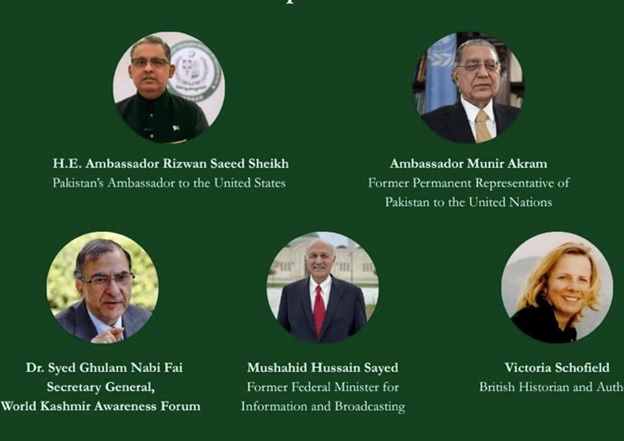
Special messages from Pakistani Prime Minister Shehbaz Sharif, President Asif Ali Zardari and Deputy Prime Minister/Foreign Minister Ishaq Dar stating unwavering political, moral, and diplomatic support for the people of Indian Illegally Occupied Jammu and Kashmir (IIOJK) were read followed by an address by Rizwan Saeed Sheikh, Ambassador of Pakistan to the United States.
“The brutal history of repression certainly took its most dangerous turn on the 5th of August 2019 when India unilaterally revoked the relevant articles of the Indian constitution,” the ambassador said.
He also emphasized the need of capitalizing on the internationalization of the Kashmir issue citing the revival of Pakistan’s national credibility and prestige following the four-day military clashes with India in early May.
“The significance of the Kashmir issue has increased further,” Ambassador Sheikh noted. “It has been highlighted all over again, against the design and desire of India.”
Pakistani Senator Mushahid Hussain highlighted the fascist Hindutva – Hindu ethno-nationalism – ideology of the Indian government fueling the illegal occupation of Jammu and Kashmir.
“We are not just talking of a normal occupation or an annexation of territory done illegally in total contravention of United Nations, we are talking of a certain ideology of hate that lies behind India's moves, and which is reinforced by a policy of state terrorism,” he said.
The senator also lauded the role of President Donald J Trump for offering mediation on Kashmir and recognizing it as the core issue between Pakistan and India.
“I would also like to commend the initiative of President Donald Trump, that at the highest levels of the United States government, there is the recognition of the fact that Kashmir is the core cause of conflict between Pakistan and India,” he said.
Victoria Schofield, British historian and author, emphasized the need for dialogue, mediation, and an inclusive peace process, drawing parallels with the Northern Ireland peace model. She stressed that the Kashmiri people must be central to any future negotiations, and that international mediation could help pave the way to durable peace.
Ambassador Munir Akram reiterated the centrality of the United Nations Security Council Resolutions 80, 91, and 122 in affirming the Kashmiri people’s right to self-determination. He noted that India had never formally rejected these resolutions yet continued to act in flagrant violation. Resolution 122 explicitly stated that no unilateral action would form a substitute for the prescribed free and impartial plebiscite under UN supervision.
Ambassador Akram emphasized that Article 25 of the UN Charter obliged all member states to comply with Security Council resolutions, making India’s actions a clear, consistent and blatant breach of its international commitments and responsibilities.
“India’s behavior has been exposed by recent events,” he stressed, further calling this a “good opportunity to push for an inquiry commission and global accountability.”
Dr Ghulam Nabi Fai, Secretary General of the World Kashmir Awareness Forum, drew attention to the gross human rights violations in IIOJK, including widespread land confiscation, administrative changes, and legal maneuvers designed to alter the region’s demography. He referenced Article 17 of the Universal Declaration of Human Rights that afforded protection of the right to property and underscored the illegality of land-grabbing and forced demographic change.
All of the speakers strongly condemned India’s demographic and political engineering in the region, warning of its adverse and escalatory implications for regional as well as global peace, security and stability in a nuclear neighborhood. They denounced the ongoing human rights abuses in the IIOJK drawing international attention to the importance of a just and peaceful resolution for the Kashmiris.
In conclusion, Ambassador Sheikh stressed Pakistan’s unwavering commitment to supporting the just and legitimate struggle of the Kashmiri people towards realization of their inalienable right to self-determination as enshrined in international law and the relevant United Nations Security Council resolutions.
(Elaine Pasquini is a freelance journalist. Her reports appear in the Washington Report on Middle East Affairs and Nuze.Ink.)