
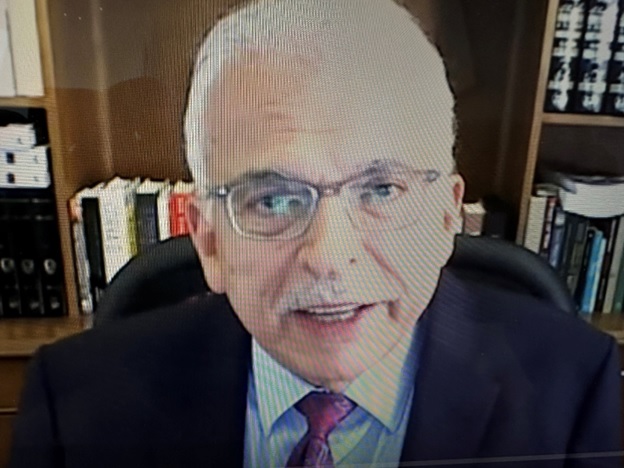
Mohsen Milani
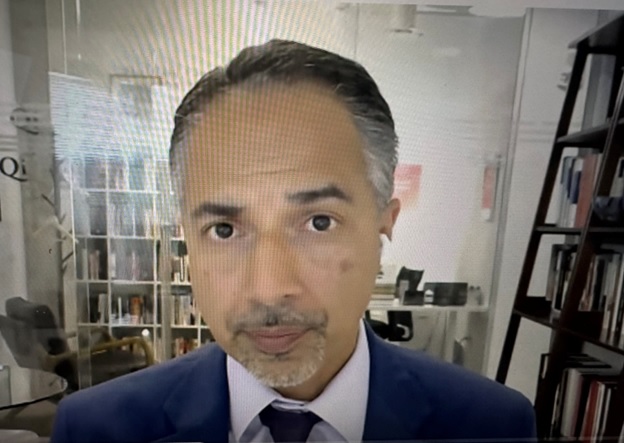
Trita Parsi
Iran Should Normalize Relations with US, Writes Mohsen M. Milani in New Book
By Elaine Pasquini
Washington, DC

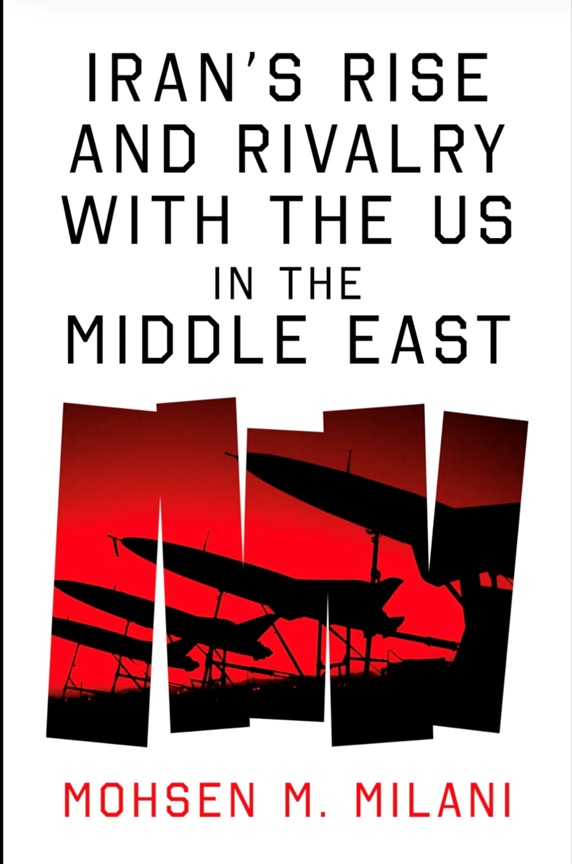
Mohsen M. Milani’s latest book, Iran’s Rise and Rivalry with the US in the Middle East, “dissects the strategic logic behind Iran’s regional policy and tells the story of how a revolutionary state boxed in by sanctions and war emerged as one of the most influential forces in the region,” Quincy Institute Executive Vice President Trita Parsi said in welcoming remarks in a webinar on July 24, 2025. “It tells the story of the evolution of the US-Iran rivalry and explains how the so-called ‘axis of resistance’ was born and whether Iran can sustain this path given its many internal and increasingly external challenges.”
Milani, professor of politics at the University of South Florida and executive director of the Center for Strategic and Diplomatic Studies, explained that for a long time he had been struggling with the question of how Iran, a country that had suffered through sanctions and other problems, became such a formidable power in the Middle East. “That’s when I decided to write the book,” he said, which he finished right before the fall of the Bashar Assad regime in Syria and the assassination of Hezbollah leader Hassan Nasrallah in Lebanon.
In his book, Milani asserts that the combination of the Islamic Revolution of 1979 plus the Iran-Iraq war of 1980-1988 provided the ideological and military basis for Iran to expand its power in different countries. “Throughout the book,” he said, “I bring specific examples by looking at how Iran expanded its power in Iraq, Syria, Lebanon, Yemen and in Gaza through its relationship with major Palestinian groups.”
Prior to the fall of Assad and the assassination of Nasrallah, “Iran was able to exercise its power in a way that it hasn’t done for centuries. They were reaching almost to the Mediterranean. They had a small naval presence. They were a formidable force in Lebanon…in Iraq, … and were helping Hamas and the Houthis.”
Looking at the evolution of Iranian regional policy, the idea of “forward defense” became the cornerstone when General Qasem Soleimani became leader of the Quds Force in 1998.
There was the belief that Iran could not confront the United States through conventional warfare. Therefore, they decided that one way they could do it was to resort to asymmetrical strategies – helping non-state actors and pursuing forward defense. “That policy did not work,” he stated. “And today we see that it has been almost shattered.”
Milani went on to state that the power Iran wielded prior to the fall of Assad and the assassinations of Nasrallah and Soleimani is “unsustainable.”
“I think Iranian decline in the region began after the assassination of General Qasem Soleimani,” Milani stated. “That is when Iran realized that without him it cannot pursue the same policy,” which was “actively pursuing policies not in reaction to other countries’ policies but in order to pursue its own interest.”
In other words, Soleimani was pursuing both offensive and defensive policies. In the past five years since his death, however, Iran became a passive player. “I think the decline accelerated and Iran has been only reacting,” he opined. “As long as they do this, the decline is going to continue.”
Soleimani, in addition to being a very different kind of general than others, was unique in that he would go into the battlefield. “He knew everyone personally and most importantly he could bypass the bureaucratic red tape because [Ayatollah Ali] Khamenei trusted him,” Milani said. “He didn’t have to get approval from the Iranian parliament or the Iranian national security. On the spot, he could make decisions.”
Iranian personalities, he stressed, have always played a more important role than institutions. “Soleimani was a charismatic guy, and he had established personal relationships with everyone. When he entered a room, people noticed something different. And, moreover, he wasn’t afraid to make decisions. That’s why I said that Iran’s ability to expand power had to do with the will of its leader. After Soleimani’s death, no one has been able to demonstrate or exhibit that kind of will.”
With respect to bad relations between Washington and Tehran, the fundamental cause, he argued, has “nothing to do with ideology, human rights violations or with the Islamic essence of the Islamic Republic. It has everything to do with power. Iran is seeking to expand its power, and the US is trying to maintain its hegemonic role in the Middle East. That’s what international politics is all about.”
But he insisted, “Iran cannot win the cold war against the United States. The best way is to move toward normalization of the relationship.”
One powerful phenomenon taking place in Iran, he related, is “a sense of patriotism” that he hasn’t seen since the beginning of the Islamic Revolution in 1979. This is a direct result of Israel’s illegal attack on Iran in June this year.
Presently, he stated: “The Israeli-American attack on Iran is a gift of God to the Islamic Republic because for the first time people of the world begin to understand why Iran has a 3,000-year history because its people understand that when they are being threatened by an external force they unify.”
Even though they are upset with the Islamic Republic, “when their home is attacked, they unify,” Milani said. “Now, the Islamic Republic has a unique opportunity to make fundamental changes in its regional policies as well as in its domestic policies. It is time for the Islamic Republic to put an end to Islamist policies, release political prisoners, agree to free elections in Iran and put an end to some of its repressive policies.”
At the same time, Iran should “move toward normalization of relations with the United States which is not an enemy of Iran,” he emphasized.
In conclusion, Milani said that one of the most important consequences of the October 7 attack by Hamas on Israel is the development of a different mindset in Israel which is that they are not going to allow any threat emerging in their region. “Therefore, I think we have entered into unchartered territory between Israel and Iran.”
(Elaine Pasquini is a freelance journalist. Her reports appear in the Washington Report on Middle East Affairs and Nuze.Ink.)
