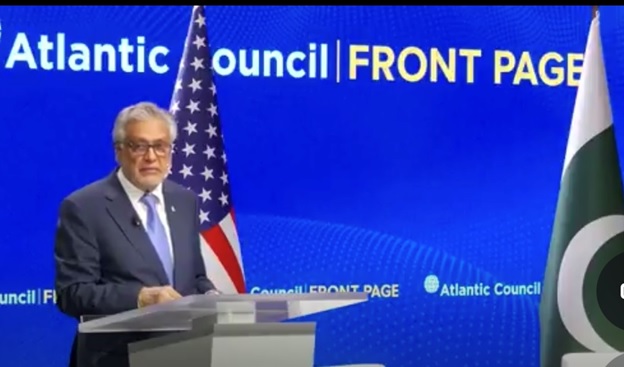
“The world is changing at a rapid pace; old certainties are giving way to new realities,” Muhammad Ishaq Dar, deputy prime minister and foreign minister of Pakistan, told an Atlantic Council audience on July 25, 2025
Deputy PM/FM Ishaq Dar Is Upbeat on US Trade Deal and US-Pak Relations
By Elaine Pasquini

Washington, DC: “The world is changing at a rapid pace; old certainties are giving way to new realities,” Muhammad Ishaq Dar, deputy prime minister and foreign minister of Pakistan, told an Atlantic Council audience on July 25, 2025. “Power is diffused, and conflict is complex. The global economy is under pressure. Climate, technology, and geopolitics are converging. In such challenging times, peace cannot be passive.”
The foreign minister spoke at the venerable think tank during a two-day visit to Washington in-between important meetings and conferences at the United Nations in New York City.
Dar pointed out that Pakistan – a youthful nation of 240 million – while being a nuclear power is “also a peace-seeking and peace-loving nation [that] believes in peace through resilience and responsibility.”
Since Pakistan’s current government led by Prime Minister Shehbaz Sharif assumed office in 2024, Pakistan has encountered many challenges to the economy.
A successful IMF program for the fifth largest country in the world, however, helped improve the situation, and the first review of the 37-month, $7 billion Extended Fund Facility “validates Pakistan’s macroeconomic stabilization efforts and pursuit of structural reforms,” he reported. “Recent improvements in macroeconomic indicators are evident through improved current account balance, stable exchange rate, declining inflation, and rebuilding of forex reserves.”
On the subject of democracy in Pakistan, Dar averred, it’s “not only functioning, but thriving,” with the Sharif-led government being committed to “human development with substantial investments in health, education, skills development and social protection.”
In addition, Pakistan remains “committed to deepening the rule of law, freedom of expression, and pluralism – values we share with the American people and ideals we hope to see upheld consistently,” he added.
Of great importance to Pakistan is the country’s relationship with the United States, which Dar called “enduring, wide-ranging and evolving.”
It has proven to be a consequential partnership whenever the two countries converged on global issues, be it the Cold War or the War on Terror, he said, and “Pakistan is encouraged by the upward trajectory in its bilateral partnership” since President Donald Trump assumed office for his second term in January.
Prior to his appearance at the Atlantic Council, Minister Dar held a productive meeting with US Secretary of State Marco Rubio. “We agreed on our shared commitment to deepen and broaden the Pak-US bilateral partnership,” he said. “Our nations are coming closer, and we have made considerable progress already in a short span of six months.”
In his address to Congress, Dar noted that President Trump recognized Pakistan’s “vital assistance” in capturing Abbey Gate mastermind Sharifullah. “Pakistan’s significance for US national security in battling global terrorist outfits has been underscored by the US military leadership – more recently by Commander of CENTCOM General Michael Kurilla.”
The United States is the largest single-country destination for Pakistani exports. “Our cost-effective and quality textiles and apparel ensure keeping costs low for the households,” he said. “This industry is also an example of a great partnership. Not many are aware that Pakistan is the second-largest buyer of US cotton – contributing to the wellbeing of US farmers.”
Talks on working towards granting greater market access to US products in the large Pakistani market are underway, including discussions on textiles, digital trade, and agriculture. “We hope to conclude a mutually beneficial trade agreement at the earliest, hopefully in days, not weeks,” he said.
“Eventually, a Free Trade Agreement could be a game-changer to boost our economic partnership,” Dar stated. “We value our economic partnership with the United States. We see trade, not just aid, as the future.”
Moving on to a discussion of regional issues, Jammu and Kashmir, he said, remains a core dispute between Pakistan and India. “At the heart of this dispute lies adherence to UN Security Council Resolutions reaffirming the right of self-determination to the Kashmiri people.”
“India’s unilateral actions in August 2019 were illegal and unilateral,” Dar said. “Its actions to change the demographics of the disputed region are in contravention of international law, including the Fourth Geneva Convention.”
Minister Dar thanked President Trump, Secretary of State Rubio and his team for facilitating the ceasefire between India and Pakistan after a standoff between the two nuclear-armed neighbors this past May – sparked by a familiar pattern of escalation and mutual distrust – brought the region dangerously close to the brink.
“Once again, crisis diplomacy, backchannel communications, and international engagement – particularly from the United States and friendly countries– played a critical role in de-escalation,” he stated.
“But we cannot, and we must not continue to rely on luck and last-minute interventions. What we need is a sustainable architecture for peace in South Asia. An architecture in which the United States, as a global power and historic partner to both nations, can play a constructive and stabilizing role.”
“Regional peace, however, will remain elusive until all parties, including India, commit to dialogue and dispute resolution in good faith and under international norms,” Dar said. “In this regard, I want to underscore the importance of credible, continued US engagement. This includes strategic dialogue, but also military-to-military coordination, counterterrorism cooperation, and importantly, clear-eyed diplomacy that recognizes both the risks of disengagement and the potential of balanced involvement.”
Lastly, he said, Pakistan is deeply concerned by the violence in Gaza with loss of over 50,000 innocent lives, predominantly women and children. And now, relieving famine and starvation is of the greatest importance.
“We call for an immediate ceasefire, durable peace and rebuilding of Gaza,” the minister stated. “A two-state solution is the only path to lasting peace.”
In closing, Minister Dar was upbeat about a future where the “US-Pakistan partnership can rise above history – and help shape it.” He added: “We seek partnerships – grounded in mutual trust and respect and we seek progress – for our people, for our region, and for the entire world.”
(Elaine Pasquini is a freelance journalist. Her reports appear in the Washington Report on Middle East Affairs and Nuze.Ink.)