Dialogue Bridges the Muslim-Christian
Gap
By Jonathan Hayden
American University
Washington, DC
Washington, DC: Ambassadors
Akbar Ahmed and Doug Holladay, champions of the interfaith
dialogue movement, spoke to a diverse and lively crowd on
Mar 11 at American University. During the Keynote Luncheon
of The Intercultural Management Institute’s conference
on Enhancing Cross-Cultural Effectiveness, the audience was
treated to speeches by the two ambassadors followed by an
entertaining and thought provoking question and answer session
moderated by Dr. Robert Pastor. Scholars such as Doug Johnston,
business leaders, administrators, government employees and
international organization executives attended the conference.
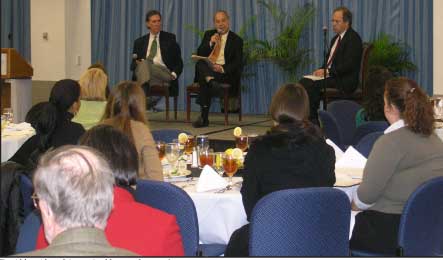
Dr.Akbar Ahmed (centre)addresses the meeting |
Dr. Lois Goodman, Dean
of the American University School of International Service,
opened the luncheon with the introductions. Afterwards, Ahmed,
a Muslim, and Holladay, a Christian, addressed the assembly
with prepared remarks on the importance of having a dialogue
between faiths. They gave examples of how men of faith have
altered the course of history and explained how, with a true
dialogue between men and women of different faiths, we can
begin to understand each other build bridges and avoid conflict.
Dr. Ahmed, Ibn Khaldun Chair of Islamic Studies at American
University, began by asking a question: Who is the best selling
poet in the United States? The answer: Rumi, the 13th century
Persian mystic. Rumi was also a Muslim and at a time when
Muslim-American relations are arguably at their nadir, the
significance is clear to Dr. Ahmed. Ahmed spoke of the poetry
of Rumi and the themes of universal love and the bridge between
civilizations that Rumi offers as an alternative to the dominant
themes of the “clash of civilizations”. He also
offered a Rumi poem about his admiration for Jesus, reminding
all that the Muslim faith has great respect and admiration
for Jesus.
Dr. Ahmed then addressed the need for dialogue, the theme
of the luncheon. He started by citing a recent poll that found
that 70-75% of Americans either knew nothing of Islam or were
hostile to it. Why should the West try to understand Islam?
Dr. Ahmed pointed out that there are 57 Islamic states in
the world, one of which is currently nuclear, and 1.3 billion
Muslims. In order to engage the Muslim world, the West must
understand the Muslim World. “It is impossible to fight
the war on terror without knowledge of Islam”, said
Ahmed. He went on to note that “there is no more worthy
exercise than dialogue. We cannot afford to not have dialogue.”
Dr. Ahmed closed by giving three steps to be taken to promote
dialogue. First, we must begin the process of understanding
each other. “Just as Americans should read about Islamic
figures, Muslims should read about the Founding Fathers so
that they can understand why Americans think like they do.”
Secondly, he pointed out that we must have dialogues whenever
and wherever we can. He spoke of the beginnings of the dialogue
between himself and Ambassador Holladay and how they have
rallied around their friendship. The dialogue now includes
many influential members of both faiths. Lastly, he stressed
the value of creating and building friendships. According
to Ahmed, “Dialogue without friendship is only conversation,
empty words.”
Next, Holladay, General Partner of Park Avenue Equity, spoke
of the side of faith that is “powerful and transformative.”
He cited William Wilberforce’s initiate in abolishing
the slave trade in England under the Puritan idea of “giving
all of this life to the purposes of God.” Holladay explained
that he didn’t do it alone, that he had a band of friends
that surrounded him. Wilberforce also had tenacity, a long-term
view, something that Holladay says that we do not have in
this day and age. Holladay described Wilberforce as a reconciler,
“a man who brings people of different world views together
to unite and accomplish goals”. Holladay was making
the point that Wilberforce is a model for what must be done
today.
Ambassador Holladay went on to discuss the friendship that
has grown between he and Dr. Ahmed and the dialogue that has
blossomed into what they hope will be a model for others to
follow. The model that they seek is a group of people “living
with differences and embracing each other”. Their personal
dialogue has matured into a larger group of very influential
people that “once touched, can make a difference.”
In one of the most stimulating moments of the event, Holladay
wondered aloud how their “small story fits in with God’s
bigger story”. He concluded that he doesn’t know
and that here is an excitement in that.
The question and answer session of the luncheon was jam packed
with hard-hitting questions from Dr. Pastor and the well-educated
audience. Most of the questions revolved around the issue
of faith and its role in government and interfaith dialogue
and how it can be a peacekeeping mechanism.
One of the toughest questions came from Dr. Pastor, former
security Advisor to Jimmy Carter, when he cited example of
the most violent and deadly conflicts in history having come
from a clash within civilizations as opposed to a clash of
civilizations. Both of the acclaimed speakers held that the
global media has turned the world into one large civilization.
Dr. Ahmed stated, “Muslims must see people like Doug
(Holladay), a great Christian. Instead they are seeing other
supposed ‘Christian Leaders’ who want to attack
Islam. Media creates an illusion of clash and must promote
dialogue among civilizations.” On this point, Holladay
added, “We must create models of civility for people
to see.”
One of the questions from the crowd had to do with the way
that Americans are seen in the world in such a negative light.
Holladay addressed this question by saying that America, since
becoming the lone superpower, “has not learned to live
with other people. We are not the source of all evil, but
we must empower people. We must create a relationship of parity
with the world. A lot of us are searching our souls for answers
to this.”
Dr. Ahmed mentioned the great things that America is known
for, Human rights and democracy, among others. “America
must be true to themselves… and must export these things
to the world because these are not just American ideas. The
rest of the world embraces these.” He mentioned the
revered Pakistani politician Muhammad Ali Jinnah, who, in
the 1940’s, called for equal rights for all Pakistanis,
without regard to their religion.
Ahmed added an exciting and hopeful side note. In President
Bush’s inaugural address, he mentioned the Muslim holy
book. This is the first time that this has happened. These
small things that are done to embrace Muslims are being noticed
in the Islamic world and are appreciated. “A new religion
has joined the mosaic of culture and religion that make up
the U.S.”, said Ahmed.
Dr. Pastor ended the luncheon by thanking the brilliant speakers
who entertained all in attendance. The expectation of the
luncheon was for all to leave enlightened. The reality is
that they left engaged in a dialogue that is of critical importance.
-------------------------------------------------------------------------------------