AMA, UMA Honor Marghoob
Quraishi
By Hazem Kira
Santa Clara: The American Muslim Alliance
(AMA), a national organization with 101 chapters, and
the United Muslims of America (UMA), one of the oldest
Muslim organizations specializing in community development
and interfaith dialogue, held a joint meeting to pay tribute
to noted community leader Mr. Marghoob Quraishi who died
of lung cancer a few days earlier.
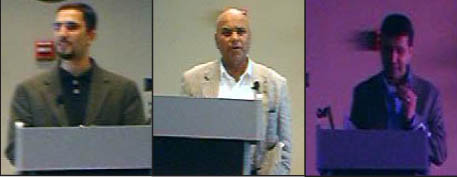
L to R :Dr.Hatim Bazian,Dr.Waheed Siddiqee,and a
speaker |
“Originally this meeting was
scheduled to honor him in person for his many services
to the community but unfortunately he died a few days
before this event,” one of the organizers said.
Seven speakers and more than 150 participants honored
the life and work of the late Marghoob Quraishi (1931-2005)
recalling that Mr. Quraishi, as a pioneer, had served
the community over the past 40 years by establishing a
number of political and social institutions. Mr. Quraishi
was instrumental in founding four important organizations:
the Muslim Youth Camp, the Muslim Student Network internship
program in Washington, DC, the Islamic School at Stanford
and the Strategic Research Foundation (SRF), a think tank.
He was also an active member of the United Muslim of America
and had served as its vice president for one term.
Speakers praised his vision and encouraged community members
to best honor his memory by continuing the work he started.
Noting that he had known late Marghoob Quraishi since
1967, Dr. Waheed Siddiqui went on to recall, “I
first experienced his hospitality in 1967 when our family
came to California. I had a job offer from Stanford Research
Institute in Menlo Park. The Company had arranged our
accommodation in a motel. Our elder son Amer was suffering
from mumps. I had gotten acquainted with Marghoob through
a telephone call from my brother Moin Siddiqui. We barely
knew each other. Later we found out that they were expecting
their first child and were quite busy with various preparations.
“However, when he heard of our coming to the Bay
Area, he came to receive us at the train station and insisted
that we stay with him till we find a place to reside.
I told him that SRI is paying for our accommodation. He
said so what? What will you do alone in a motel? Just
come and stay with us. Then I told him that Amer, who
was just four years old has mumps and it is not advisable
for us to visit him since it could be risky for him and
Mrs. Quraishi. To which he retorted in a typical eastern
way, ‘Array kuch naheen hota, bas aap log ajayee.’
I couldn’t decline this most sincere offer and we
did stay with them for more than a week during which he
made sure that we were totally comfortable. Their first
child Asifa was born the very next night after our arrival.”
The next speaker Dr. Haseeb Rizvi told the audience that
as the 1991 Persian Gulf War played out, Mr. Quraishi
arranged a conference of Muslim activists, intellectuals
and scholars in Palo Alto, California. He wanted Muslim
scholars and activists to present a ‘state of the
Ummah’ report to find ways to overcome our collective
difficulties. The think tank was built, he told the audience,
on Mr. Quraishi’s understanding for the need of
that shared knowledge and the strategies necessary to
address the issues facing the community. “Action,”
said Dr. Rizvi, “is the only thing that will save
us now!”
Dr. Hatem Bazian, who teaches at the Department of Near
Eastern Studies, University of California-Berkeley and
who worked with Mr. Quraishi on a number of activities,
probed into the necessity for institutions and intellectual
discourse to counter the attacks on the Muslim community.
He also reflected on how Mr. Quraishi was instrumental
in building some of those foundations.
“It was foreign students, such as Marghoob Quraishi,”
said Dr. Bazian, “who after coming to the United
States built the Masajids and institutions we have today.
This is due to their contribution and we owe them a debt
of gratitude”. The reason Mr. Quraishi was effective
at institution building, said Dr. Bazian, was “he
was a master at networking, and related to people on a
personal level”.
Mr. Quraishi’s “goal was to develop structures
that were sustainable and responsive to the needs of the
community. His deep concern was how to contribute to policy
outcomes and how to strategize and build institutions”.
Dr. Bazian cited examples of the threats facing the community
ranging from the USA PATRIOT Act which seeks to curtail
civil rights of Muslims to new restrictive legislation
that will seriously curtail academic freedom of Middle
Eastern Studies programs in the areas of curricula, faculty
hiring and course materials in institutions that accept
federal funding. Dr. Bazian stressed the importance of
continuing the efforts initiated by Marghoob Quraishi
to establish think tanks to confront these regular attacks.
“The absence of a response has allowed enemies to
flood the market with their attacks”.
Dr. Agha Saeed, national Chair of the American Muslim
Alliance, and long time friend of Mr. Quraishi, delved
into defining the task of a Muslim think tank, sketched
out some of the existing Islamophobic forces and the challenges
they pose. “The primary tasks of a US-based Muslim
think tank are to institutionalize the charter of American
Muslim obligations and to build freedom”, Dr. Agha
Saeed said.
“This charter consists of three primary obligations:
1) defending the United States, our homeland, physically
against invasion, terror, and sabotage, 2) defending it
intellectually by upholding its primary values and ideals
such as the bills of rights, due process, equal justice
and no ex post facto laws, and 3) defending it spiritually
by caring for fellow Americans under distress and in need.
“A Muslim think tank”, Dr. Agha Saeed said,
“must play a pivotal role in building freedom in
the Muslim communities and Muslim countries from within
and without.
“Building freedom from within requires internal
reforms in the areas of free and fair elections, good
governance, transparency, accountability, rule of law,
gender equality, minority rights, and institution-building.
But those reforms will be nearly impossible without opposing
and curtailing tribalism, feudalism, and militarism.”
Citing Gen. Musharraf’s military rule as an example
of militarism, Dr. Agha Saeed pointed out that after seizing
power in a military coup, Gen. Musharraf immediately promulgated
a Provisional Constitutional Order (PCO) . Article 2 of
the Provisional Constitutional Order stipulated that “Subject
as aforesaid, all courts in existence immediately before
the Commencement of this Order shall continue to function
and exercise their respective powers and jurisdictions:
Provided that the Supreme Court or High Court and any
other court shall not have the powers to make any order
against the Chief Executive or any person exercising powers
or jurisdiction under his authority”.
“After forcing the judges to take a new oath of
office under the Provisional Constitutional Order, Gen.
Musharraf had little difficulty in getting the Supreme
Court to rubber stamp his takeover. A Muslim think tank
dedicated to building freedom must challenge such corrupt
practices and devise means to put a permanent end to them”,
Dr. Agha Saeed said.
“But at the same time”, Dr. Agha Saeed, “We
must show the courage to build this freedom from without
by opposing imperialism, colonialism, and occupation.
We must oppose all foreign occupations from Palestine
to Iraq. This also includes refuting and defeating attacks
on Islam by Churches as well as think tanks like Rand.”
“The Neocons have created detailed plan to create
mischief and civil strife between Muslims, to constrain
any legitimate movement, and divide Muslims along ethnic
and sectarian lines. The Rand Reports, which are financed
by the US Air Force, provide in essence a blueprint on
how to accomplish these ends. The fact that it is an institution
of the US government that is commissioning these reports
is a clear violation of the First Amendment”.
“In 1805 Missionary Cram of Boston Missionary Society
had refused to shake hands with Sioux Indians saying that
there is ‘no fellowship between religion of the
God and the devil’. As reported by Susan Sachs in
the New York Times on December 31, 2002, Christian pastors
are publicly saying that ‘This is not a conflict
between religions but a conflict between God and Satan,
between good and evil.’
“We need institutions that can defeat such nefarious
attacks with intellectual analysis. A think tank is not
worth its name if it doesn’t”, Dr. Saeed informed
the audience.
“I would like to end my speech by proposing two
guiding principles”, he said. “We must correct
ourselves when we are wrong and show the courage to stand
up when we are right, and we must forthrightly oppose
internal oppression as well as external domination.”