Travelogue Author Gives
Useful Tips on Traveling
By Zeb
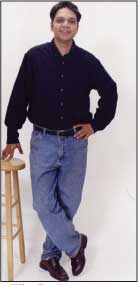
Ali Hasan Cemendtaur |
A lecture on 'Backpacking
Essentials' attracted hard-core travelers and the tidbits
shared by the participants helped educate everyone. The
lecture given by local writer Cemendtaur, author of several
travelogues in Urdu and English, at Kabab and Curry Restaurant
in Santa Clara was arranged by the Koshish Foundation, a
non-profit organization working on education-related projects
in the developing world. The event was organized under Koshish's
Knowledge Exchange program (http://www.koshish.org/KX.html).
The prospect of travel greatly excites us. Travel is in
our blood because not too long ago we were all nomads. Just
as incarceration and confinement to a building or area is
one of the most severe punishments devised by man, because
a jailed person has the urge to move around c and is deprived
of the freedom of movement, travel is the fulfillment of
the ingrained urge. In his lecture on 'Backpacking Essentials'
Cemendtaur gave advice to people willing to rough it in
their travels.
Cemendtaur's advice was based
on his travel experiences in over forty countries around
the world and especially many overland trips from Karachi
to Bangkok via China and Laos; from Swaziland to Kenya along
the East Coast of Africa; from the Gulf of Aqaba to Istanbul;
from Athens to Helsinki via Eastern Europe; and from San
Francisco to Rio De Janeiro via Central America. In response
to his own question about 'where to go?' Cemendtaur asked
the participants to go anywhere they really wanted to go.
"Globetrotters are frequently asked about the best places
they have been to and find it very hard to answer this question.
How can you possibly compare Mali with Norway? Each place
has its own charm, its own sites to see, its own great food
to eat, and its own very different people to meet. So go
wherever you really want to go." Cemendtaur warned his audience
against the much-hyped tourist destinations promoted by
glossy travel brochures. "Serious backpackers avoid those
places. And they avoid them for two reasons; first because
of their popularity these places lose their originality,
they don't give you the real taste of a country or show
you what it is really about. For example, Puerto Vallarta
and Acapulco are not the real Mexico. Secondly, the tourist
traps should be avoided because they are generally much
more expensive than the real country.
So instead of going to England
or Germany or the Bahamas, backpackers go to Papua New Guinea,
Laos, Uruguay, etc. You will definitely have more fun off
the beaten track." Answering the question 'When to travel?'
Cemendtaur said there were two answers to the two variances
of this question. "When you ask yourself when should you
travel in your lifetime consider the fact that in most cases
as you grow older you tend to have more money, and with
money comes the latitude to travel. So you can either travel
when you are old and frail, or you can travel young and
poor. All of us have seen tourist buses pouring out senior
citizens, popping pills, taken from one tourist attraction
to another. When you travel in your younger years you don't
have a lot of money but you are in good health and can travel
rough. And if you are afraid that in traveling young you
will miss on career opportunities you should tell yourself
that travel enriches you. And hopefully the travel experiences
will more than make up for what corporate ladder-climbing
opportunities you miss. "There is an excellent piece of
advice given to people who have long-term goals.
The advice is to mark the
calendar for two years from now. Tell yourself that is the
day when you are going to die. Now set up your priorities.
What do you think your purpose in life is? What do you really
want to do in this short time that is left? Do not put it
off. "When to travel in terms of weather: Backpackers study
a lot before embarking on their travel. They study everything
about the places and countries they are going to visit.
Because backpackers travel light, they don't travel in very
cold or very hot weather. They travel in pleasant weather.
"If you are traveling through a number of countries then
you basically need to look at the weather and decide which
way and in what succession of countries you will like to
go. For example if you are traveling in Europe and you start
your travel in January, then it will be good to start from
Southern Europe, say Spain or Portugal and then work your
way up so that around summer time you are in Scandinavia.
Similar considerations are made when traveling north or
south in Africa. In response to the 'What to carry?' question
Cemendtaur said that backpackers travel very light. He then
showed the audience his backpack, as he had prepared it
for an extended trip.
"The idea is to have just
one pair of outer-skin clothes, the clothes that you wear.
And then you have three or four pairs of underclothes: socks,
underwear, and T-shirts. You change the underclothes every
day or every other day. The outer layer is washed once in
2 to 3 weeks and that too at nighttime, so that you get
up in the morning and put the same clothes on again. Cemendtaur
said that traveling is easy but expensive in the developed
countries and hard but cheap in the developing world. "In
western countries you find all the information about a place,
on the Internet. That's not the case in the developing countries.
In some places the best information you get is from the
tourists coming back from the place that you are going to.
"In Western countries the cheapest places to stay at are
the youth hostels. Contrary to what their name suggests,
youth hostels are open to people of all ages. In North America
you can stay at a youth hostel for $15 to $25 per night.
"In the developing countries there are hardly any youth
hostels and especially none outside the big cities. In the
developing world you stay at cheap hotels.
You get your recommendations
from a guidebook that wasn't published too long ago. Because
the hotels you stay at are cheap and often dirty you carry
two bed sheets in your backpack. The bed sheets are used
to insulate yourself from the bed. Answering his own question
about travel costs Cemendtaur said that travel can cost
as much as the traveler is willing to spend. "Backpacking
or budget travel requires making a realistic budget and
then traveling within that budget. That requires a lot of
self-control and discipline, but you just would have to
do this. Otherwise you will be coming home sooner than your
actual plan. For most of Europe I will put $50 per person
per day. For Scandinavia I'd raise it to $75/day. For most
of the developing world you can comfortably travel for $30/day."
Cemendtaur then gave advice on how to keep travel costs
low. He said that transportation, meals, accommodation,
and sight-seeing being the four components of travel, the
backpacker works on cutting down the costs of each one of
them. "You cut down the cost of transportation by traveling
the way the local people are traveling. Backpackers seldom
take a taxi. Never go unprepared. Never reach somewhere
at night when you can't get your orientation right. "You
can eat cheap and still be healthy. In the western countries:
One way to save money on meals is to limit the number of
hot meals per day; for example you can gather things for
the breakfast and have it in your room in the morning; you
can then have a sandwich for lunch, and then a hot meal
at night. In the developing world you don't want to worry
about such extreme measures because it doesn't cost a whole
lot to eat out. In the developing world it is more of a
challenge to eat healthy when eating outside.
And the way to do is to eat
from places that seem to be popular and full of people;
and eat things that are hot. "Saving in accommodation: Your
guidebook will be your best friend. You basically look for
the hotels that are within your budget in the guidebook
that you are using. "There is not much you can do about
cutting costs in sight seeing. You will have to buy museum
tickets. But you have to decide for yourself if you really
want to visit every single museum in the city you are visiting.
Of course there are places you can't afford to miss-you
won't like to miss Uffizi or the Louvre." Answering a question
about 'How to manage money while traveling?'Cemendtaur said:
"With travelers checks and different currencies in your
money belt, and the changing exchange rates it gets a little
confusing. You can lose to control the money you are spending.
The way to handle finances is to count your money every
night and see if that day you remained within you budget.
"Not too long ago world travelers used to travel with travelers
checks and some cash in hard currency (US dollars or Pound
sterling). Now people prefer using ATMs. These come very
handy because you draw out the exact amount of money that
you need and you get a good rate too. ATMs are available
in big cities in most countries, but you may not find them
in smaller places. Plan your travel and money accordingly."
In response to the question about how to keep in touch with
family and friends while traveling, Cemendtaur said that
email is the communication mode of choice in today's world
- here are Internet cafes in cities big and small all over
the world. "But it won't hurt to send back a few post cards.
The post cards and the postage stamps become your souvenirs.
Occasionally call your folks so that people know about your
whereabouts and where are you planning to go. Pretty soon
world travelers will be traveling with cell phones that
could be operated from anywhere in the world. But let's
just wait till that becomes affordable for the budget traveler."
-------------------------------------------------------------------------------------