Los Angeles Mayoral Elections:
Cash, Votes, and Volunteers
By Dr Shakil Akhtar Rai
The campaign for the mayoral
elections in Los Angeles to be held on March 8 is in full
swing with thirteen candidates vying to win the top position
in the City Hall. Apparently five candidates are being taken
more seriously. The seriousness, as always in American politics,
is commensurate with ones ability to raise money for the campaign,
the strength of the network of support one builds around various
competing interest groups, how one remains positively high
profile in the news media, how efficient and effective is
the campaign machine, and how you connect with the voters.
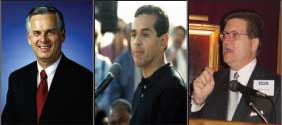
L to R:James Hahn,Antonio Villaraigosa,Bob Hertzberg |
In addition to incumbent James
K Hahn there are four leading contenders: Antonio Villaraigosa
(the Eastside councilman), Bob Hertzberg (former Assembly
Speaker), Bernard C. Parks (City Councilmen and city's former
police chief), and State Sen. Richard Alarcon (D-Sun Valley).
Analysts are projecting a runoff election on May 17, as the
first ballot among so many candidates may not prove decisive.
In this election, as in others too, there is dual praxis between
the candidates and the voters: candidates looking for ways
and opportunities to reach out to potential voters through
various ethnic, religious, regional, professional groups,
and through high, middle, and low income neighborhoods; at
the same time there are groups and communities seeking to
increase their political weight by inviting candidates to
their places of business, worship, and residence, and offering
them a solid block of voters, donations, and volunteers provided
the candidate's vision and program corresponds with theirs.
In the current campaign all ethnic, political, commercial,
and professional interest groups are jockeying for stronger
position, and clout in the next city government.
The candidates are being invited
to forums and platforms organized by various interest groups
to listen to each candidate's program for the general public
and for that particular community or group. Communities are
making campaign donations, and encouraging volunteers from
their ranks to work for the candidate of their choice. Through
volunteer work and financial contributions, for one or more
candidates, individuals and communities express their support
for the program of the concerned candidates, and establish
a mutual socio-political rapport, hoping to maintain their
political relevance in the next set up. The Pakistani and
Muslim communities have sizeable presence in Los Angeles,
both in terms of numbers and money. According to 'Lewis Mumford
Center for Comparative Urban and Regional Research' the number
of Muslims in Los Angeles metropolitan area was 167, 548 in
2000 or 1.8% of the city population, showing an increase of
25.6% between 1990-2000. It's safe to assume that in 2005
the Muslim population in Los Angeles metropolitan area is
over 200,000.
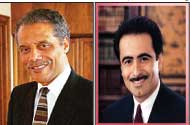
L to R:Bernard C.Parks and Richard Alarcon |
According to the same source
American Muslims have improved their income, home ownership,
and education level. In 2000 the average Muslim-origin person
lived with a median income of $56,000 (4% increase since 1990),
about 60% of them owned homes (2% increase), and more than
35% had college degree (5% increase). This increasing strength
has not translated into political weight, as one would wish.
There are fifteen members of the City Council, from as many
districts, none of them is a Muslim, nor there are prospects
that one would appear on the scene in the near future. They
were reasonably active, without being organized into a single
vote bank, during the November elections, and earlier during
the gubernatorial elections. The current mayoral election
campaign in LA does not seem to have ticked the community,
nor the candidates have felt the need to approach them. It's
important that the Pakistani and Muslim communities as a whole
come forward and play their due role in the city politics.
The election campaign for the mayor of Los Angeles is too
important a political event to be ignored. It may be of interest
to note that the current budget of Los Angeles is over $ 5.5
billion, which is one-third of the total federal budget of
Pakistan this year. Also, if the community wants to assert
itself politically it has to put its act together at the city
level, first: that's democracy at grassroots level.
Christian and Jewish communities
are inviting candidates to their churches, professional and
political forums, which provide an opportunity to the community
to listen to the candidates and let the candidates know about
the community and their political outlook. In the last mayoral
election in 2001 Jewish voters were estimated at 16%; coupled
with their financial clout they have attained a political
level of importance where candidates feel it necessary to
approach them. The way the Muslim community is today, candidates
do not feel it expedient to approach them. It's therefore
for the Muslims to reach out to the candidates and show their
political presence and awareness.
The changed circumstances since
the terrorist attack of September 11, make it all the more
necessary for the Muslims to get together and organize themselves
into a bloc of voters, volunteers, and donors. Why some of
the candidates should not be invited by one of the Muslim
organizations in the city to let them speak directly to the
voters, and let the voters make an assessment of the candidate.
Why they cannot be invited to one of the mosques before or
after the Friday prayer? Why Muslim students organizations
should not send out volunteers to work in the campaign for
one or the other candidate. And why the media should not take
the lead and invite the candidates without endorsing any one
of them. Or at least run a series of interviews, and profiles
of a few candidates. If it is too late for the March 8 election,
there is enough time to get organized for the runoff election,
which is likely. - drshakilakhtar@yahoo.com
-------------------------------------------------------------------------------------