Nuclear Arms Serve as
Bargaining Power - Dr. Ayesha Siddiqa-Agha
By A.H. Cemendtaur
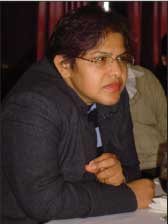 Last
Saturday a small group of Bay Area Pakistanis interested in
contemporary Pakistani politics gathered to listen to Dr.
Ayesha Siddiqa-Agha, a scholar of Pakistan's military and
security affairs and a writer for the Friday Times newspaper.
Currently Dr. Siddiqa-Agha is a fellow at the Woodrow Wilson
International Center for Scholars in Washington, DC. She was
on a short visit to the San Francisco Bay Area. Meeting with
Dr. Siddiqa-Agha took place over a lunch arranged at the Chandni
Restaurant in Newark. Dr. Khawaja Ashraf, editor of the online
Pakistan Weekly and the host of the get-together, opened the
meeting by inviting Ayesha Siddiqa-Agha to share with the
audience her vision on Pakistan.
Last
Saturday a small group of Bay Area Pakistanis interested in
contemporary Pakistani politics gathered to listen to Dr.
Ayesha Siddiqa-Agha, a scholar of Pakistan's military and
security affairs and a writer for the Friday Times newspaper.
Currently Dr. Siddiqa-Agha is a fellow at the Woodrow Wilson
International Center for Scholars in Washington, DC. She was
on a short visit to the San Francisco Bay Area. Meeting with
Dr. Siddiqa-Agha took place over a lunch arranged at the Chandni
Restaurant in Newark. Dr. Khawaja Ashraf, editor of the online
Pakistan Weekly and the host of the get-together, opened the
meeting by inviting Ayesha Siddiqa-Agha to share with the
audience her vision on Pakistan.
More than talking about her
vision Dr. Siddiqa-Agha prodded the audience in exploring
their own minds and question where Pakistan was headed."Everyday
on waking up in the morning I ask myself where are we going
as a country." [Dr. Siddiqa-Agha's conversation was not voice-recorded.
While the thoughts articulated by Dr. Siddiqa-Agha and other
scholars are being presented in quotation marks in this report
they may not constitute the exact words.] Dr. Siddiqa-Agha
was listened to with the intentness intellectuals coming from
Pakistan are listened to--expatriates believing the visitor
will share with them inside stories they are not aware of,
in spite of their regular reading of the Pakistani newspapers
over the Internet.
Though informal Dr. Siddiqa-Agha's
conversation was structured around four main topics: Pakistan's
image in the international community, Pakistan's nuclear capability,
Pakistan's relations with India, and our country's future.
Like all patriotic citizens who owe to themselves the honor
of their country Dr. Siddiqa-Agha was indignant over the negative
publicity Pakistan gets in the international media. "There
are at least twenty-six insurgencies going on in India at
this time. But the moment Balochistan trouble is mentioned
everybody in the the world looks at Pakistan as if it is going
to disintegrate soon. "Pakistan has existed for the last 1400
years or more, ever since Mohammad Bin Qasim landed in Sind.
That Pakistan is very much a reality and will remain so. Dr.
Siddiqa-Agha didn't seem to have any qualms about Pakistan's
nuclear capabilities. "Having nuclear arms gives you bargaining
power." In response to this comment Dr. Tariq Rahman, Quaid-i-Azam
Chair on Pakistan Studies at UC Berkeley, said that his emotional
dislike for nuclear weapons aside he was not convinced the
weapons of mass destruction can bring peace to a region. "If
both India and Pakistan had nuclear arms in 1971 there would
have been a nuclear exchange for sure." This writer was not
that sure about that assertion.
If both countries had nuclear
weapons at that time Pakistan's internal turmoil would not
have ended in a war with its neighbor; a more likely ending
was a cruel crushing of the insurgency and continued suffering
of the Bengalis under the hubris of the West Pakistanis. Geoffrey
Cook, a local journalist with interest in Pakistan and the
Muslim world, agreed with Dr. Siddiqa-Agha in her contention
that nuclear weapons deter wars. "In the last round of high
tensions between India and Pakistan the only reason India
even with its obvious military advantage over Pakistan didn't
attack its rival was that Pakistan had nuclear arms." Commenting
on India-Pakistan relations Dr. Siddiqa-Agha said that living
with a big neighbor was not easy. She said she had visited
India four times. "I understood Pakistan in a deeper sense
and became a better Pakistani after my first visit to India."
Dr. Siddiqa-Agha said she wanted to see peaceful relations
between India and Pakistan.
"I have seen how Indians and
Pakistanis go together very well when they meet outside our
region. It is hard to see any other two peoples having such
close relationship. Indians and Pakistanis share a lot of
commonalities. But we (Pakistan) have been an independent
country for the last 58 years and want to remain independent."
One participant thought Pakistan finds it hard to have congenial
relations with India because such warm relations challenge
the very ideological basis of Pakistan. To this claim another
person responded that the two-nation theory should not be
seen as a hateful proposition but as a realistic assertion
of one group of people trying to find political space for
itself. Speaking on Pakistan's future Dr. Siddiqa-Agha opined
on the three likely scenarios Pakistan can take.
"We can either have a dynamic
modern Pakistan that is confident about itself; another possibility
is the Pakistan of the MMA, a Pakistan that asserts its Islamic
identity and is not seen favorably outside the Muslim world;
and the third possibility is to have a feudal Pakistan the
way it exists today. Commenting on the road ahead she said
that Pakistan has suffered from a leadership vacuum, but the
need of the hour is to have a vision about the future of the
country. In this regard this writer thinks differently than
most of his fellow Pakistanis. As a citizen of Pakistan this
scribe is not asking the Pakistani government or its intellectuals
to provide a grand, glittering vision about the country -
this correspondent is only interested in living in a civil
society where the rule of law is held supreme.
-------------------------------------------------------------------------------------