Berkeley Conference
Discusses Pakistan Minority Issue
By Ras H. Siddiqui
The University of California
at Berkeley's Center for South Asia Studies held its "20th
Annual South Asia Conference" at the International House
on February 11 and 12, 2005. During this two-day affair
which drew students, scholars and academics with an interest
or expertise in the South Asian region, topics as diverse
as "Space, Place and Gender in Indian Film and Literature"
to "Gendered Violence: Notes from the Postcolonial Present"
generated a great deal of interest. And one of the sessions
"Who is Muslim? Religion and Politics in Pakistan Fifty
Years after the Munir Report (1954)" covered an area which
pertained to Pakistan specifically. And since a report on
the full conference was not possible due to this writer's
inability to be there for two days, this one session will
be under focus here. Chaired by Tariq Rahman, Quaid-i-Azam
Chair Pakistan Studies, UC Berkeley the panel which addressed
this issue and a lot more was made up of Matt J. Nelson
of the Political Science Department at Bates College, Najeeb
Jan from the History Department at the University of Michigan
and Robert Rozehnal, Dept of Religious Studies at Lehigh
University.
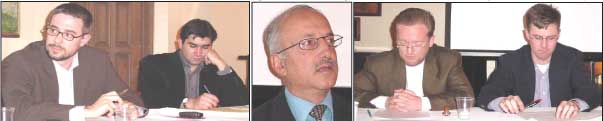 Robert
Rozenhal and Najeeb Jan
Dr.Tariq Rahman v
Erik Jensen and Matt Nelson
Robert
Rozenhal and Najeeb Jan
Dr.Tariq Rahman v
Erik Jensen and Matt Nelson |
The discussant was Erik Jensen,
Co-Director of the Rule of Law Program at Stanford University
Law School. With such academic luminaries present and their
more than adequate introduction by panel chair, Dr. Tariq
Rahman, the main topic (for those that are not aware of
it) pertained to religious practices and policies in Pakistan
of which the "Ahmadi Question" of the Justice Munir Report
in 1954 was the focus area. This along with subsequent declarations
of Ahmadis as non-Muslims by the Government of Pakistan
in 1974 and the 1980's blasphemy laws instituted during
the Zia Regime have impacted not only the Ahmadis but the
social and political fabric of Pakistan. Starting with the
topic of "Making Muslims: Madrasas and the Meaning of Modern
Education in Pakistan," Matt Nelson painted a realistic
picture of religious thinking in which matters of State
also came into play. The boundaries of Islam constituted
in the context of Education and parental thoughts on religious
education (in Baluchistan, Punjab and the NWFP provinces)
were a part of his study. Nelson asked if these boundaries
addressed the current sectarian differences in Pakistan
and "Can Ahmadis be called outside this definition?" But
beyond the questions he had a great deal to add that Pakistani
policy makers today may find very useful.
A group of attendees |
Nelson found in interviews
he conducted that people in Pakistan give a very high priority
to the religious education of their children, along with
their other education. But as the Munir Report had mentioned
neither the State nor ordinary people are in a position
to resolve religious differences. Nelson called to attention
the "Elephant in the Living Room," on differences in the
sectarian religious practices within Islam that continue
to impact Pakistan. He said that this elephant has to be
discussed, but it is not. And as Pakistan heads towards
"Moderation" today, Nelson called for an open discussion
on this subject within Pakistani society and the teaching
of religious and sectarian differences in schools at an
early age so that the issue can be grappled with more effectively.
In other words (and not necessarily on the Ahmadi issue)
he recommended an open discussion on religious differences
as a path towards moderation in Pakistan instead of ignoring
them and leaving others to dictate policy. He hinted that
this path of open discussion, instead of the competing efforts
by the Maulanas to define the Umma (the Muslim Family) could
be more beneficial for the country (the Shia-Sunni and other
differences being accepted without discussion and prone
to emotion do lead to strife). Najeeb Jan next went into
some depth into the topic of "Of Momin's and Kafirs: Legislative
Exorcism and the Deoband Anti-Ahmadia Movement," in which
he also touched on the recent emphasis on Deobandi thought
because of its reported links to the Taliban.
"Boundaries negotiated by
acts of violence," were not the best way of resolving issues,
he said. He added that one of Deoband's major achievements
is considered to be the ouster of the Ahmadis from mainstream
Islam. Jan spoke briefly about the 1974 to 1986 period in
Pakistan during the Z.A. Bhutto and General Zia era and
the rising influence of the Ulema in the country since then,
of which the Anti-Ahmadi movement was a major step. He said
that fundamentalists could not have appeared on the landscape
except in this modern age where the new "Philosopher Kings"
are the Ulema. A subjectivity Map of a formal Islamic/Muslim
nomenclature in Pakistani society was also presented dealing
with Deoband, Barelvi Tableeghi Jamaat, Ahle Hadith, Wahabi
Jamaati (Maududi) and various Shia Groupings including the
Bohri, Twelver Shia and the Ismaili along with the Sufi-Naqshbandi
and Chishti orders. The Ahmadis were placed in an outside
circle. The Pakistani political landscape including its
Islamist political parties were touched upon. It is interesting
to note that 90% of Pakistani voters do not vote for the
religious platform. The history of Deoband and its influence
from Shah Waliullah to the Deeni Madrasas today along with
the 1953 anti-Ahmadi riots, the Taliban destruction of the
Bamiyan Buddhas in 2001, also came under discussion. The
last panel presentation was by Robert Rozehnal who spoke
on "Narrating Tragedy: The Politics of Sufism in Pakistan."
Robert pointed out that Sufism is a highly debated subject
as part of the reality of Pakistan as a modern Muslim state.
But his main focus in this session was the tragedy that
took place at Baba Farid's annual Urs at Pakpattan in Punjab
where a stampede killed over a 100 people in April 2001.
The Chishti Sabiri Murids
(disciples) tried in their own way to make sense of this
tragedy while blame went all around, including fingers pointed
at local police authorities. The Government blamed the disciples
for the stampede, raised issues about whether this was real
Islam and stated that police had just been overwhelmed by
an unruly mob. Since one of the children that died was from
the family that heads the shrine, a Karbala-like scenario
was linked to this tragedy. And in these various viewpoints
and interpretations of the sad event, Rozehnal was able
to share with us a significant insight into the religious,
social and political aspects of Pakistani society. The job
of a discussant is never easy. Erik Jensen expressed his
own views on the three presentations and raised some questions
of his own on the subject. Dr. Tariq Rahman had questions
of his own and ended with some interesting thoughts. The
question and answer session seemed painfully short for the
length and breath of the issues highlighted here but since
the "elephant in the living room" idea prevailed, nobody
really directly approached the Ahmadi question. Most of
the questions asked, remained academic in nature and did
not get into details of beliefs.
Since the subject generates
strong emotions from many readers, as a reporter, this was
certainly a difficult assignment. But let me just close
here with what Dr. Rahman said in his concluding remarks
and add to them if I can. Dr. Rahman asked this question:
"What kind of state should Pakistan be?" Should it be an
Islamic (Ulema dominated) country or a (modern) Muslim country?"
Let us just add to that. Since most Pakistani Muslims do
not accept the followers of Mirza Ghulam Ahmad of Qadian
as Muslims, should the state of Pakistan also officially
endorse that view? And beyond the differences in religious
beliefs, how should a modern Muslim state handle the social
and cultural ramifications of excommunicating a group of
people from a religion? Justice Munir in his report had
tried to address that issue. But a question that has always
been difficult to think about is not about religion but
about a nation. We have talked about Government defining
who is a Muslim. But how does it go about defining a Pakistani?
-------------------------------------------------------------------------------------