
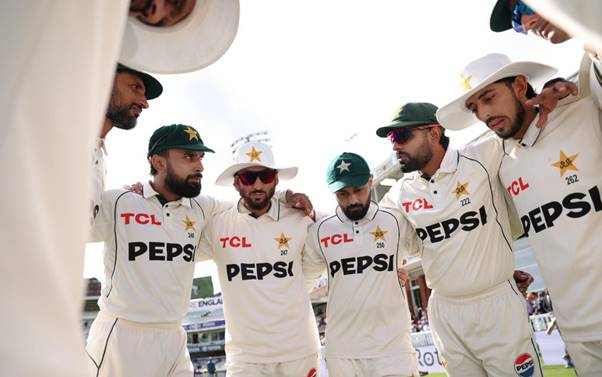
Pakistan have made wholesale changes to their squad and coaching staff after defeat by England at Lord’s – Stu Forster/Getty Images
The Inside Story of Pakistan’s Tour from Hell
By Saj Sadiq The Telegraph
At around 5pm on Monday, Pakistan players began receiving messages from friends and family, asking if they knew what was going on. The players, who were wandering around London on a day off or at the team hotel, replied that they had no idea what they meant.
The players were then sent social media posts of the statement Pakistan had just released: seven players were being sent home from the tour of England and the coaching staff sacked.
Imam-ul-Haq, Mohammad Rizwan, Ali Usman, Khurram Shahzad, Salman Ali Agha, who captained the team in the defeat at Headingley , Aamir Jamal and Muhammad Awais Zafar are the banished seven. Team management had not told them beforehand. To say they were shocked was an understatement.
Some of the seven had not even played a Test match on what has turned into Pakistan’s tour from hell. Others had performed reasonably well in the two heavy losses. All agreed, though, that the way the shock decision had been handled left the most bitter of tastes.
The international future of many Pakistan players is now up in the air with questions over their character, fitness and decision-making.
It also sums up Pakistan cricket at its very worst. Bizarre decision-making, a lack of proper structure or professionalism and absolutely no attempt at proper communication.
A day of chaos
When it comes to chaos, nobody does it quite like the Pakistan Cricket Board. Pakistan may currently be bottom of the World Test Championship standings but, when it comes to running a cricket team like a circus, they have an unsurmountable lead.
But, even by the PCB’s turbulent standards, the last few days have been quite extraordinary.
It began with whispers of possible changes within the squad and soon escalated into a full-blown upheaval with almost half the touring party being classed as surplus to requirements.
The scale and sheer disorder of the decisions have stunned players and bewildered supporters, leaving observers to once again question how a major cricketing institution can operate in such an irrational manner.
The PCB’s frustration appears to have been simmering for some time and the events of the series – both on and off the field – pushed the board into a reaction which blindsided the players.
Several of them contacted friends and family privately, expressing shock and confusion as to what was happening with no direct communication coming from the team management, captain or coach.
One player, who has played in the series and believes he has performed satisfactorily, felt he was being unfairly scapegoated. He was in his room at the team hotel in London when he also started receiving messages. A friend then forwarded the press release to him. He had to read the press release twice to believe it, initially assuming it was fake.
Not even telling the players they were being sent back home was viewed as degrading by those in question.
The farce continued on Tuesday when former captain Misbah-ul-Haq appeared to resign from Pakistan’s selection committee after he was not consulted about the seven players called up.
Senior players under fire
Before the decision to rip apart the squad and the management, Pakistan’s tour of England had been marred with tension between the players and the board.
The atmosphere in the squad deteriorated significantly as the tour progressed, with morale low after two crushing defeats at Headingley and Lord’s.
Players paint a picture of a squad in turmoil, unsure of direction and lacking even the most basic communication from those in charge.
One of the players sent back to Pakistan and at the centre of a storm is opener Imam-ul-Haq. His international future is thought to be in serious doubt after he did not bat in either innings at Lord’s following a “calf injury”, for which he drew widespread criticism from the likes of Stuart Broad, Nasser Hussain and Ramiz Raja.
The PCB was furious with how the injury situation unfolded, believing the episode reflected poorly on both the player and the team. Just last summer, Chris Woakes had batted for England with his arm in a sling while both Australia’s Nathan Lyon and India’s Rishabh Pant had also memorably come to the crease with injuries in recent years.
The incident appears to have been a tipping point. The handling of injuries and player fitness has long been a contentious issue in Pakistan cricket and this latest controversy intensified concerns about the lack of clear protocols and accountability.
The board has demanded a detailed assessment of Imam’s injury, including when he first reported the problem, the medical evaluation carried out during the Test and the reasons he was unable to bat at Lord’s.
Rizwan is another senior player sent home after finding himself in the firing line. It is understood the PCB is unhappy with his influence in the dressing room, feeling he has become a disruptive presence.
Rizwan’s shot selection at times during the Test series has reportedly frustrated senior figures within the team management and at board level, who expected far better from a player of his experience and stature.
Rizwan has long been considered one of Pakistan’s most resilient cricketers, but the board’s dissatisfaction could have long-term implications given his recent struggles with the bat which has resulted in his Test average declining.
Coaches swiftly axed
The coaching staff have not escaped the fallout, either. Rumours were swirling that head coach Sarfaraz Ahmed might be sacked. They proved accurate.
Sarfaraz, 39, was a surprise pick for many as head coach given his lack of experience. He had only coached at the under-19 level and in a two-Test series in the Caribbean prior to the tour of England.
Coaches tend not to last very long at the best of times in Pakistan cricket, but Sarfaraz’s abrupt removal midway through a series will raise eyebrows.
The PCB, unhappy with performances and the defensive brand of cricket, acted decisively in relieving Sarfaraz of his duties. The decision reflects a familiar pattern: when results dip, the coach is often the first casualty.
Umar Gul, the bowling coach, has also been removed from his role. The PCB felt he failed to get the best out of the current group of seamers and his explanation for the poor display at Leeds – namely, the cold weather – did not sit well, irritating senior officials who felt it lacked accountability.
Gul, a respected former fast bowler, had been tasked with revitalising Pakistan’s pace attack but how he was supposed to turn a group of medium-pacers into Waqar Younis or Shoaib Akhtar in the blink of an eye is beyond comprehension.
Threat of play boycott
The PCB was already under pressure before it swung the axe. The airing of an interview with Imran Khan’s sons added another layer of controversy with the PCB complaining to Sky about the broadcaster’s decision to air the documentary, feeling that it was mixing politics with sport. A threat not to return to the field after lunch followed.
The fact that the PCB only became aware of the program when promotional clips began circulating has been widely viewed as another failure by those who run cricket in Pakistan.
Whilst there has been no official word from the PCB about whether it was indeed contemplating boycotting play after the airing of the interview, both Babar Azam, the captain, and Sarfaraz rather sheepishly played down the incident and stated that they were unsure of what was going on behind the scenes.
These latest episodes reflect a governing body lurching from crisis to crisis, unable to control narratives, manage personnel or maintain stability.
Pakistan cricket, already struggling on the field, now finds itself engulfed in a state of turmoil so severe that it threatens to undermine any attempts at rebuilding.
The decisions made regarding squad changes may have been intended to signal authority and decisive action, but the manner in which they were executed has instead exposed deep flaws in governance.
For supporters, the chaos is becoming depressingly familiar. For players, it is destabilising. And for Pakistan cricket as a whole, it is yet another reminder that, with each passing day, a once proud cricketing nation is becoming a bigger laughing stock. – The Telegraph
