Facebook
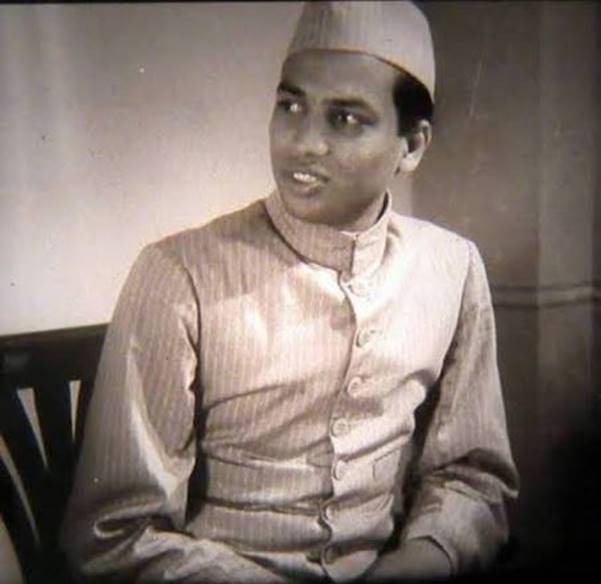
About Nakshab
By Dr Asif Javed
Williamsport, PA
After the phenomenal success of Mahal in 1949, Nakshab was riding high. He had written the popular songs of Mahal including Aye-ga-aney-wala. Deservedly regarded as a talented poet in Bollywood, he was planning to start a movie of his own. Never short of confidence, he approached Naushad and asked him to give the music for his forthcoming movie.
It is unclear whether Nakshab was aware of Naushad’s style of work. Mauseqar-e-Azam was very selective in his choice of movies. He would rarely commit to more than one movie at a time, was slow and methodical in his work. His output was generally one movie per year, and he was mostly committed to Dilip Kumar’s team. Also, he usually teamed up with poet Shakeel Badayuni. So, he said no to Nakshab.
Naushad was a polite man who had generally avoided controversies in his long and distinguished career. One can only assume that he explained the reasons for his inability to work with Nakshab. In movie business, this type of refusal is common. But poor Naushad could not have imagined what was to follow.
Nakshab took Naushad’s no as a snub. He approached Shaukat Ali, a struggling musician, and asked him to give music for his movie Naghma. Nakshab then proceeded to choose a new filmi name for Shaukat Ali.
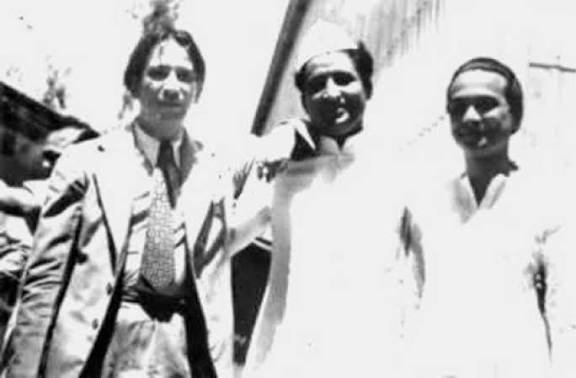
Khurshid Anwar, Nakhshab, and Naushad Ali – Photo Dawn
When Naghma was released, hardly anyone noticed that the music was by Nashad, and not Naushad. By choosing a deceptively similar, almost identical sounding name for his movie’s musician, Nakshab had a dual purpose: he wanted to irritate Naushad for what Nakshab considered a personal affront. Also, many in public remained under the false impression that the music was by Naushad. Naghma, it turned out, was a mediocre movie, but with good music and launched the career of Shaukat Ali who continued to use filmi name Nashad even after he immigrated to Pakistan. This incident reveals much about Nakshab’s character. Regrettably, this was not the only controversy that he created.
Nakshab (real name Akhtar Abbas) was originally from a town called Jarcha (hence the name Nakshab Jarchawi) in UP. While un-employed in 1943, he had participated in a poetry session in Delhi. Another newcomer to read his ghazal in the same event was a young Shakeel Badayuni. The event was presided over by Kanwar Mahindar Singh Bedi, himself a poet and a civil servant. AR Kardar, who had moved to Bombay from Lahore years earlier, was present. Kardar was very influential in Bombay, having directed several hits. He was impressed by the ghazals of Shakeel and Nakshab and recommended that the young poets should try their luck in Bollywood. Both Shakeel and Nakshab followed the veteran film maker’s advice. As fate would have it, whereas Shakeel became a legend in Bollywood and became an integral part of Dilip Kumar and Naushad’s highly regarded team, Nakshab had moderate success and, over the years, created several headlines for all the wrong reasons.
“Nakshab, already married, was by nature a lecher,” writes Kanwar Mohindar Bedi. “He was madly in love with a prostitute in Delhi…Once she got upset with Nakshab and, just to humiliate him, pretended to turn her affection towards a tonga-wala. Nakshab was beside himself with jealousy.” Bedi then gives amusing details of how he used a local policeman to get Nakshab’s rival in love away by intimidating him.
Bedi then narrates yet another incident of a few years later:
Nakshab appeared in desperate hurry to advance his career, and to earn money by any means. He would always stick with me whenever I visited Bombay. From my arrival at Bombay airport to the departure, he will not leave me alone and would insist on accompanying me to wherever I went. This continued for a while. Eventually, he asked me to help him borrow Rs 50,000 from anyone so that he could produce a movie…. Despite my reservations, I arranged the loan from a mutual friend…Soon afterwards, Nakshab vanished from the scene…Found after a lot of difficulty, he behaved in a fishy manner. I could tell that the loan was never going to be paid back…. He then suddenly immigrated to Pakistan, and somehow took the prints of an Indian movie with him. In Pakistan, he got the prints developed, got it released and made a lot of money…The guy who owned the rights to the movie in India went to the court and tried to stop the illegal release of his movie across the border but without success…Sometime later, I visited Pakistan and while visiting Gul Sahib (presumably Agha GA
Gul who owned Evernew Studio in Lahore), I bumped into Nakshab. Nakshab then asked me not to say anything negative about him in Pakistan since it would have harmed his career. Despite feeling otherwise, I did not.
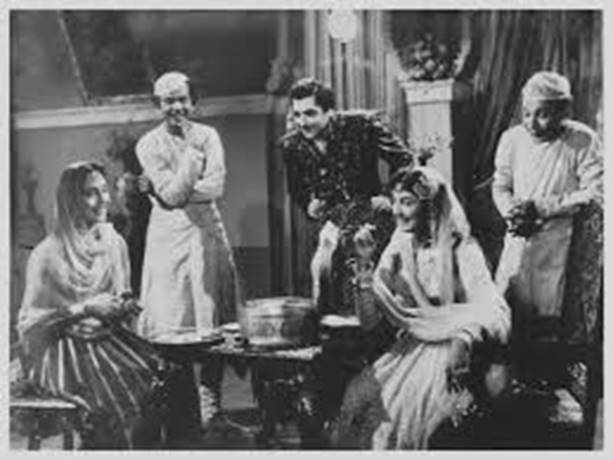
Zindagi Ya Toofanhad only moderate success in India but was released to packed houses in Pakistan
Nakshab’s arrival in Pakistan in 1960 generated a lot of excitement. He had brought the print of Zindagi Ya Toofan with him which had only moderate success in India but was released to packed houses in Pakistan. Many filmgoers in Pakistan were already familiar with his name. Even before Mahal, he had gained fame for being the lyricist of famous qawaali “Ahin-na-bharin-shikwe-nakiye” in Shaukat Hussain Rizwi’s Zeenat that had become very popular back in the 1940s. Naturally, great things were expected of him. It was not long before Nakshab announced Fanoos.
While in Bombay, Nakshab had developed a reputation of being romantic and a flirt. He could also be very arrogant and had an unpleasant habit of putting down and unnecessarily criticizing others. Having moved to Pakistan, he created a lot of animosity towards him. He said that no one here knew how to write the lyrics or direct a movie. He followed that up with a bold declaration that he will demonstrate how it should be done. Fanoos, his first movie in Pakistan was announced in this background. He then posted two security guards at the entrance to the floor at Shahnoor Studio where Fanoos was being filmed. Rashid Atray, his friend from Bombay days, was signed up to give music. Friends they may have been but working with Nakshab was not easy. Rashid Atray soon left, having recorded just one song. He was replaced by Saif Chughtai. Fanoos was duly completed, released and flopped. Not to be deterred, Nakshab followed that up with Maikhana that met the same fate despite heavy publicity even from Radio Ceylon that was a popular Radio Station back then. Nakshab made no other movies in Pakistan.
Regrettably, his talent as a lyricist was never used in Pakistan by anyone. What else could he expect? He had burnt a lot of bridges by his outrageous statements. Nakshab then turned his attention to horse-racing and made decent money by making bets on horses.
Nakshab continued to live alone in Pakistan. He was well dressed, handsome, eloquent and a good host. He had several friends, some in high places in the bureaucracy. His friends had helped him release Zindagi YaToofan in Pakistan despite a ban on Indian movies at the time. While in India, he had married actress Nadia who had acted with Dilip Kumar in Aan. The marriage did not last long. It is not known what became of his first wife back in Jarcha. He had no children and it is unknown if he had any siblings.
Nakshab had a god given talent as a poet. He could easily have become another Sahir, Majrooh, Shalindra or Shakeel and create a legacy for himself. Instead, he self-destructed
Nakshab had a god given talent as a poet. He was lucky to get an early and successful start in the movie business. He could easily have become another Sahir, Majrooh, Shalindra or Shakeel and create a legacy for himself. Instead, he self-destructed. His undoing was creating a lot of enemies in his business, having ridiculed people unnecessarily. His sudden and unexpected death at a relatively young age in 1967 was barely noticed and he was quickly forgotten. Today hardly anyone remembers him. And that was his tragedy.
References : Filmi Alaf Layla by Ali Sufyan Afaqi; Yadon Ka Jashan by Kanwar Mahindar Singh Bedi; Dabistan Film Ke Nighma Nigar by Zakhmi Kanpuri.
(The writer is a physician in Williamsport, PA and may be reached at asifjaved@comcast.net )